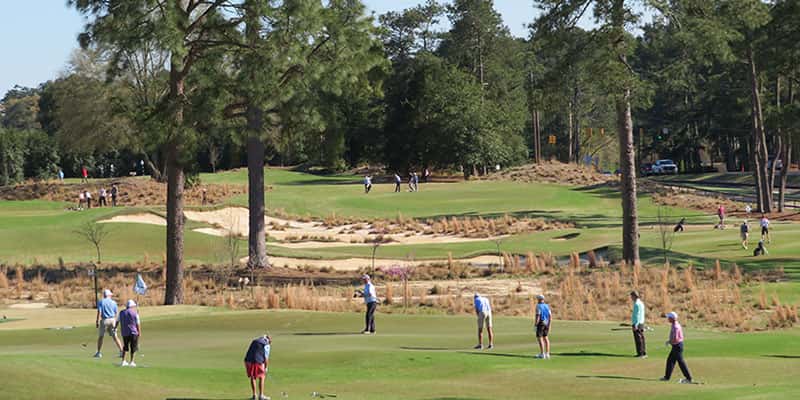

Gil Hanse had spent his career creating places where other golfers could make a hole-in-one. He was still waiting for his own.
Then, on September 25, 2019, he stepped onto the second hole at The Cradle, the short course he had designed at Pinehurst. With a borrowed 58-degree wedge, he played the 78-yard shot toward a cup he couldn’t see.
Walking toward the green, Hanse spotted something white behind it. A ball that had run through? It turned out to be a tee.
His ball was in the hole.
Even better, the green had been built by his design partner, Jim Wagner. Hanse suddenly had both a first ace and something to tell his colleague about, according to Pinehurst’s account of the moment.
That is a fitting story for The Cradle: a little golf hole capable of producing a moment someone will remember forever.
A small course on historic ground
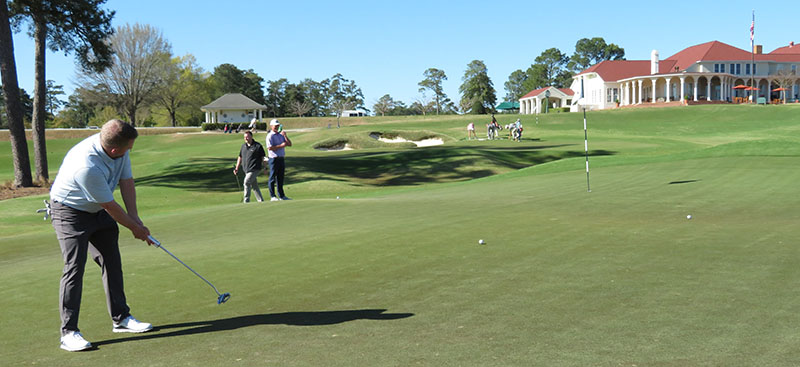
Opened in 2017, the nine-hole, par-27 course measures just 789 yards. Its small footprint contains plenty of trouble: deep bunkers, changing approach angles and greens with enough movement to make a short putt feel considerably longer. Hanse gave golfers a place where touch and judgment have room to matter. A wedge can get you there; what happens after the ball lands is another question. Pinehurst’s course guide lays out the compact challenge.
The setting gives those little shots some weight. The Cradle occupies land where Dr. Leroy Culver laid out Pinehurst’s first nine holes in 1898. More than a century later, Hanse worked native sand, wiregrass and rugged bunker edges into a fresh version of golf on that historic ground. The scale is compact, but the landscape belongs unmistakably to Pinehurst, as Golf Course Architecture documented ahead of its opening.
AmateurGolf.com’s 2021 visit to The Cradle captured another part of its appeal: golfers pairing up with people they had just met, music around the course, and families enjoying a layout where length didn’t decide who could have a good time. The third hole, known as the Punchbowl, drew particular praise for a green that could gather a well-placed shot toward the flag.
A U.S. Amateur encore
One of its best stories belongs to William Holcomb V.
In 2019, Holcomb reached the semifinals of the U.S. Amateur at Pinehurst. That evening, after his semifinal match, he went out to The Cradle—and made consecutive holes-in-one on the third and fourth.
Two swings. Two aces. Quite an encore after a day of championship golf.
By its third anniversary in 2020, Pinehurst reported 115,094 rounds and 549 holes-in-one at The Cradle. Those are historical totals, but they capture how quickly this small course became a place people wanted to play—and play again. Holcomb’s extraordinary evening appears among the milestones in Pinehurst’s three-year retrospective.
One more chance

For an amateur golfer, the appeal is easy to understand. There is something irresistible about a flag within reach. You can picture the shot before you hit it: one clean strike, a soft landing, a little turn toward the cup.
Of course, you can also leave it in the bunker.
But the next tee brings another chance. And somewhere between choosing a wedge and watching a friend’s ball creep toward the hole, the score becomes only part of the afternoon.
Hanse’s first ace required a borrowed club and a walk up to the green to discover what had happened.
The Cradle leaves you with that possibility.
Bring a few clubs. Something worth telling might happen.