

Bel-Air is not the kind of course that reveals itself all at once. Its slopes, angles, bunkering, and elevation changes require patience and precision. No single television shot or photograph can fully capture the undulation in the fairways or the subtle challenges around the greens.
I had the opportunity to play the course, and it was a very memorable experience. The following holes left the biggest impression and left me with a story to tell about each of them.
For the Curtis Cup players, Bel-Air will ask demanding questions. Some holes will test length. Others will test discipline. Many will test whether a player and caddie can pick the correct number and trust it.
The players’ short games will require lethal precision, and understanding the contours of both the fairways and greens will be paramount to success.
The Long Par 4s
No. 4 — 432 yards

The fourth hole, known as the Tarzan hole, brings one of Bel-Air’s best pieces of lore. Johnny Weissmuller, who played Tarzan in the 1930s and 1940s MGM film series, filmed scenes for at least one of his movies in a hidden cave above the fourth hole at Bel-Air Country Club.
No. 15 — 430 yards

The 15th is framed by a beautiful purple tree on the right, but the real challenge is the green. Measuring about 50 yards from back to front, the putting surface emphasizes finding the fairway and choosing the correct approach number.
Missing right or left of the green makes for a difficult up-and-down, but being short or long of the hole can also leave players in very real three-putt territory.
No. 17 — 453 yards

Played as a par 4, No. 17 will require an exceptional drive. From there, players can expect a 160- to 180-yard approach shot, with an incredible view of UCLA and Los Angeles in the backdrop.
This was one of my favorite walks on the course.
The “Short” Par 4s
Bel-Air’s shorter par 4s may not overwhelm players with yardage, but they will demand precision. These are the holes where wedges must be controlled, angles must be respected, and aggressive decisions can quickly turn into dropped shots.
No. 7 — 348 yards

Although distance may not be an issue on this hole, the hand-like bunker guarding the front of the green acts as a catcher’s mitt for a golf ball if players do not choose the right number. Hit it long, and there is a small bunker behind the green waiting as a backup plan to induce a bogey behind the front bunker.
The drive and approach are essential. Short game alone may not be enough to stave off bogey if a player fails to hit the green in regulation.
No. 9 — 322 yards

This hole is sweet and rewarding as long as the player and caddie choose the correct number to hit off the tee and their ball does not find the barranca guarding the edge of the fairway.
No. 11 — 391 yards
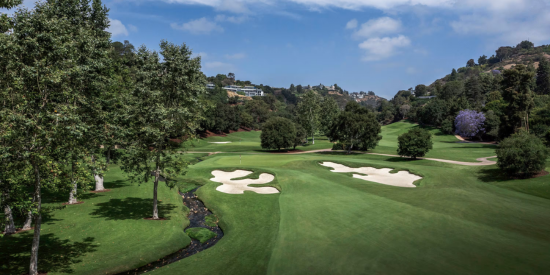
The tee shot and walk down the 11th fairway were among my favorites on the course. No photo or television shot will do the fairway's undulation justice.
Find the proper position off the tee, and players can expect less than 120 yards for their approach. Miss the fairway to the right, however, and the shot becomes much more complicated. From there, players will have difficulty gauging spin and release while also navigating the front bunkers and the creek running behind the green.
No. 12 — 355 yards
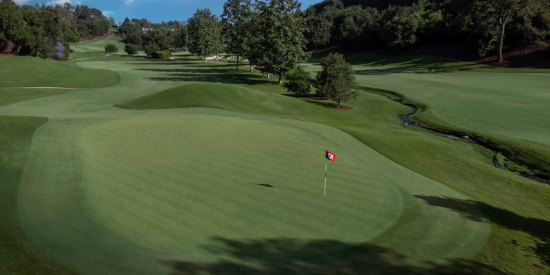
A short par 4, No. 12 does not present an overly difficult tee shot, but the approach asks a much more precise question. Players who find themselves on the left side of the hole will have to contend with a mound protecting the green.
It is a difficult shot to judge, but a very well-designed hole.
Par 3s With Endless Character
No par 3 at Bel-Air feels the same. The holes range from wedge shots to demanding long irons or hybrids, and each tee shot requires full commitment. Most of the greens are protected by bunkers, with No. 10 standing out for the carry required and the pressure from the clubhouse gallery breathing down players’ necks from the viewing decks above.
No. 5 — 122 yards
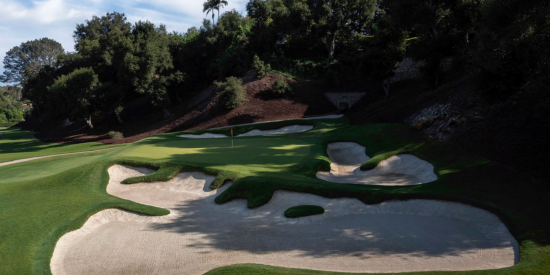
No. 5 may sound simple at only 122 yards, but the bunkering is diabolical. Catching a wedge fat or skinny can be a player’s demise, and being above the hole will present a massive challenge when trying to make a birdie.
Staying below the hole is paramount to success, but that is easier said than done with the massive bunker protecting the front of the green.
No. 10 — 205 yards
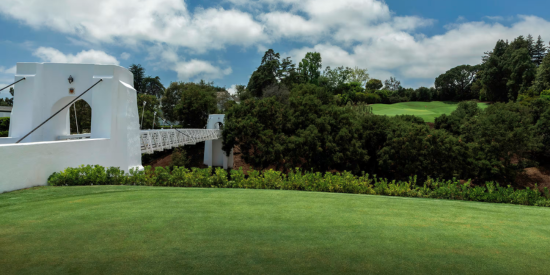
The 10th hole may play up to 220 yards for the Curtis Cup players, who will have to carry a gorge to reach safety. Crossing the infamous swinging bridge will be a sigh of relief after an extremely intimidating tee shot.
No. 16 — 161 yards
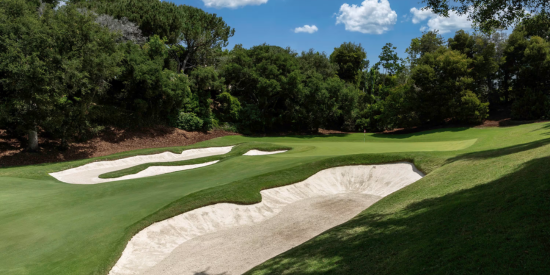
On No. 16, players will be able to use one of four chimneys in the backdrop as aiming points, depending on the hole location.
A front pin may be the most difficult hole location on this green, with large greenside bunkers on both sides. Miss long, and players will have to traverse the three-tiered green, which is lightning quick downhill.
Par 5s That Tell a Story
The par 5s at Bel-Air are not simply scoring opportunities. They are holes with history, strategy, and plenty of room for momentum to swing during match play.
No. 8 — 496 yards

The eighth is the infamous Howard Hughes hole. As the story goes, Hughes had been late for a date with Katharine Hepburn and decided to land his plane on the fairway of the par-5 eighth hole. The scene was later depicted in The Aviator.
It is difficult enough to land a tee shot in this fairway. I could not imagine landing a plane on it.
No. 14 — 547 yards
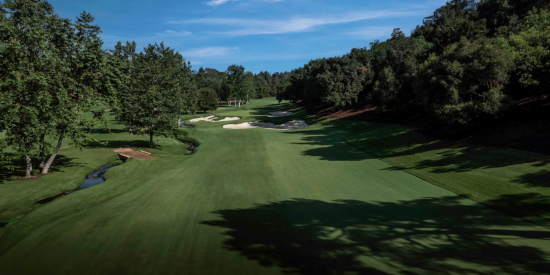
My caddie said the 14th might be his favorite hole on the course.
A true three-shot par 5, No. 14 features a creek running up the left side of the fairway and thick rough up the right. The green is surrounded by bunkers on the front left and center, with the creek coming into play just behind. It is a hole that will require patience, placement, and discipline.
A Worthy Curtis Cup Stage
By the end of the walk, Bel-Air had made its identity clear. This is not a course that can be reduced to yardages alone. The numbers matter, but the real test will come from uneven lies, exacting approach shots, fast downhill putts, and the constant need to understand where the ball must finish.
For a Curtis Cup, that should make for a compelling match-play venue. Bel-Air will reward players who think clearly, commit fully, and control their golf ball under pressure.
It will be a true test for the world's best amateur golfers.
All photos courtesy of the USGA and Kirk H. Owens