


There are plenty of ways for a golfer in his 30s to spend a summer vacation day.
More than 6,000 of them chose to spend one trying to shoot 68.
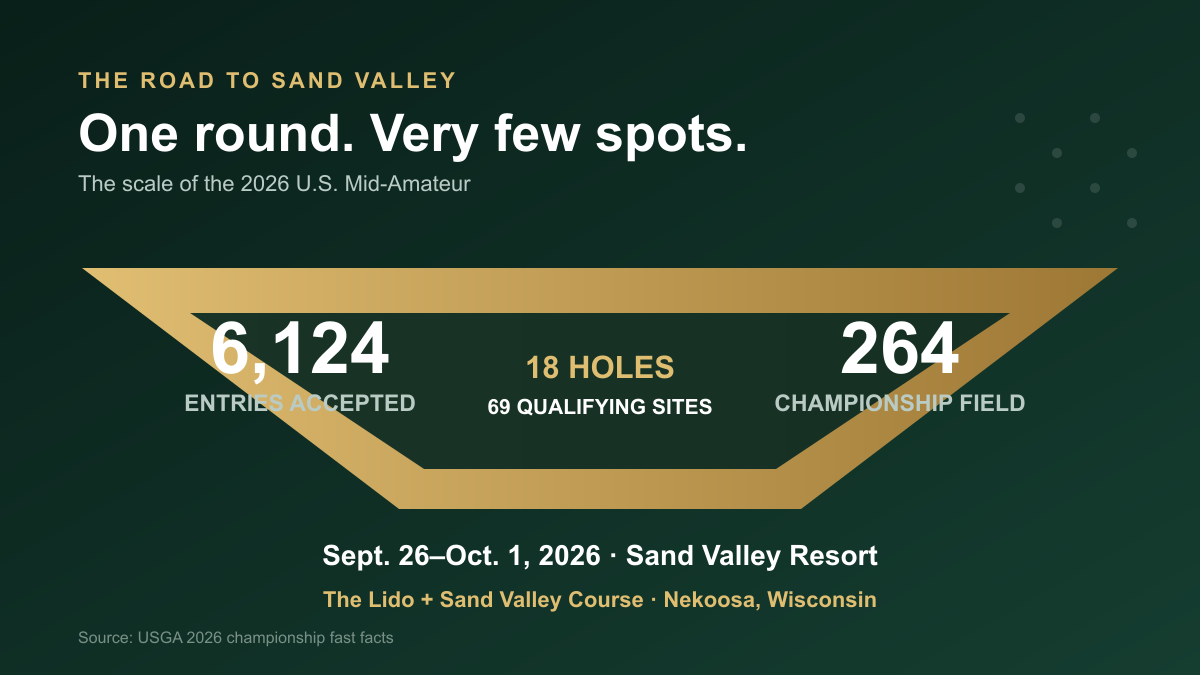
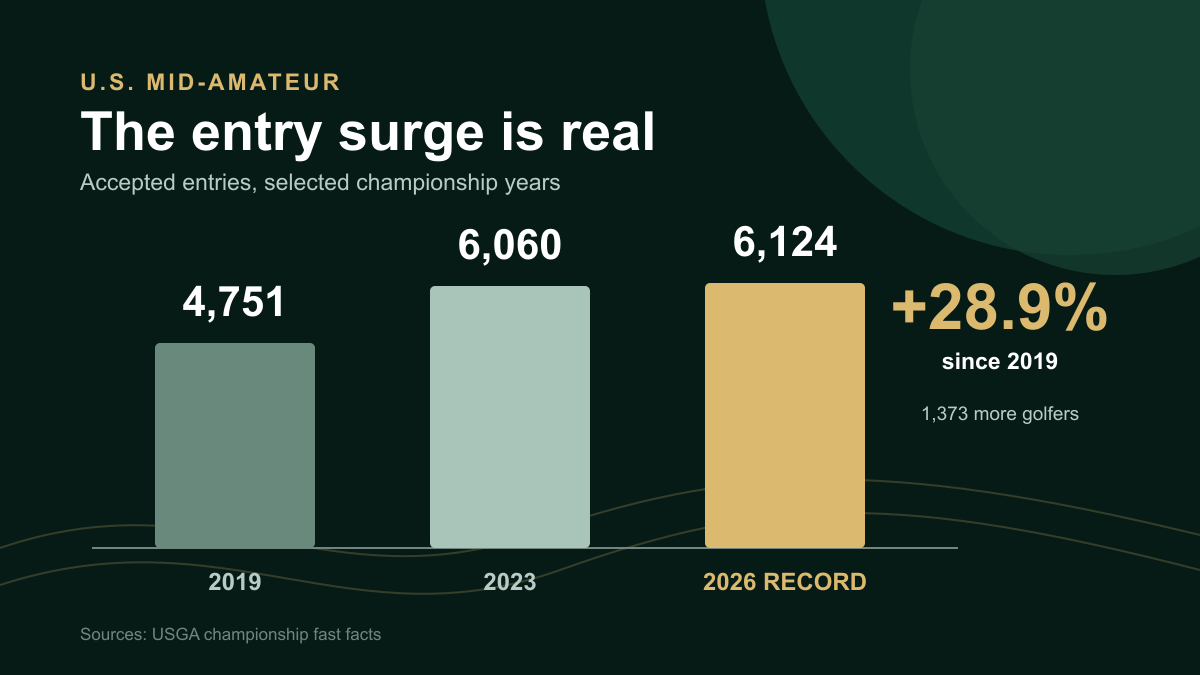
The USGA accepted a record 6,124 entries for the 2026 U.S. Mid-Amateur Championship, breaking the previous mark of 6,060 set in 2023. Only 264 players will make it to Sand Valley Resort in Wisconsin for the championship, which begins Sept. 26.
For the overwhelming majority of the field, getting there requires surviving one of the most unforgiving days in amateur golf:
18 holes. One score. Very few spots.
The U.S. Mid-Amateur qualifier may be one of the best measurements we have for the health of competitive amateur golf.
Right now, that measurement is pointing up.
From 4,751 entries to 6,124
Consider where the championship stood only seven years ago.
The 2019 U.S. Mid-Amateur received 4,751 entries.
This year: 6,124.
That is an increase of nearly 29 percent.
These aren't college golfers whose tournament calendars are built by coaches. They aren't juniors traveling with parents.
The U.S. Mid-Amateur is open to amateurs who are at least 25 years old by the start of the championship and have a Handicap Index of 2.4 or lower. Most of the people entering have careers. Many have children. They have mortgages, meetings, school drop-offs, work trips and limited practice time.
Yet more of them than ever are attempting to qualify for a national championship.
Competitive golf was supposed to get harder to pursue once adulthood arrived. Instead, thousands of golfers are finding ways to keep playing it seriously.
Being scratch isn't the same as being U.S. Mid-Am good
This year's handicap requirement can create a misleading impression.
A 2-handicap is an excellent golfer.
At many U.S. Mid-Amateur qualifiers, that player is nowhere near the score required to advance.
AmateurGolf.com previously analyzed more than 20 years of Mid-Am qualifying data and found an average qualifying line of 70.5.
Some regions are tougher still:
- Southern California: 69.8
- North Texas: 70.2
- Florida North: 70.3
- Arizona: 70.5
- Georgia: 71.0
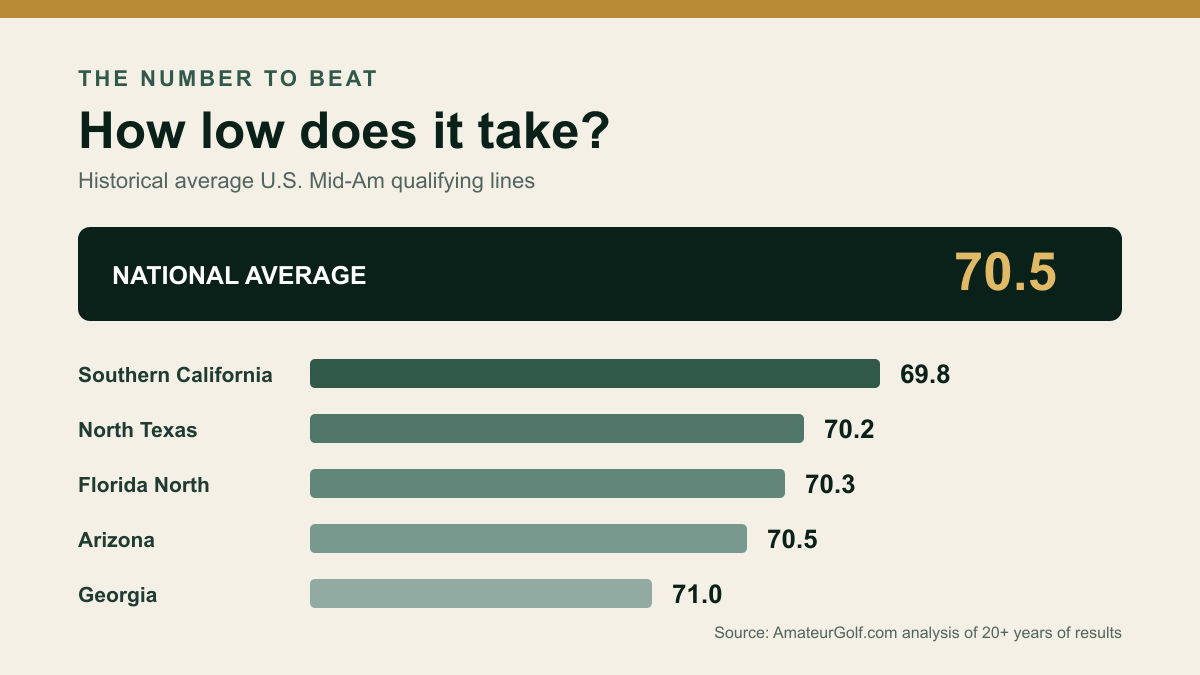
Those numbers expose the gap between recreational definitions of elite golf and actual championship golf.
At your club, shooting 71 might win the gross game.
At a U.S. Mid-Am qualifier, it might send you home.
One round changes everything
That's part of what makes qualifying so compelling.
There is no three-day tournament to find your game. There is no cut after 36 holes. There is no second round to recover from a 74.
You get 18 holes.
Your first tee shot matters. The three-footer on No. 3 matters. The bogey after finding the trees on No. 7 matters. The decision to attack or lay back on the final par 5 matters.
A player can be one of the better golfers at his club for 364 days of the year and find himself standing over a six-footer on the 18th green knowing his entire U.S. Mid-Amateur comes down to one stroke.
That's championship qualifying.
Look at what happened in Florida last year
The 2025 qualifying results show how small the margin can be.
At The Conservatory at Hammock Beach in Florida, Patrick Dewey shot 66. Jordan Pomeranz shot 67. Marc Dull and Justin Heimer shot 68.
Jimmy Kozikowski also shot 68.
He was the first alternate.
Michael Smith shot 69.
Second alternate.
Think about that: You can shoot 3- or 4-under golf in a USGA qualifier and still spend the rest of the afternoon hoping somebody withdraws.
At Bear Creek in California, three players qualified at 69. Two players shot 70. They were alternates.
At The Apawamis Club in New York, scores of 68, 69, 69 and 70 advanced. Another 70 became the first alternate.
This is what the U.S. Mid-Amateur has become.
Par isn't the objective. Par may not even keep you in the conversation.
The modern mid-am is really good
There is another reason qualifying has become so difficult: The player pool itself has changed.
Former Division I golfers are everywhere. So are reinstated professionals. There are players who tried mini-tour golf, stepped away, built careers and later regained amateur status. There are former college athletes who never turned professional but never stopped competing.
There are also golfers using launch monitors, speed training, strength programs, advanced putting systems and tournament schedules that would have been difficult for a working amateur to assemble 20 years ago.
The label "mid-amateur" can make the category sound like a step below elite amateur golf.
It isn't.
At the top, these guys can play.
Brandon Holtz is the perfect example
The defending U.S. Mid-Amateur champion may represent the modern championship better than anyone.
Brandon Holtz played professional golf before regaining his amateur status. Then, in his first USGA championship, he won the 2025 U.S. Mid-Amateur at Troon Country Club.
He defeated Jeg Coughlin III, 3 and 2, in the 36-hole final. The victory earned Holtz exemptions into the 2026 U.S. Open and future USGA championships, along with the invitation that took him to the Masters.
Holtz hasn't slowed down.
This month he won the Illinois State Mid-Amateur by six shots, opening with a 65 and finishing 10 under.
That is the level sitting at the top of this category.
And Holtz is far from alone.
Peyton White just shot 17 under
Ohio supplied another example this week.
Peyton White won the Ohio Mid-Amateur Championship at 17-under 199. His rounds: 68, 64, 67.
He won by eight shots over Coughlin, the 2025 U.S. Mid-Amateur runner-up.
White isn't a touring professional. He's a mid-amateur.
Scores like that help explain why a U.S. Mid-Am qualifier can feel less like a club championship and more like Monday qualifying.
The pool is deep. And it's getting deeper.
Why are so many golfers doing this?
There isn't one answer.
Part of it is access. Golfers can find tournaments more easily than they could 15 or 20 years ago. Schedules and registration are online. Rankings make it easier to see where you stand.
Part of it is technology. A working golfer can practice for an hour on a launch monitor and collect more information about his swing than players once gathered over an entire season. Indoor golf has changed winter practice. GPS and shot-tracking systems have changed course management. Remote coaching has changed access to instruction. Fitness has extended competitive careers.
But there may be another factor that is harder to measure.
Golfers simply don't feel like they have to stop competing anymore.
The post-college golf problem
Competitive golfers encounter an awkward moment after college.
Junior golf has a structure. College golf has a structure. Professional golf has a structure.
Then you're 27 with a job.
What now?
For years, the answer for many good players was some version of: Play your club championship. Maybe enter the state amateur. Play some weekend events. Move on with life.
The modern amateur calendar looks different.
State mid-amateurs have become meaningful championships. National invitationals attract elite fields. Associations run player-of-the-year races. Ranking systems track results. USGA qualifying gives almost anyone good enough to meet the handicap requirement a path to one of the biggest prizes in golf.
And AmateurGolf.com makes it possible to build an entire season around competition.
A player can be an accountant Monday through Friday and spend Saturday chasing ranking points against former Division I golfers.
For a certain type of golfer, that's incredibly appealing.
The Masters changes everything
The U.S. Mid-Am isn't merely another national championship.
The champion has long received an invitation to the Masters, provided he remains an amateur. That changes the psychology of the event.
A 35-year-old amateur doesn't have many pathways to Augusta National. He isn't going through PGA Tour Q-School. He isn't climbing the Korn Ferry Tour points list. He probably isn't qualifying through a professional victory.
But he can enter the U.S. Mid-Amateur.
He can qualify. He can survive 36 holes of stroke play. He can make the 64-player match-play bracket. He can win six matches.
And suddenly he's driving down Magnolia Lane.
It's wildly improbable.
But it is possible.
That matters.
First you have to get to Sand Valley
This year's championship adds another attraction.
The 2026 U.S. Mid-Amateur will be played at Sand Valley Resort. The championship course is The Lido, the recreation of C.B. Macdonald's lost Long Island masterpiece.
The USGA lists The Lido at approximately 7,219 yards, par 71, with a 76.3 course rating and 152 slope. The Sand Valley Course, designed by Bill Coore and Ben Crenshaw, will serve as the stroke-play co-host.
Qualifying is being conducted over 18 holes at 69 sites from July 27 through Sept. 9.
That means the reward for surviving is significant even before anyone starts thinking about trophies or Augusta.
You get to play a USGA championship at Sand Valley.
For a competitive golfer with a day job, that can be motivation enough to enter.
6,124 golfers tells us something
The headline number is a record.
But the more revealing part isn't that the U.S. Mid-Amateur received 64 more entries than it did in 2023. It's the scale of participation.
More than 6,000 golfers over the age of 25 believe enough in their games to put their names on a USGA entry form.
They'll travel. Take time off work. Pay an entry fee. Practice. Prepare. Stand on a first tee knowing that 18 holes may decide whether they get to play in a national championship.
Most won't make it.
Many will play extremely good golf and still won't make it.
And next year, many of them will enter again.
That's why the U.S. Mid-Amateur may tell us more about competitive golf than almost any participation survey could.
For a growing number of golfers, getting older hasn't meant becoming less competitive.
It has simply changed what they're competing for.
So what score do you actually need?
Based on AmateurGolf.com's historical data, 70 is a useful benchmark.
But location matters considerably. In the deepest regions, breaking 70 may be necessary. At other sites, difficult conditions or tougher golf courses can push the qualifying number into the low 70s. Every year produces outliers.
The lesson isn't that you have to shoot exactly 69.
It's this:
If you're preparing for a U.S. Mid-Am qualifier, prepare to break par.
Don't build a strategy around surviving with 72. Don't assume shooting your handicap will get you through. And don't treat the qualifying round like a normal club event.
The numbers suggest that a player serious about advancing should arrive believing he can shoot something beginning with a six.
Because thousands of other golfers apparently believe the same thing.