
It's a bold claim, and the internet is not where you'd expect to find it defended rigorously. So we did what any golf-and-numbers publication should do: we rebuilt the model from scratch, verified every figure, and cross-checked it against the peer-reviewed operations research on pace of play. The short version is that the Reddit author is standing on solid ground — the same ground occupied by a decade of academic work from Columbia and Cornell. The longer version is more interesting, because the places where the argument overreaches are exactly the places that matter to tournament golf.
A course is a factory line, not a parking lot
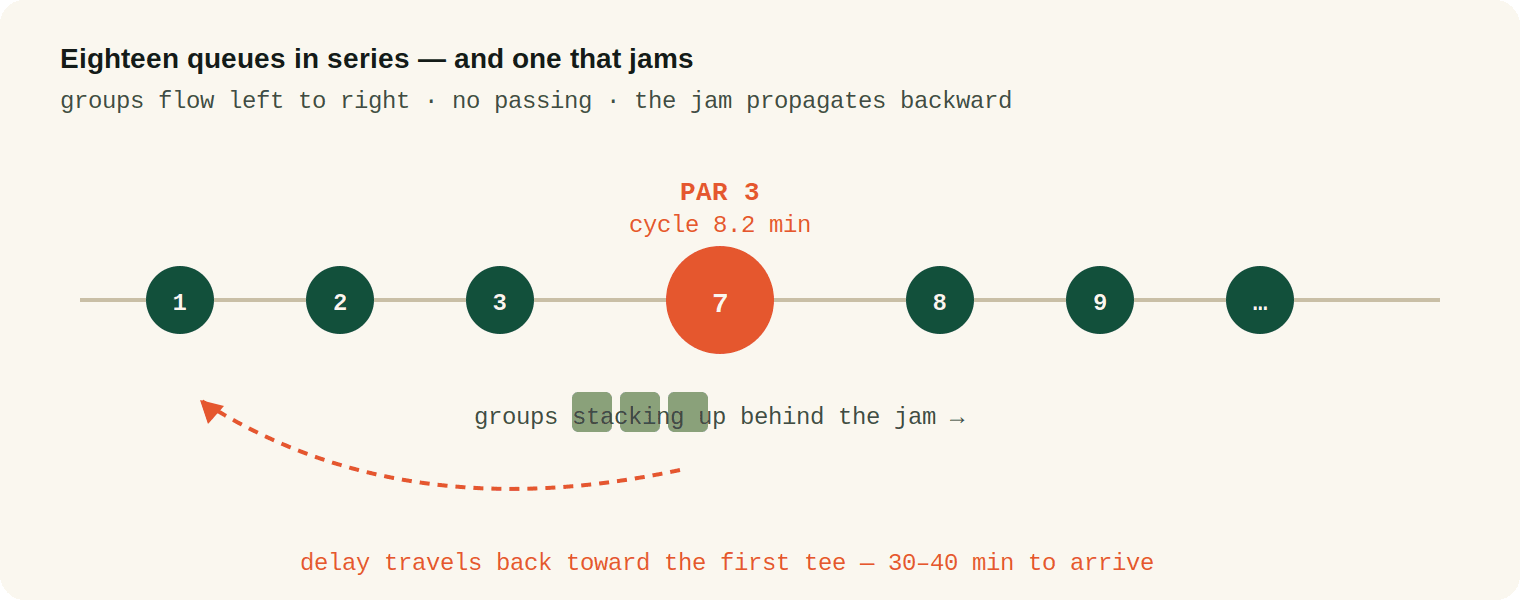
Start with the mental model, because everything follows from it. A tee sheet looks like a capacity problem — how many groups can we fit? — but a golf course doesn't behave like a parking lot that's simply full or not full. It behaves like an assembly line. Each hole is a workstation. A group can't skip ahead, can't pass, and there's only room for about one group to stand and wait before the backup spills onto the previous green.
In that kind of system, the number that governs throughput is not how long a hole takes to play. It's how often a hole can start a new group — its cycle time. Most holes cycle faster than you'd think, because groups overlap: you're teeing off while the group ahead is still walking to their second shots. The trouble begins at whichever hole that overlap collapses.
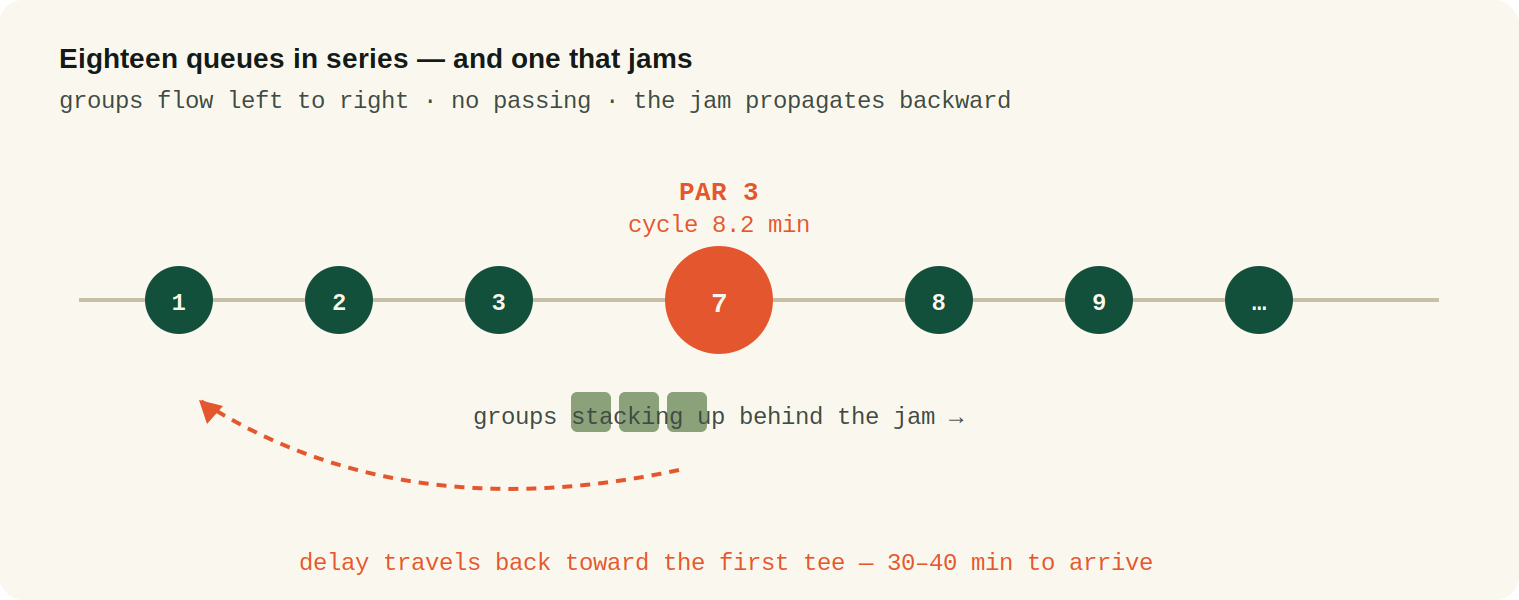
This is not folk wisdom. It's the exact structure of the queueing model built by Ward Whitt and Qi Fu at Columbia, whose simulations found that when the tee interval is set to 7.5 minutes and a par 3 becomes overloaded, that single hole can account for the overwhelming majority of total waiting time on the course. The Reddit author reached the same conclusion by reasoning, not citation — which is what makes the post worth taking seriously.
Little's Law, and the number clubs get backwards
Here's the calculation almost every club uses to justify its tee sheet, and why it's circular. Assume two groups per hole, multiply 36 groups by an 8-minute interval, and you get 288 minutes — a tidy 4 hours 48 minutes. It looks like you've derived a pace. You haven't. You assumed the density (two groups per hole) and got back the pace that density produces. It's an assumption wearing the costume of a result.
The correct tool is Little's Law, a result so fundamental to queueing theory it's almost embarrassing that tee sheets ignore it. It says the number of groups on the course equals the round length divided by the interval: L = W / T. Rearrange it and you can see how density and round time are locked together — you cannot wish for a low density and a short interval at the same time.
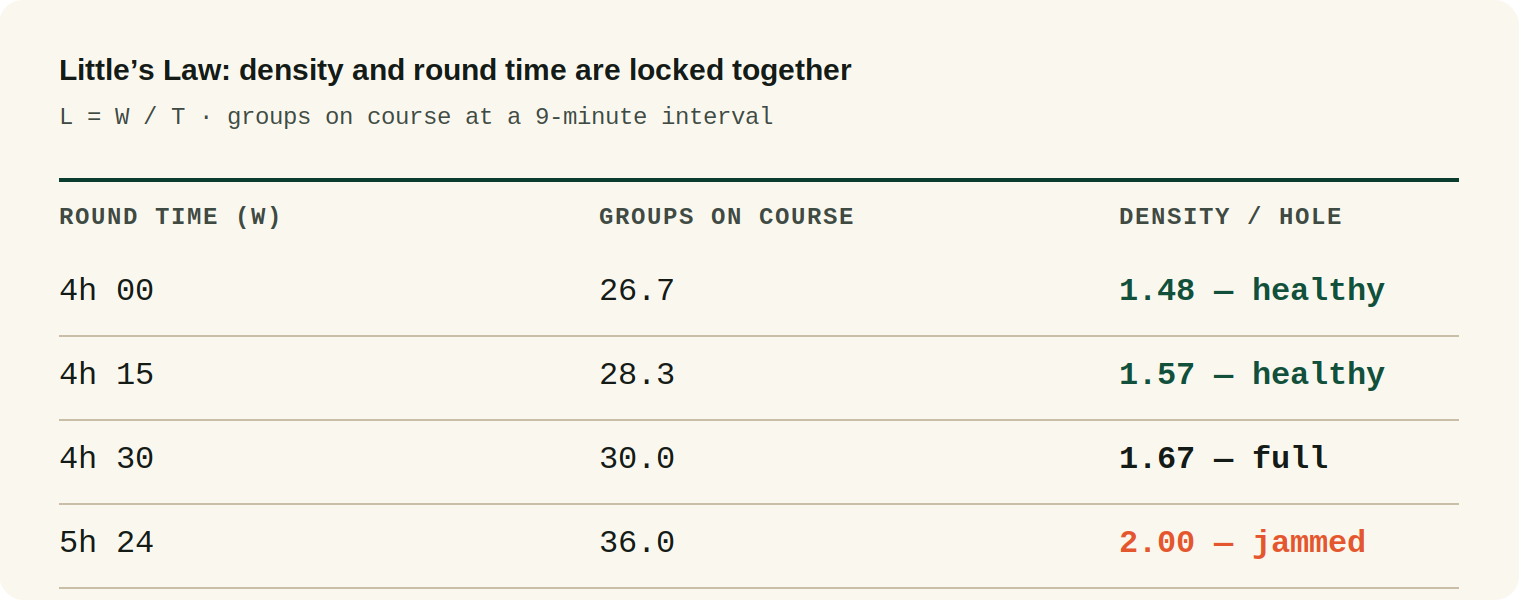
A course that's genuinely running well carries something like 1.4 to 1.7 groups per hole. Pack it to 2.0 and you're no longer running a golf course; you're running a five-and-a-half-hour traffic jam. We verified each of these figures independently — they're exact.
Why 8 minutes is a coin flip: the congestion curve is a cliff
This is the heart of the argument, and the part most golfers have never internalized. The severity of congestion at a station scales with a quantity queueing theorists write as ρ/(1−ρ), where ρ is the hole's cycle time divided by the tee interval. When ρ is comfortably below 1, small delays get absorbed. As ρ creeps toward 1, congestion doesn't rise gently — it goes vertical. At ρ = 1, the math stops returning a finite number at all.
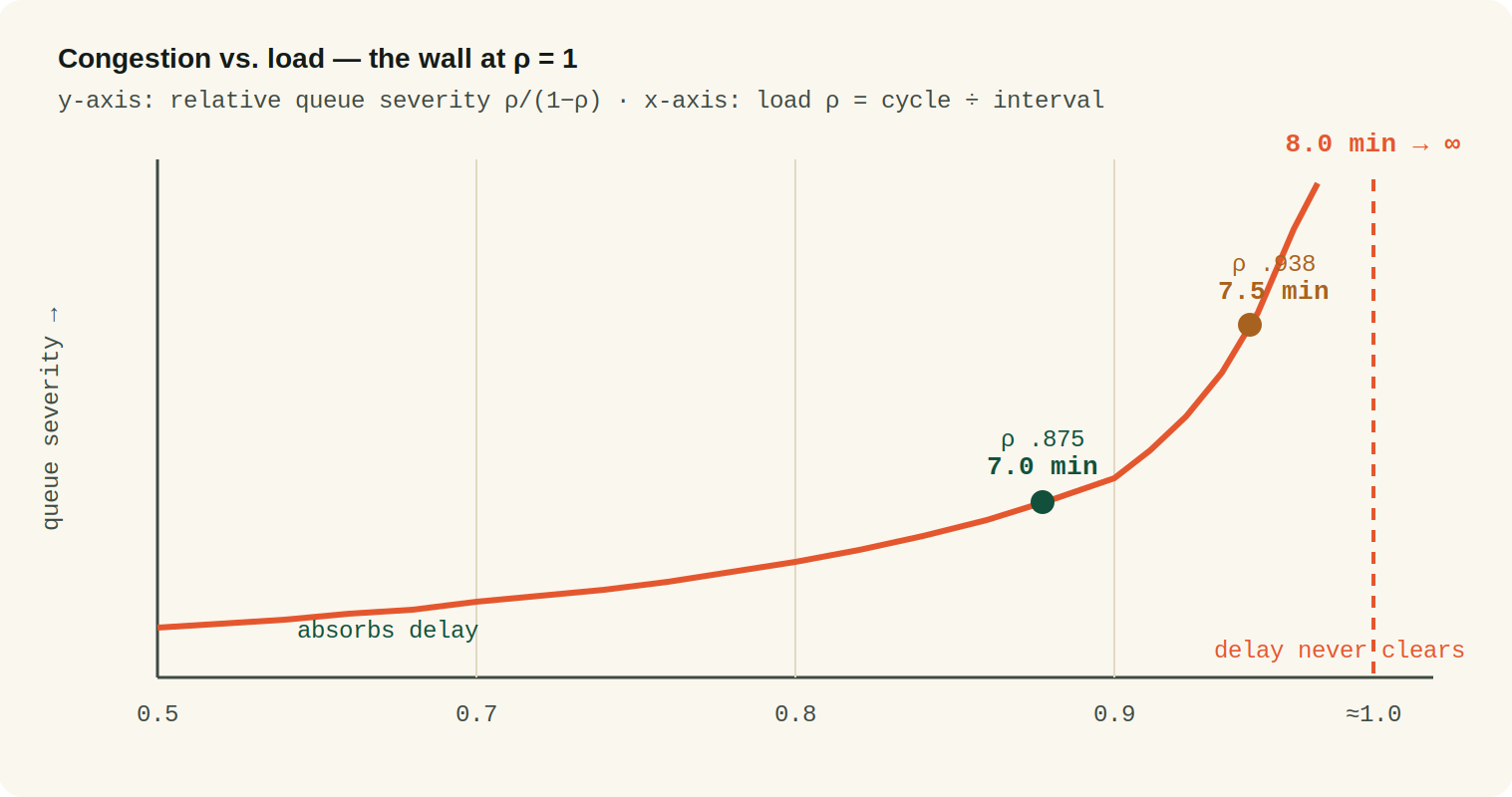
Holding the interval at 8 minutes, we recomputed the author's congestion figures from ρ/(1−ρ): a bottleneck cycling at 7.0 min gives 7.0, at 7.5 min gives 15.0, at 8.0 min goes infinite, at 8.5 min is unstable. Every value matches. The point isn't the exact numbers; it's the shape. This is a cliff edge, and 8-minute intervals park most mixed-field courses right on the lip of it.
Now the throughput trap, which is why clubs keep choosing 8 minutes anyway. Twelve hours of tee times at 9-minute spacing is 80 slots. At 8 minutes it's 90 — ten more groups, real money. But if the true bottleneck cycles at 8.2 minutes, the course physically tops out at about 88 groups no matter what the sheet says. So the honest gain isn't ten groups. It's the difference between 88 and the 81-ish you'd have run cleanly — a handful of extra groups, purchased by pushing every afternoon round past five hours. Seven groups sold; eighty-plus rounds made worse. We checked that arithmetic too, and it holds.
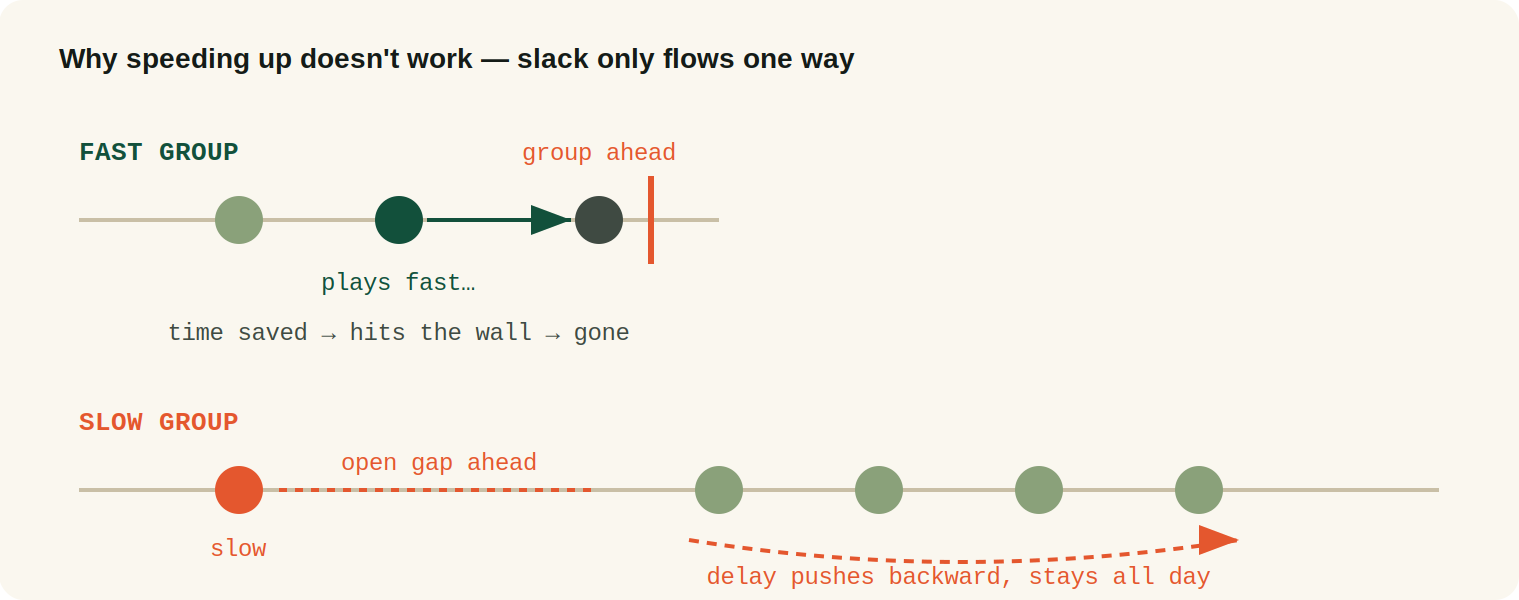
Fast groups don't bank time. Slow groups spend it forever.
If you take one idea from all of this, make it this one, because it inverts how most golfers assign blame. A fast group does not save time for the field. It plays a hole quickly, catches the group ahead, and then stands on the next tee. The time it saved evaporates the moment it reaches the group in front. Slack, in a no-passing queue, cannot be stored.
A slow group does the opposite. It opens a gap ahead, and that gap transfers backward through every group behind it, and it persists — because nobody downstream can pass to close it. This asymmetry is why the marshal shouting "pick it up" accomplishes so little: by the time a group is visibly behind, the lost time is already gone, dispersed into the field. You cannot recover it by speeding up one group; you can only prevent it by not scheduling density the bottleneck can't absorb.
Where we part ways with the post: three caveats it skips
Here's where AmateurGolf.com adds its own read, because the Reddit case, for all its rigor, has a rhetorical tilt: it wants slow play to be entirely a management failure and never a behavioral one. The truth is more useful than that.
The "not slow golfers" framing overcorrects. The post's own logic quietly concedes this. The individual slow group — twenty minutes behind the field with open fairway ahead — is a genuine behavioral problem, and marshalling does fix that one. The author is right that it's a smaller share of total pace complaints than members believe, and right that under-intervalled courses manufacture the appearance of slow players where none exist. But "the interval is usually the real cause" is the defensible claim. "Slow golfers aren't the problem" is a slogan, and it will get quoted more than it should. Both things are true at once: bad scheduling creates most of the congestion, and a single genuinely slow group early in the day can still wreck a well-set sheet — which is precisely why the post's own commenters kept saying "it only takes one."
The clean model assumes a stable, single bottleneck. The elegant ρ/(1−ρ) math assumes one identifiable constrained hole with a stable cycle time. Real courses drift. A 10th-tee merge, a halfway-house backup, a wide handicap spread, morning dew versus afternoon firmness — these move the bottleneck around during the day. Whitt and Fu's own papers are careful to note their cleanest approximations apply to balanced courses not dominated by one hole. The Redditor's model is the right first tool, not the last word. Measuring the bottleneck once on one Saturday, as the post recommends, is the start of the job, not the whole of it.
"Just widen the interval" collides with revenue reality. Telling a daily-fee course to go from 8 to 9 minutes is telling it to sell fewer tee times. The post is right that the extra slots are partly illusory — but "partly" is not "entirely," and a course operator staring at a booking sheet is not wrong to weigh it. The genuinely strong move the post makes is reframing the choice: don't widen the whole sheet, fix the one hole. A forward tee marker, a repositioned drop area, a wave-up rule on the bottleneck par 3 — the academic literature confirms these raise that hole's capacity and can buy back the interval without surrendering the revenue. That's the actionable core, and it survives all our caveats.
Our verdict: The Reddit post is roughly 85% right and worth every upvote. The queueing model is real, the math is correct to the digit, and it maps cleanly onto a decade of published research most golfers have never seen. Dock it for one thing: the headline overstates its case. Slow scheduling is the dominant, under-recognized cause of chronic five-hour rounds — but it is a dominant cause, not the only one. Fix the tee interval and the bottleneck hole first; keep the marshal for the genuine outliers.
What it means for the competitive amateur
Tournament fields amplify everything. A mixed handicap field has wider pace variance than a members' Saturday, which fattens the bottleneck's 80th percentile — exactly the number that matters. If you run events, your interval needs more cushion than a public course, not less.
Shotgun starts dodge the queue, tee-time starts inherit it. A shotgun loads all eighteen stations at once and empties them together; a sequential tee-time start feeds the whole field through hole 1 and straight into whatever the bottleneck is. Know which format you're running and set spacing accordingly.
Measure your bottleneck before you blame a group. Log the gap between consecutive groups' tee shots on each hole during your busiest wave. The hole with the worst 80th-percentile cycle time is your real constraint — and it's usually a par 3 or a forced-carry par 4, not the players.
Pace policy should target the tail, on one hole. Interventions aimed at the whole field on all eighteen holes are noise. A wave-up rule or a forward marker on the single bottleneck hole does more than any amount of "ready golf" on a par 5 nobody was waiting on.
Don't oversell the morning to save the afternoon. The seven extra groups a tight interval "sells" are the same groups that push your last waves past five hours. For a competitive round, that's not just annoyance — it's fatigue and scoring integrity late in the day.
None of this is a reason to stop asking players to keep up. It's a reason to stop only asking that. The golfer standing on the tee can see the group ahead of him and cannot see the tee sheet — so he blames the group, every time. The most useful thing the Reddit author said is buried in the middle of his post: that misattribution is the whole problem. Fix the schedule, fix the bottleneck hole, and most of the golfers you were about to blame turn out to have been fine all along.
—
Sources and method: Math independently verified in Python; all figures reproduce the original claims exactly. Theory cross-checked against Fu & Whitt, "Analyzing the Pace of Play in Golf" (Columbia); Choi, Fu & Whitt on bottleneck-par-3 placement; and Kimes, "Golf Course Revenue Management: Tee Time Intervals" (Cornell).