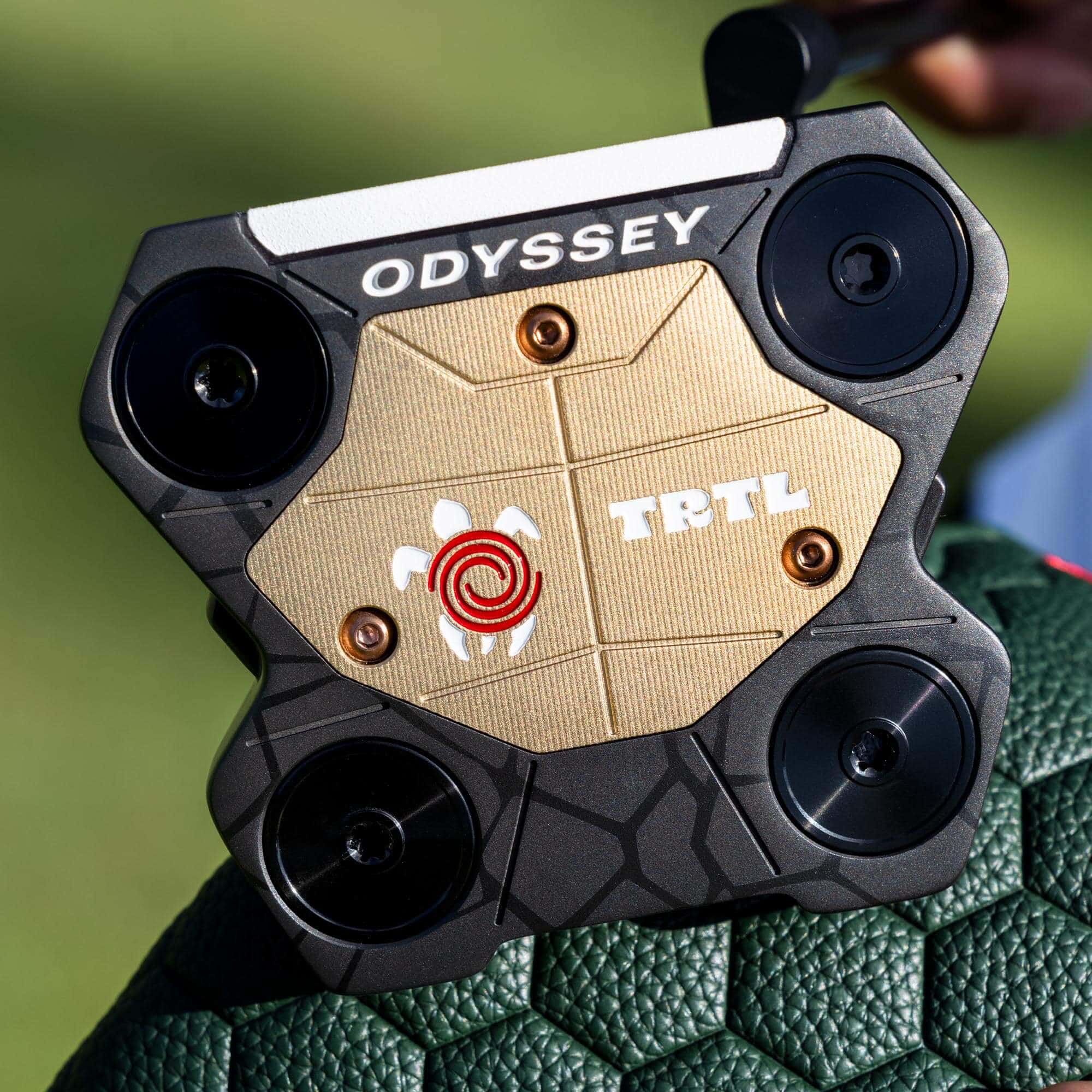
Every few years a putter shape shows up that changes what the practice green looks like at a state amateur. Odyssey thinks it has the next one. The new TRTL lineup, four high-MOI mallets built around a new insert and adjustable corner weights, reaches U.S. retail on November 6 after a run at the top of the Japanese market and a fast climb on Tour.
I've had the TRTL CH, the crank-hosel version, in my hands ahead of launch. The short version: it's extremely solid off the face, it's one of the easiest mallets I've lined up in a long time, and it sits square without any help from me. Below is what stood out, along with what Odyssey's product and R&D leads shared about how and why it was built.
Hands-on: the TRTL CH
Feel. I love it. Contact is extremely solid, and the ball comes off the face with more pop than the soft inserts Odyssey has leaned on lately. If you've been leaving putts short with a soft-faced mallet, that firmer response is the first thing you'll notice.
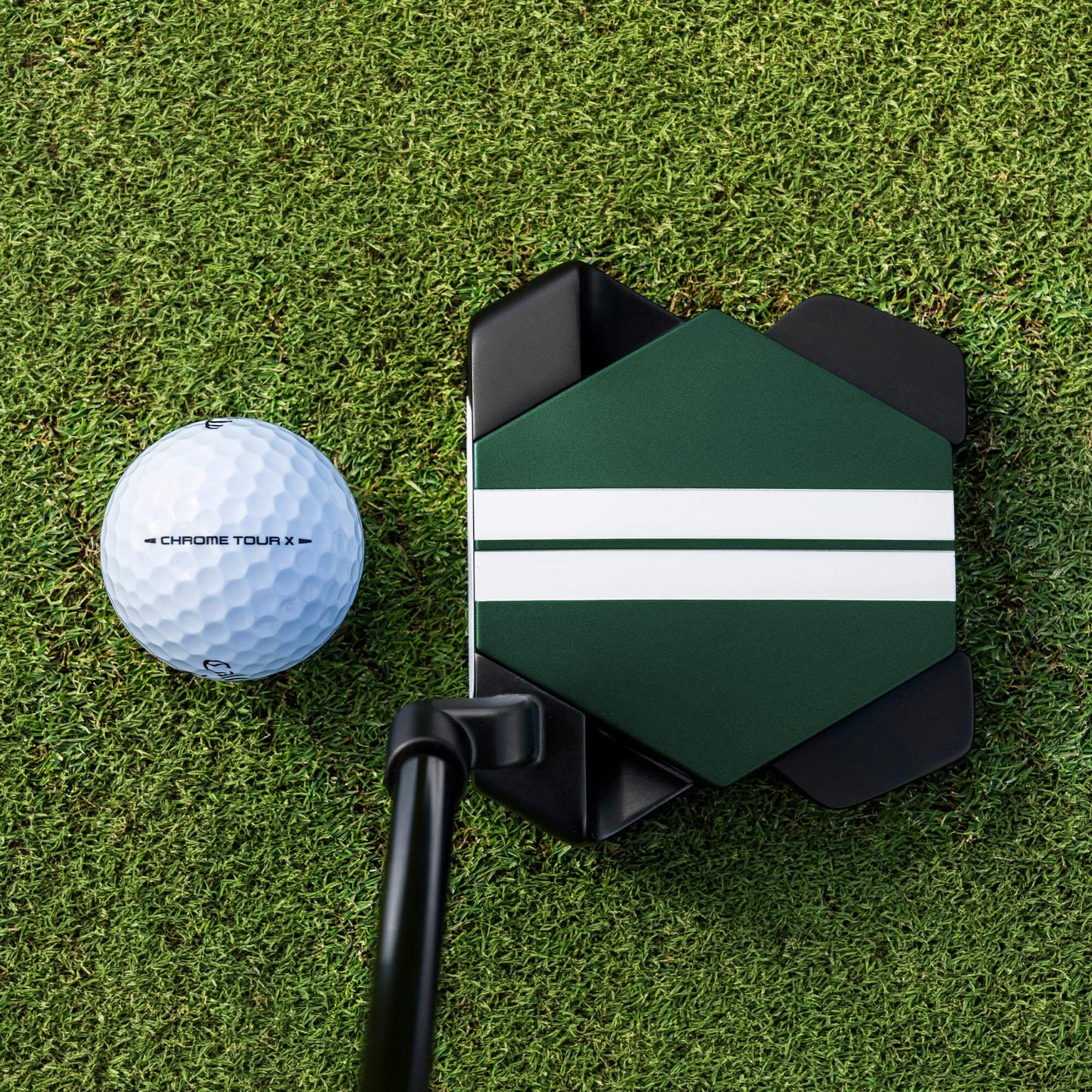
Alignment. The wide, high-contrast Twin Track line is the easiest thing about this putter. It runs all the way to the leading edge and stands out sharply against the green crown, so pointing the face at a spot a few inches in front of the ball takes almost no effort. Players who aim with one long continuous line will be right at home.
At address. It sits so square. Set the TRTL CH down and the face is looking at the target without any fiddling with the hands. That matters more than it sounds: any correction you make at address becomes part of your stroke, and this head takes that variable out.
The crank hosel. The CH is the classic crank-neck look, and it frames the ball cleanly at address. Paired with the square-sitting sole and the bold line, it's an easy putter to trust over a short one.
How TRTL came to be
TRTL started as a sketch from Ishino, a product designer on Odyssey's team in Japan. According to Odyssey R&D Director Eric Stubben, the concept was strong from day one: take weight out of the middle of the head and push it to the four corners to maximize MOI. Getting from that first angular rendering to the finished shape took roughly a year and a half.
Along the way the team softened the edges, pulled the shell forward so the alignment line could reach the face, moved the weights from the outside of the head to underneath, and flipped the color scheme to black PVD outside with the green crown inside. The alignment system alone went through so many iterations that Odyssey Senior Director Luke Williams called it "almost a whole separate project."
The Ai-Star insert, and why speed matters most
Every TRTL model gets Odyssey's new Ai-Star insert: a urethane striking surface over an aluminum backer, the same basic construction as the original Ai-ONE. This time the face is a little thinner in the heel and toe to bring ball speed up on mishits.
The more interesting part is the reasoning behind it. Odyssey says its robot and player testing found that about 87 percent of how far a putt travels comes from initial ball speed. Roll accounts for roughly 7 to 8 percent and launch angle the rest. So for Ai-Star, Odyssey went back to emphasizing speed and speed consistency. The company defines its sweet spot as any point on the face that produces ball speed within 1 percent of a center strike, and it says Ai-Star expands that zone over both previous Ai generations.
Odyssey was also candid about its last insert. Ai-ONE Dual traded ball speed for more topspin and roll, and early feedback was that it felt a little too soft. Ai-Star brings impact ratio (smash factor, essentially) back up to the firmer, faster level of the original Ai-ONE. That matches exactly what I felt with the CH.
The insert also carries a redesigned Forward Roll groove pattern, with deeper grooves on a 19-degree slope meant to get the ball rolling end over end sooner whether you catch it high or low on the face.
What TRTL is made of
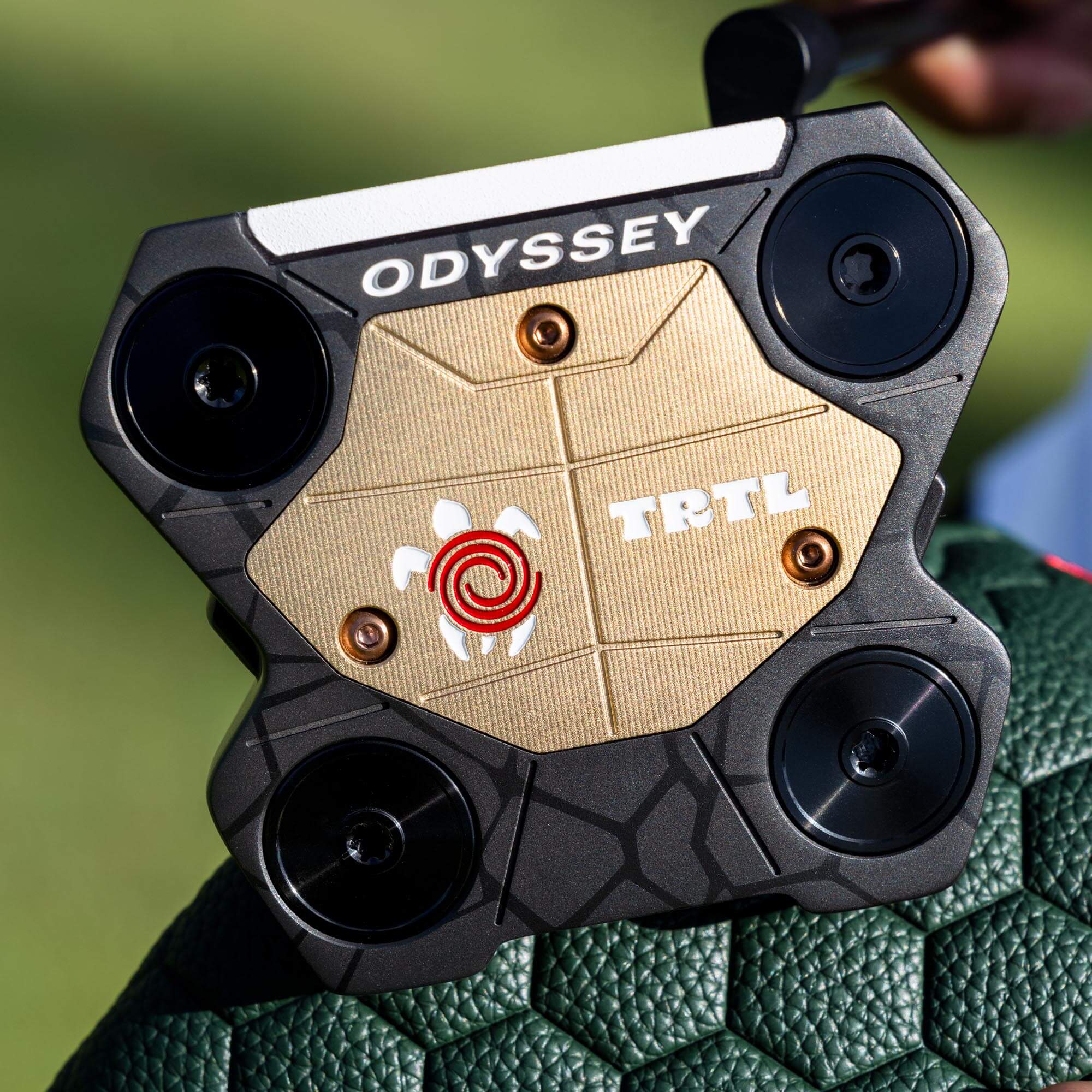
The body is steel with a black PVD finish, the shell is lightweight ABS and the sole is aerospace-grade aluminum. Keeping the center of the head light is what lets Odyssey push mass to the perimeter, raising MOI and making off-center strikes more forgiving. The sole's rake and camber are designed so the head rests flush on the turf, which is the engineering behind that square-at-address look.
Four weights, real adjustability
Most premium putters offer two adjustable weights, heel and toe. TRTL has four, in the corners of the head, so you can shift the center of gravity forward and back as well as heel to toe. Moving weight also changes toe hang, which means one head can be tuned for a straighter stroke or for more arc.
Williams describes the weights as a fine dial: once a fitter has the right hosel, length, loft, lie and grip, the weights dial in the last bit of performance. Min Woo Lee is the early example. He liked how TRTL looked, sat and felt, but after a session on Quintic, the putting analysis system invented by Odyssey staffer Paul Hurrion, he moved into the double bend with weight shifted toward the heel. He's kept putting well with it.
For serious amateurs, that's the practical takeaway: a good fitter can match this head to how you actually move the putter rather than working around it.
Already Odyssey's most-played model on Tour
Lee put TRTL in play at Pebble Beach earlier this year, when only a handful of heads existed, and it quickly became Odyssey's most-requested putter. Once Odyssey had real quantities available for its global Tour launch in the first week of August, TRTL became its most-played model on Tour, ahead of the Rossie, 2-Ball, Jailbird and #7, all of which have generations of heads still in play.
Lee, a notorious putter switcher, has stuck with it all year. "First week was Pebble, and I was, I think, second in the week for putting, which is probably one or two in my career of how good I've putted for the week," he said. "It's a bit harder than the Microhinge insert that I used to use. I love the feel of Microhinge, but my tendency is to miss a little bit short, so I thought, have a bit more pop into it."
Recent LPGA Tour winner Yuna Nishimura also has TRTL in the bag.
Number one in Japan
Odyssey gave its Japanese team, where the design originated, a head start. TRTL launched there the first week of August, and after only three days of sales the four models were the four best-selling putters in the country. They have held all four top spots for seven straight weeks since, pushing Odyssey back over 50 percent market share.
Models, pricing and availability
The TRTL head comes in three hosel options, plus a square-to-square version in a larger head. Odyssey says TRTL Max is about 6 percent larger with roughly 20 percent higher MOI than the standard TRTL. Its reasoning: the zero-torque, square-to-square putters that have performed best tend to be oversized, max-forgiveness heads.
TRTL S (S-neck) – $349.99
TRTL DB (double bend) – $349.99
TRTL CH (crank hosel) – $349.99
TRTL Max S2S (square-to-square) – $399.99
All four arrive at retail on November 6, 2026, under the campaign line "Trust the TRTL."
The amateur take
Odyssey isn't shy about where it thinks TRTL belongs, putting it alongside the Rossie, 2-Ball, #7 and Jailbird as a fifth head on its "Mount Rushmore." That's a big claim, and time will settle it. What I can say after putting with the CH is that the fundamentals are there: it feels solid, it's easy to aim, and it sits square without any help.
High-MOI mallets have been winning on the amateur circuit for a while, and TRTL doesn't reinvent the category. What it adds is a combination that's been hard to find in one head: very high MOI, a firmer, faster insert, a bold alignment line and weights you can move to change toe hang.
Who it's for: players who want mallet stability without giving up feel at impact, anyone who has been coming up short with a soft insert, and slight-arc strokes that never quite matched a face-balanced mallet. Who might pass: golfers who love a very soft, muted feel, or who prefer a minimal sightline over a bold one.
If you're shopping for a new putter heading into the 2027 season, the TRTL is worth a serious look, and worth getting fit for so the hosel and weights match your stroke.