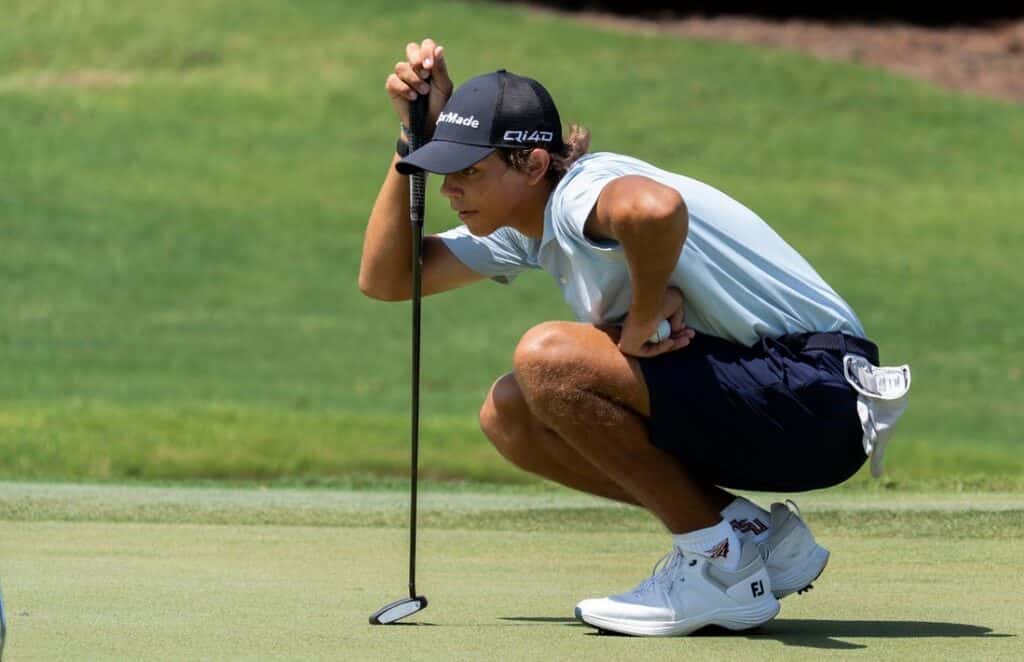


Charlie Woods has been assigned a $3 million NIL valuation.
That sentence is engineered to travel. It combines the most famous surname in golf with a number large enough to sound like a professional contract.
It also requires an immediate correction.
There is no public evidence that Woods has received a $3 million deal—or $3 million in NIL income. The figure comes from Golf NIL, an independent platform that estimates an amateur golfer’s market potential over the next 12 months. It is a valuation, not a disclosed paycheck.
That distinction makes the story more interesting, not less.
A 17-year-old high school golfer now sits atop a marketability ranking that includes college stars, national champions and Walker Cup players. The number attached to his name may be theoretical, but the marketplace it describes is real—and it has changed the meaning of “amateur golfer” forever.
What the $3 million figure actually means
Golf NIL says its valuation model weighs six broad categories: competitive performance, media exposure, social reach, future NIL opportunity, disclosed partnerships and less quantifiable “X-factors” that can amplify an athlete’s marketability.
The company describes the final number as its best estimate of a player’s NIL potential during the coming 12 months. It updates the rankings weekly and currently publishes valuations of $500,000 or more.
That is substantially different from tracking signed contracts.
Golf NIL maintains a separate Deal Watch for partnerships reported by athletes, companies, agents and other parties. As of August 20, that tracker did not list a disclosed Charlie Woods partnership or dollar amount.
In plain English: the $3 million figure estimates what Woods’ brand could command in the market. It does not establish what he has earned, what anyone has offered or whether he intends to pursue that business.
Headlines that call it his “NIL earnings” are making a leap the available information does not support.
The leaderboard reveals what brands are buying
Golf NIL’s August 13 top 10 tells a larger story about value in amateur golf:
Charlie Woods: $3 million valuation; approximately 174,000 social followers
Kai Trump: $2.25 million; approximately 9.3 million followers
Miles Russell: $1 million; approximately 158,000 followers
Preston Stout: $800,000; approximately 8,100 followers
Ethan Fang: $625,000; approximately 12,000 followers
Luke Poulter: $550,000; approximately 30,000 followers
Kihei Akina: $500,000; approximately 5,400 followers
Mason Howell: $500,000; approximately 30,000 followers
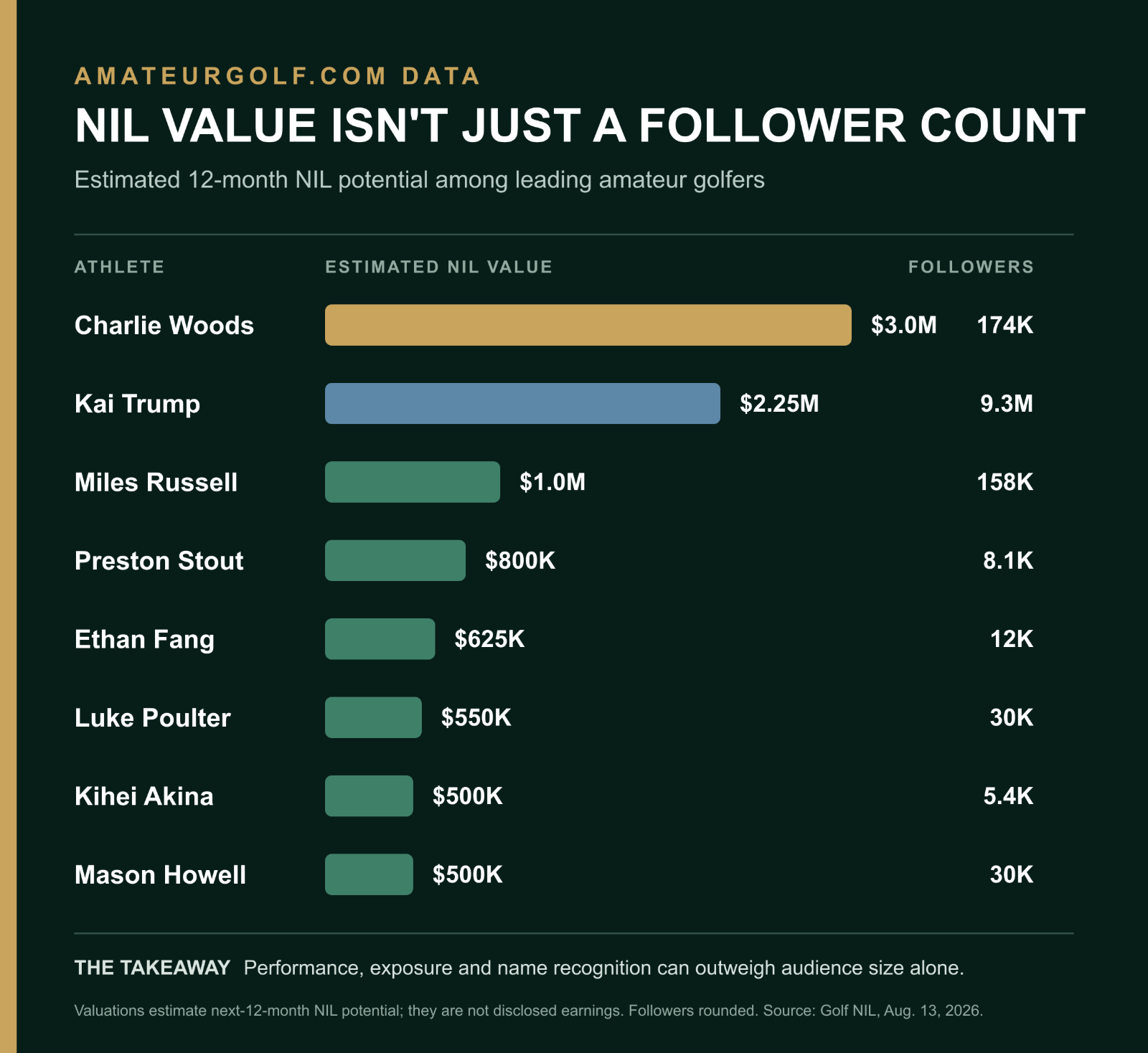
The list is not a golf ranking with dollar signs attached.
Trump’s enormous digital audience gives her a commercial reach few golfers at any level can match. Russell’s value combines growing visibility with one of junior golf’s strongest competitive résumés. Stout sits much lower in follower count but enters the college season as the world’s No. 1-ranked male amateur. Fang is an Amateur champion. Poulter is a Walker Cup player carrying another of golf’s most recognizable names.
Different players arrive at marketability through different doors: performance, audience, access, family recognition or some combination of all four.
Woods is the clearest example. He owns an AJGA victory, has committed to Florida State for 2027 and competes in elite junior events. But his commercial value cannot be separated from the attention generated by being Tiger Woods’ son.
AmateurGolf.com saw that attention firsthand at the 2024 U.S. Junior Amateur, where hundreds followed Woods and tournament officials expanded the marshal presence around his group. He shot 82-80 and missed match play. The crowd returned anyway.
That is marketability in its simplest form: people pay attention independent of the leaderboard.
Amateur no longer means unpaid
For generations, golf treated money as the bright line between amateurs and professionals. The modern rules draw that line elsewhere.
When the USGA and The R&A modernized the Rules of Amateur Status in 2022, they removed restrictions on amateurs benefiting from their name, image and likeness. Current guidance allows an amateur golfer to enter a contract and receive compensation for promoting a product or service.
The rules still distinguish sponsorship compensation from tournament prize money. They also preserve restrictions on entering competitions as a professional, accepting excessive prize money in tee-to-hole competition and performing certain professional acts.
So an elite golfer can be paid by a clothing company, hotel, golf club or other sponsor and remain an amateur. The same player cannot simply enter a tournament as a professional and preserve amateur status.
That leads to a definition that would have sounded contradictory a decade ago:
An amateur golfer can be a paid commercial endorser.
The status now describes how the golfer competes—not whether the golfer has economic value.
The deals are becoming easier to see
Golf’s NIL economy is still small compared with football and basketball, and most financial terms remain private. The public partnerships nevertheless show how quickly the market is maturing.
Golf NIL’s deal tracker lists Florida and Walker Cup player Luke Poulter joining Liberty National Golf Club as an ambassador on August 10, with the value undisclosed. It also records BYU standout Kihei Akina partnering with Travel + Leisure Co. and other leading college golfers signing apparel and lifestyle agreements.
Jackson Koivun provided the most useful glimpse of where the system can lead. Before turning professional in June, the former world No. 1 amateur built partnerships with Omni Hotels & Resorts, Betterment and Old Republic Insurance. Sports Business Journal reported that those brands continued with him after he became a professional, while he also added an apparel agreement.
For a golfer with genuine professional potential, NIL can become a proving ground. A player learns how to work with brands, create content and manage obligations before a missed cut affects the ability to pay next week’s travel bill. A company learns whether the relationship works before the golfer reaches the PGA or LPGA Tour.
The old transition from amateur to professional was a commercial starting line. Now it can be a continuation.
Junior golf adds another layer
Woods is still in high school, which makes the compliance picture more complicated.
The Rules of Amateur Status are only one layer. Junior golfers must also follow their state athletic association, school and future college eligibility rules. Florida permits high school NIL activity but places limits on how school names, uniforms, logos and events can be used. The Florida High School Athletic Association requires paperwork for participating athletes and advises families to seek legal and tax guidance.
That is not boilerplate.
A valuation can turn a teenager into a business prospect before the family has experience evaluating contracts, licensing rights, exclusivity clauses, tax obligations or agents. The opportunity is real. So is the possibility of signing away rights too cheaply or agreeing to obligations that collide with golf and school.
For families without the Woods name—or access to experienced advisors—the risks may be even greater.
The number is not the story. The new definition is.
Whether Charlie Woods could secure $3 million in NIL value is ultimately unknowable unless contracts become public. The model is an estimate, its inputs require judgment and the marketplace can change with a victory, an injury or a viral moment.
But dismissing the number entirely would miss what it measures.
Elite amateur golfers are already functioning as media properties and commercial partners. Their tournament results create exposure. Their audiences create leverage. Their names can hold value years before a professional debut—and, in Woods’ case, before the first college practice.
Golf has not abandoned amateurism. It has separated amateur competition from amateur economics.
That may be the most consequential change the game has made in a generation.
What do you think?
Has NIL improved amateur golf by helping players fund their careers—or has the sport stretched the word “amateur” beyond recognition?