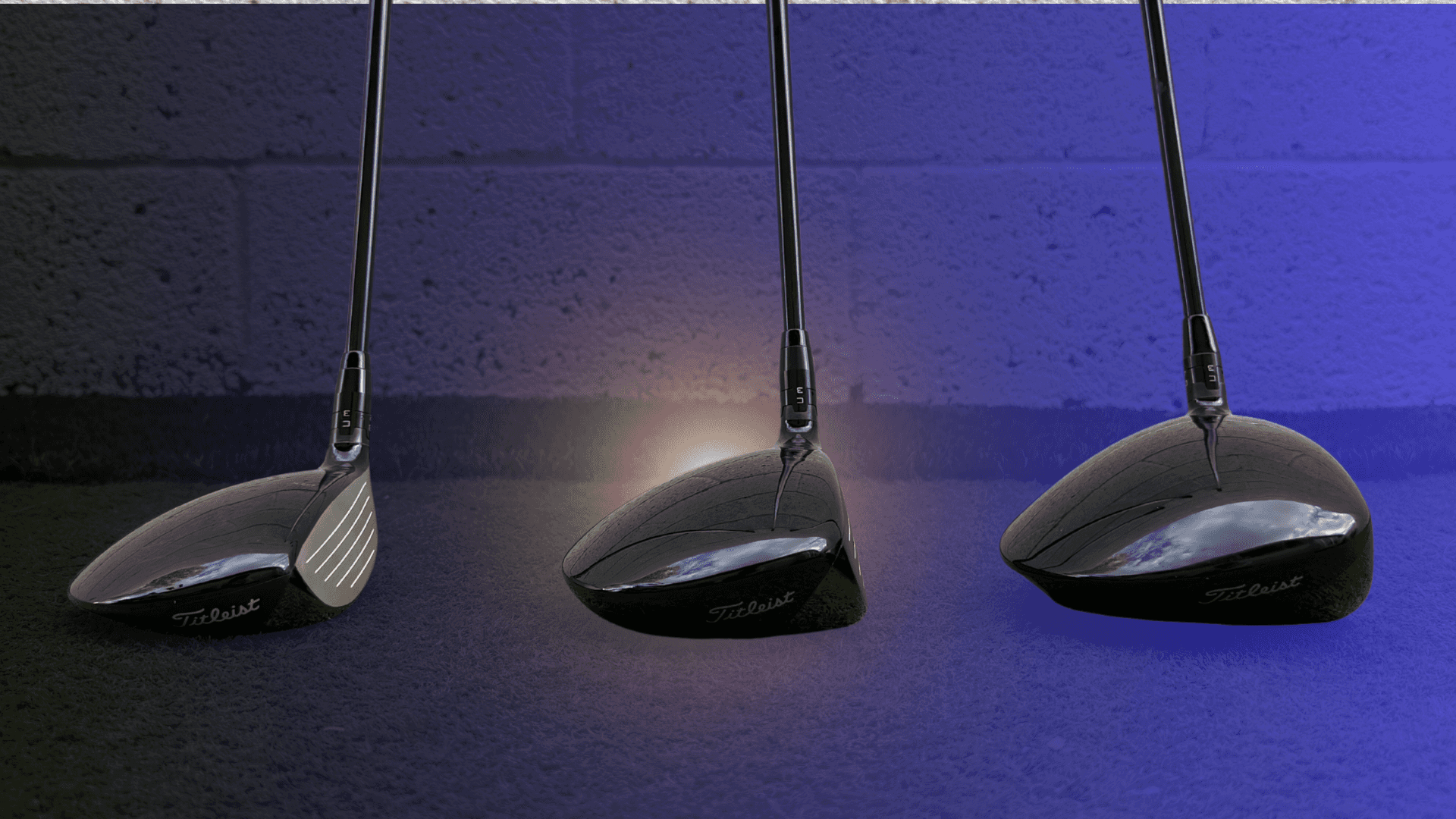
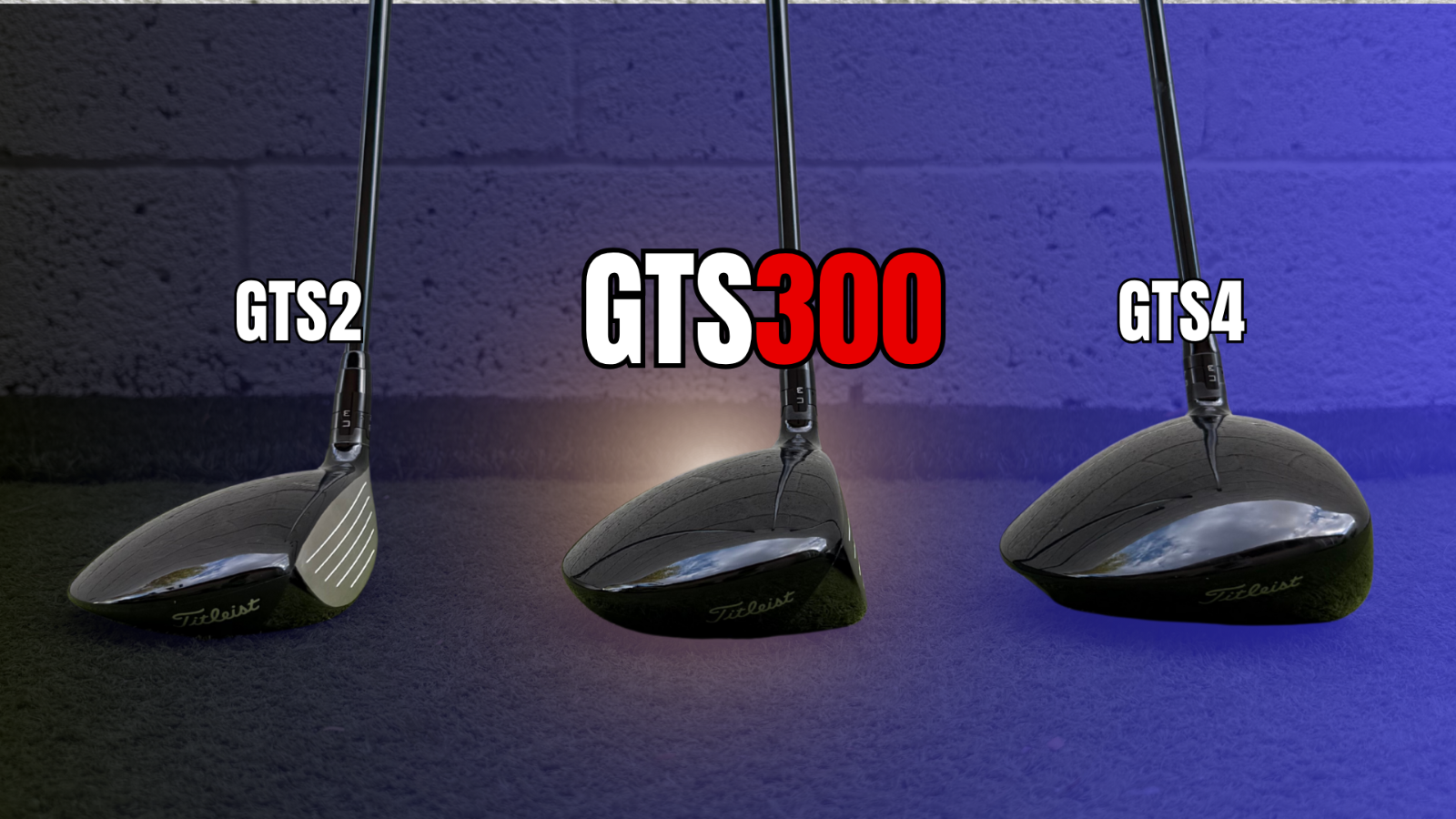
The top of the bag, left to right: GTS2 5-wood (16°), GTS300 Mini (13°), GTS4 driver (9°).
There's a question every golfer asks about a mini driver, and almost no review answers it with numbers: what does it actually replace?
I got the chance to answer it properly. A month before the GTS300 shipped to retail, I was fit into one at Titleist Performance Institute in Oceanside — the same fitting ecosystem that put a GTS4 driver and a GTS2 fairway in my bag. So when the club arrived, I took all three to Blades Golf Lounge in Phoenix and ran a gapping session on Foresight: the mini against the exact clubs it's supposed to sit between, fitted shafts across the board.
I went in expecting the standard mini-driver story — give up some distance off the tee, gain accuracy. My session said something more interesting.
What the GTS300 is (briefly)
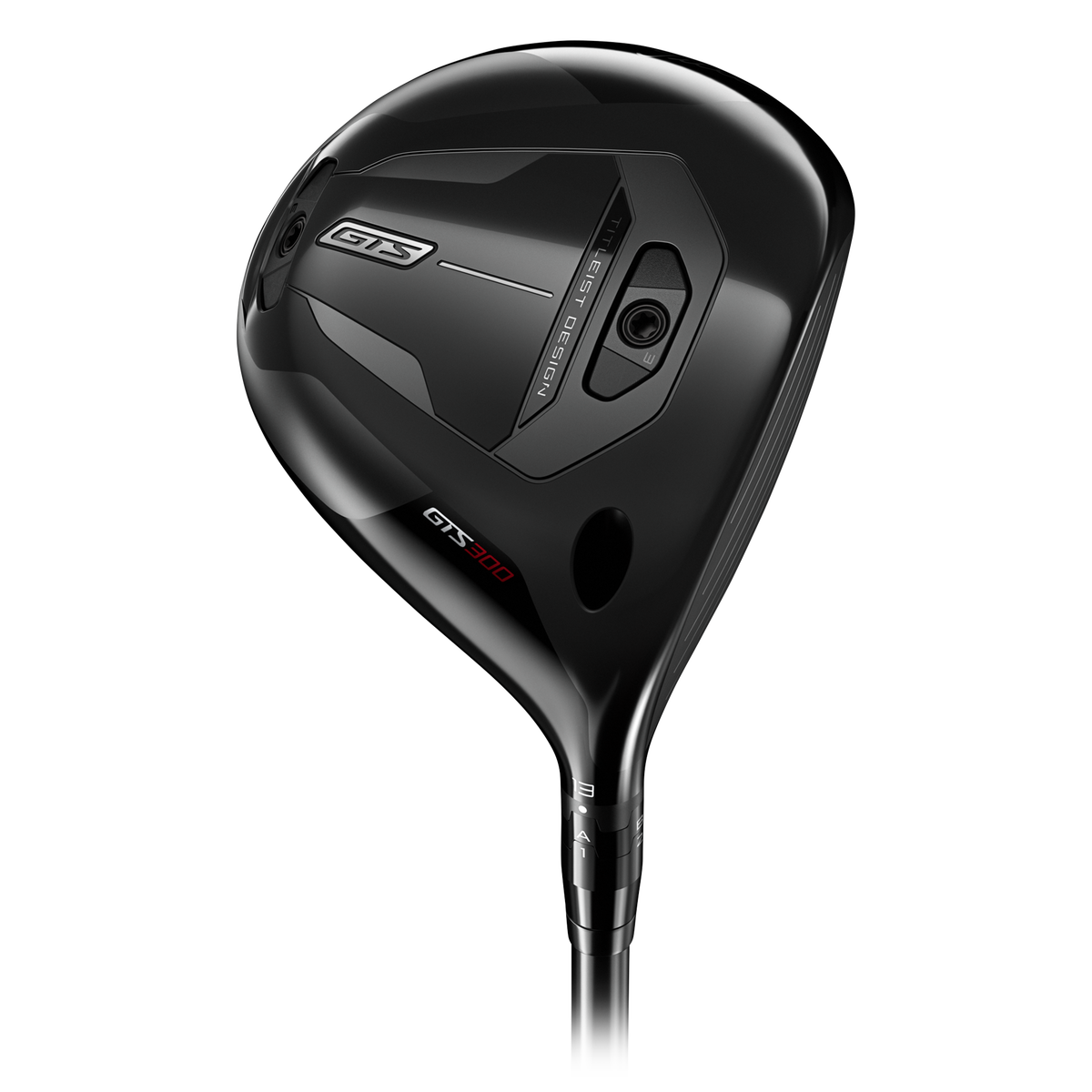
The GTS300 is the fourth member of Titleist's GTS metalwood family — same SureFit hosel ecosystem, dual weighting system, and aerodynamic shaping as the GTS drivers, in a 305cc head at 13° and a 43.5" build. Titleist says the deeper center of gravity produces 15–20% more inertia than last year's GT280, and the forged L-Cup face wraps under the sole to hold ball speed on low-face strikes — the strike you get from the turf.
The test
Three clubs, one Foresight session at Blades Golf Lounge, fitted shafts throughout:
| Club | Loft | Shaft | Length |
|---|---|---|---|
| GTS4 Driver | 9° (A1 setting) | Graphite Design Tour AD F1 6X | 45.5" |
| GTS300 Mini | 13° | Graphite Design Tour AD FI | 43.5" |
| GTS2 5-Wood | 16° (A1 setting) | Graphite Design Tour AD F1 X | — |
Five recorded shots per club per condition, averages reported — not career bests. The mini was tested both off the tee and off the deck, because those turned out to be two genuinely different clubs.
About the tester: 0.4 handicap index, 107 mph driver swing speed, 173-yard 7-iron carry. If your speed sits meaningfully above or below that, expect the absolute yardages to shift — but the relationships between clubs (flight windows, dispersion pattern, where the mini separates from the 5-wood) are the transferable part.
A note on the session: my driver averaged 158 mph ball speed and 259 carry here, below my season norms of 162 and 282. Read the gaps between clubs, which held consistent through the session, rather than the absolute yardages. Five swings per club is a fitting-bay sample, not a season of data — I'll keep updating as on-course results come in.
Off the tee: a trade, not a transformation
| Club | Ball Speed | Launch (VLA) | Spin | Side Spin | Avg Offline | Peak Height | Carry | Total |
|---|---|---|---|---|---|---|---|---|
| GTS4 Driver | 158.1 mph | 9.3° | 2,372 rpm | 301 rpm | 11.7 yds | 81 ft | 259 | 288 |
| GTS300 Mini | 149.9 mph | 11.5° | 2,932 rpm | 307 rpm | 9.4 yds | 85 ft | 246 | 265 |
| GTS2 5-Wood | 146.0 mph | 12.7° | 3,384 rpm | 206 rpm | 11.0 yds | 100 ft | 239 | 253 |
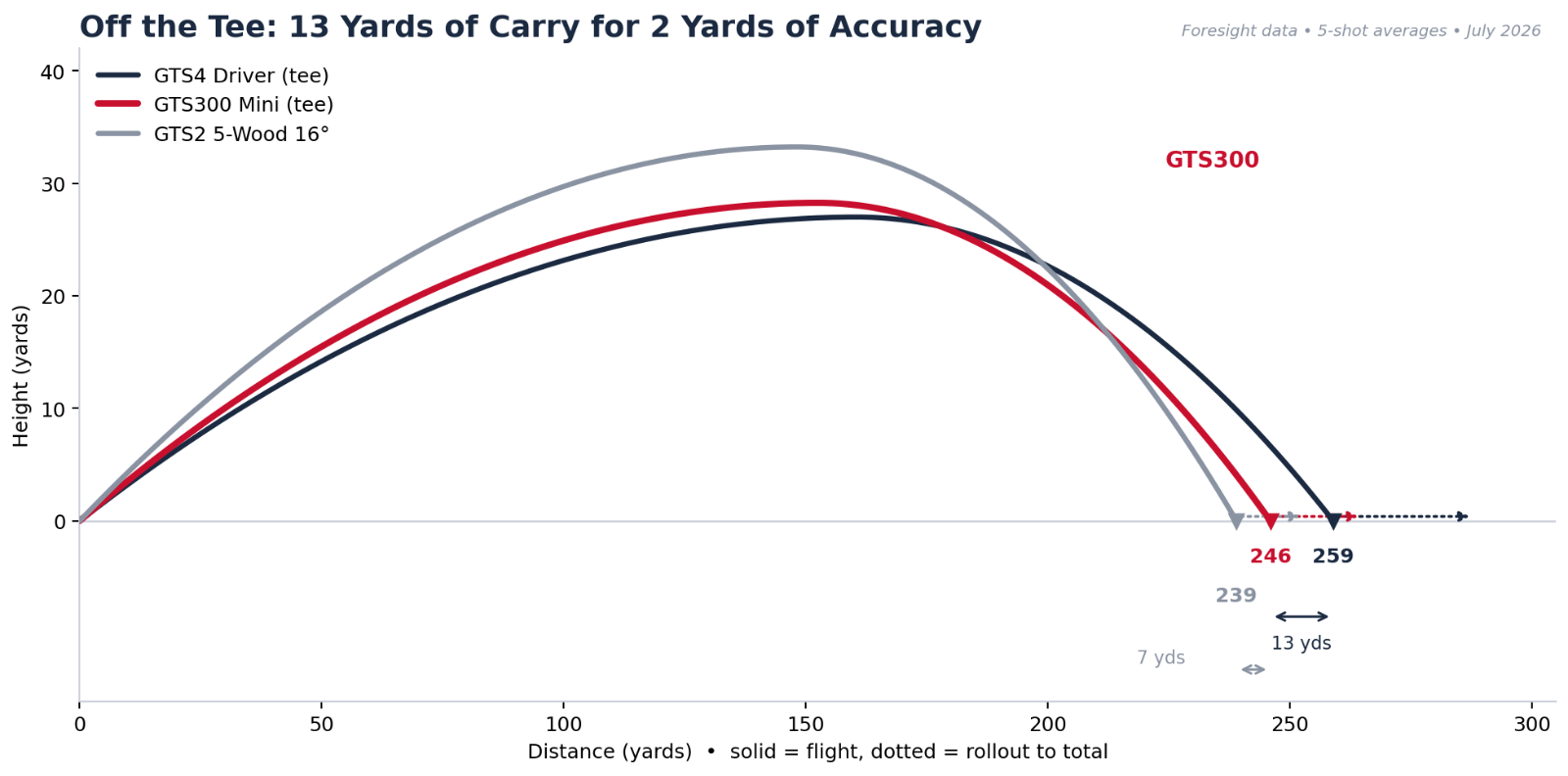
Off the tee, the mini gives up 13 yards of carry to the driver and buys back about two yards of average offline.
Here's the honest finding: the mini averaged 9.4 yards offline against my driver's 11.7 — about two yards tighter, a real gain of roughly 20%. But the price was 13 yards of carry and 23 of total, and side spin was a wash (307 vs. 301 rpm). Two yards of accuracy for 23 yards of distance is a trade, not a transformation.
That's one session and a small sample, and dispersion is exactly the stat that needs more swings to trust. But it tempers the assumption most golfers carry into a mini driver purchase — that shorter automatically means dramatically straighter. For my delivery, the tee gain was modest. If the mini earns tee-shot duty in my bag, it'll be on specific holes where 265 covers the number and a driver brings trouble into play — a yardage-and-margin play, not a blanket accuracy club.
The other detail worth noticing: the mini off the tee carried just 7 yards past my 5-wood (246 vs. 239). Off the tee alone, those two clubs are nearly redundant. Which makes what happened next the whole review.
Off the deck: where the club revealed itself
This is the shot Titleist built the L-Cup face for, and it's where my session flipped.
| Club | Ball Speed | Launch (VLA) | Spin | Side Spin | Avg Offline | Peak Height | Carry | Total |
|---|---|---|---|---|---|---|---|---|
| GTS300 Mini (deck) | 149.0 mph | 9.1° | 3,156 rpm | 119 rpm | 3.8 yds | 74 ft | 237 | 259 |
| GTS2 5-Wood | 146.0 mph | 12.7° | 3,384 rpm | 206 rpm | 11.0 yds | 100 ft | 239 | 253 |
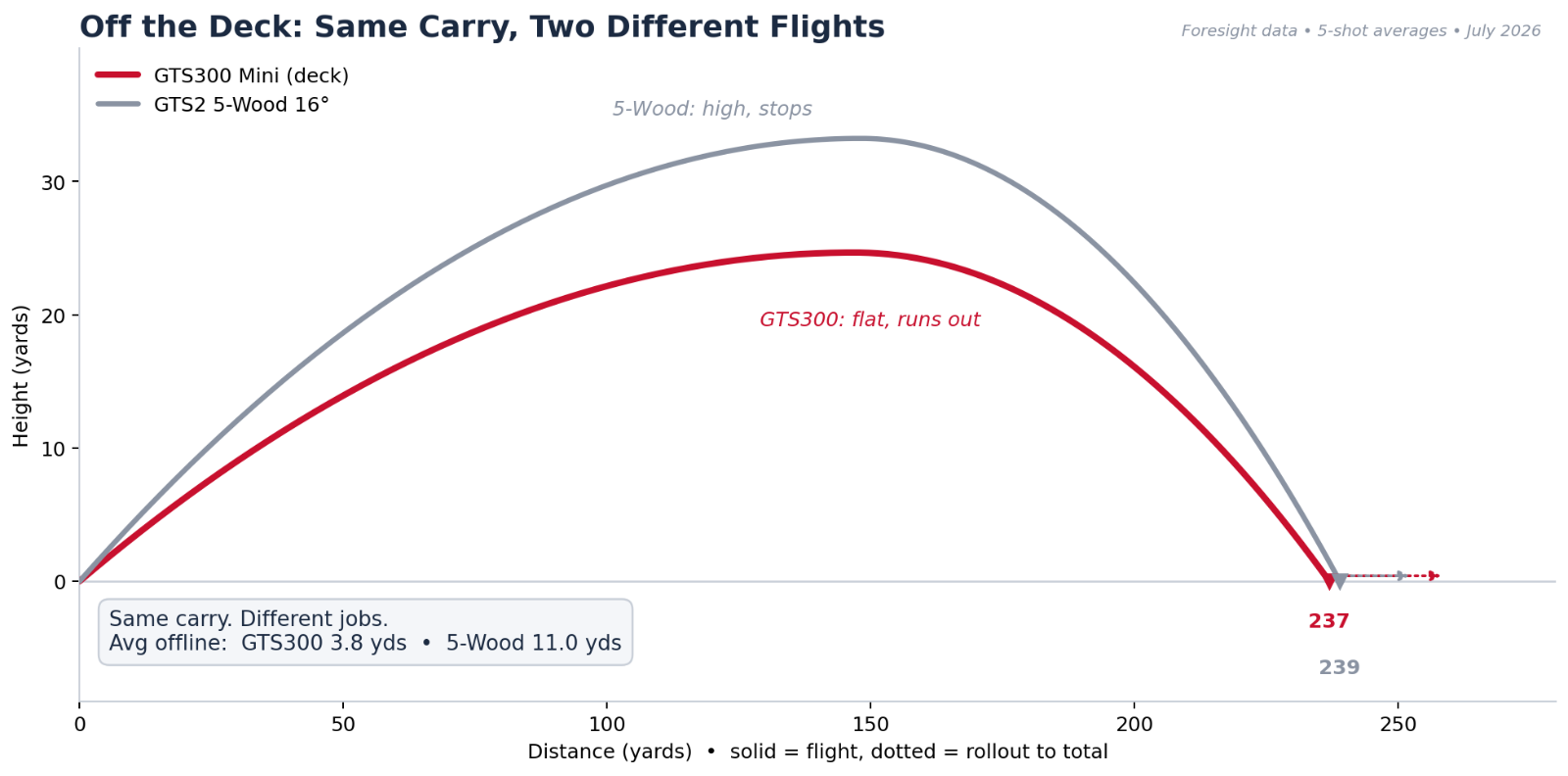
Same carry, two different flights — the 5-wood peaks at 100 feet and stops; the mini flies 25 feet lower and runs.
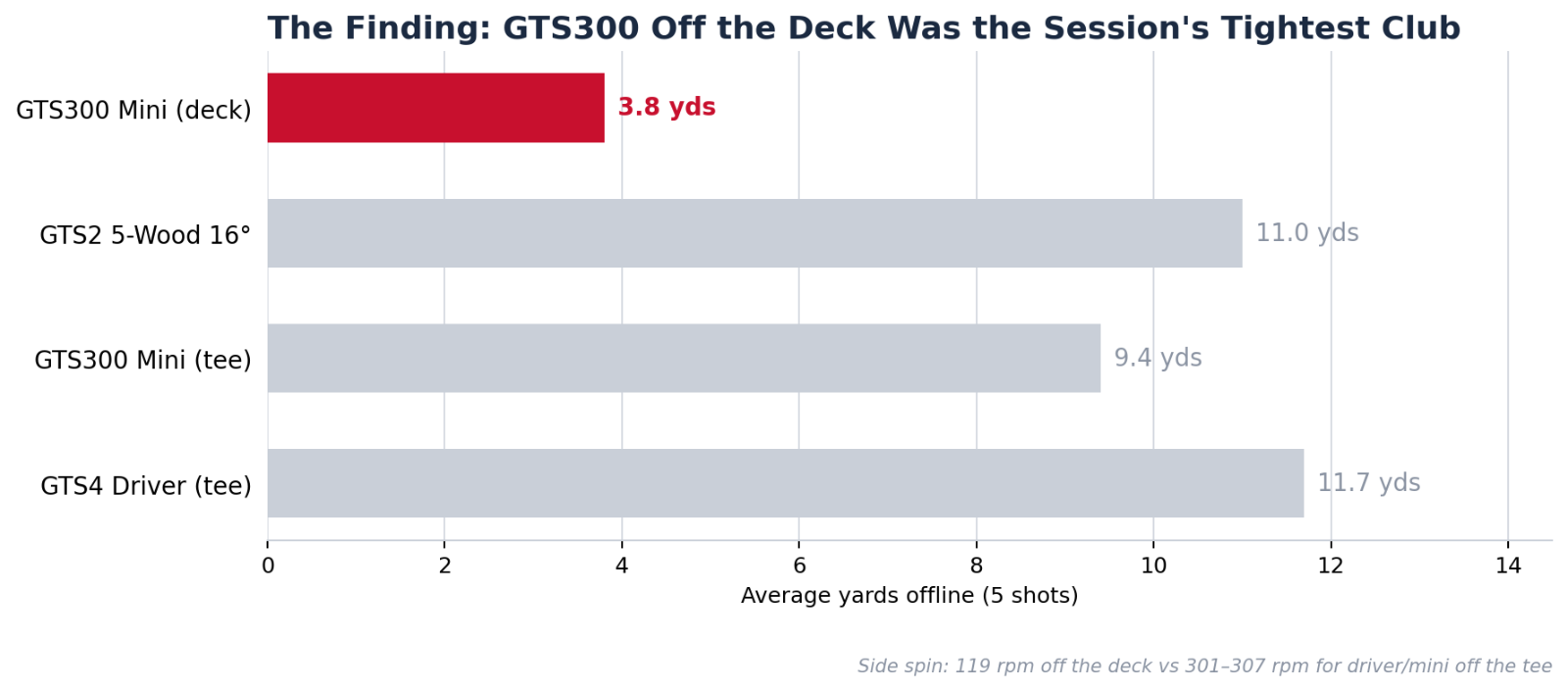
The finding: 3.8 yards of average offline made the GTS300 off the deck the tightest club of the session.
Off the turf, the GTS300 averaged 3.8 yards offline with 119 rpm of side spin — the tightest club of the entire session: three times tighter than my driver, and two and a half times tighter than the mini itself off a tee. The ball speed barely dropped from the teed condition (149.0 vs. 149.9 mph), which is the L-Cup face doing exactly what it's advertised to do on low-face strikes.
And look at the carry: 237 off the deck vs. 239 for my 5-wood. These two clubs aren't gapped by distance at all. They're gapped by flight: the 5-wood peaks at 100 feet, spins 3,400, and comes down steep — that's a club built to hold a green, which is exactly why it was fit into my bag. The mini peaks 25 feet lower, flies dead straight, and runs out 6 more yards — that's a club built to chase one onto a firm front, thread a window, or take the fear out of a long second shot with trouble on one side.
The sound tells the same story, and it surprised me. Off the tee, the GTS300 is my GTS4 — that muted, solid, very pure driver note I was fit into and love. Off the deck it changes: you can actually hear the ball compress, with more of a traditional metalwood crack to it. Same club, two sounds, two jobs.
Honest caveat: the mini still wants a reasonable lie. From light rough, or when the flag's tucked and the shot has to stop, the 5-wood's height and spin are still the play. The L-Cup face narrows the gap on imperfect strikes; it doesn't repeal physics.
The gapping ladder
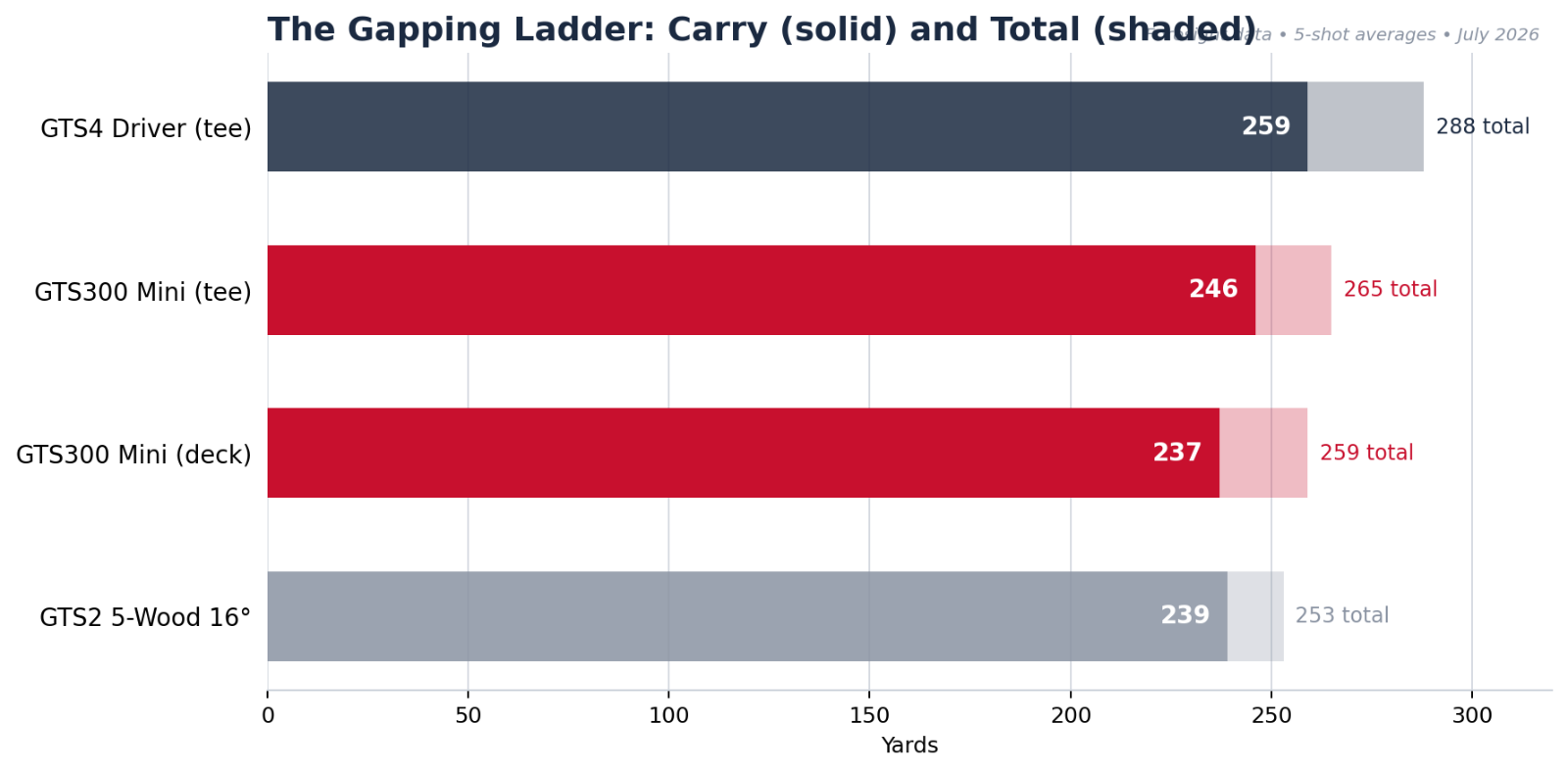
By total the ladder reads clean — 288, 265, 259, 253 — but everything under the driver carries within 9 yards.
| Slot | Club & Condition | Carry | Total |
|---|---|---|---|
| 1 | GTS4 Driver, tee | 259 | 288 |
| 2 | GTS300 Mini, tee | 246 | 265 |
| 3 | GTS2 5-Wood | 239 | 253 |
| 4 | GTS300 Mini, deck | 237 | 259 |
By total distance the ladder reads clean — 288, 265, 259, 253 — but the carry column tells the truer story: everything under the driver lives within 9 yards of carry. My top of bag isn't gapped by distance. It's gapped by shot type: the driver for max distance, the 5-wood for height and stopping power, and the mini for the straight, flat, running ball — from the fairway most of all.
That reframes Titleist's "almost a 15th club" line in a way I didn't expect going in. It's not one club doing two jobs. In my bag, it's one club doing a job nothing else could do: a 260-yard shot off the ground that misses by less than four yards.
The shaft matters more than usual
A note on the build, because stock-vs-fitted changes these numbers: my GTS300 runs a Graphite Design Tour AD FI — a stable, mid-launch control profile — matching the Tour AD family across my driver and fairway. At 43.5", shaft weight and profile shift strike and flight more than golfers expect, and my off-the-deck launch of 9.1° with spin in the low 3,000s is a fitted outcome, not a stock guarantee. If the gapping story here interests you, get fit — this club is unusually sensitive to it because it's asked to perform from two different turf interactions.
Who should bag the GTS300
You have the use case if:
You face long par-5 second shots or 240–260 yard approaches where a fairway wood's height isn't needed — or the miss matters more than the stop
You play firm, fast, or windy conditions where a 74-foot peak flight that runs is worth more than a 100-foot flight that drops
You rarely hit your 3-wood or 5-wood off the deck with confidence — the mini's bigger head and sole-wrapped face are more forgiving from the turf than they look
You want a positional tee club for specific holes and you're honest that it's a yardage play, not an accuracy guarantee
Think twice if:
You're buying it purely to find more fairways off the tee — my gain was about two yards of average offline against 23 yards of total distance given up; test that trade on a monitor for your own delivery before you commit
Your fairway wood already does everything you need from the deck and your approach shots need to stop
Your driver-to-fairway gap is under 30 yards of carry — mine turned out to be 20, and the mini earned its spot on shot shape, not spacing
Verdict
I was fit into the GTS300 expecting a fairway-finder off the tee. Five swings per club later, the tee case was real but modest — about two yards tighter than my driver, at a cost of 23 yards. The fairway case was the revelation: 5-wood carry with a third of the miss, on a flight that runs. Titleist calls it almost a 15th club. After this session, I'd drop the "almost" — it's in my bag, not as a second driver, but as the long club off the deck I've never had.
Kyle Rector is Managing Partner at AmateurGolf.com and a competitive mid-amateur (0.4 index). He was fit for the equipment in this review at Titleist Performance Institute.