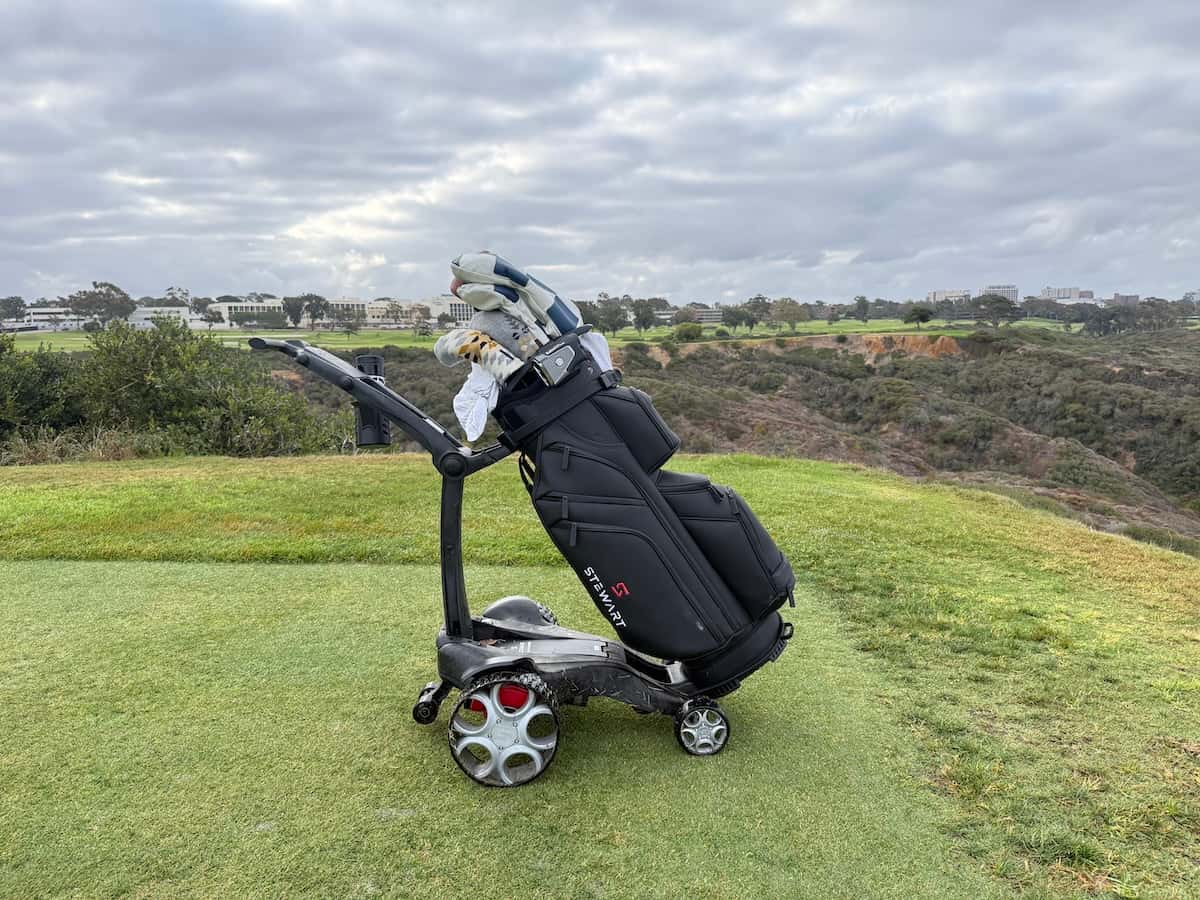
Golf Gear Myth Busters, Vol. 1: The "Follow Me" Electric Caddie
First in a series. Golf equipment is full of received wisdom — some of it earned, a lot of it repeated by people who've never touched the gear in question. In Myth Busters, we put the folklore up against the facts. We're starting with the most polarizing piece of equipment in the walking-golf world: the follow-me electric caddie.
Mention a follow-me cart in a golf forum and you'll get two reactions. From owners: quiet devotion. From everyone else: "No way would I want that thing chasing me around." One camp has used the technology. The other is guessing.
I've played with a conventional remote-control electric caddie and I've played with a true follow-me caddie. Full disclosure of my bias up front: having used both, there is no scenario in which I'd go back to an electric caddie that doesn't follow. But you don't have to take my word for it. Recently I stopped a player named Steve Brown, who's been gaming a Stewart follow cart for years — he bought it specifically because it follows. More on him in a minute.
Let's bust some myths.
Myth #1: "It'll run into you — or roll onto the green."
This is the number one objection from people who've never used one, and it's the first thing I asked Steve about.
"No, not when you're on follow me," he told me. "It follows like five yards behind you, and you stop, and it stops. It never runs into me."
That's not luck; it's the whole design. Stewart's system pairs a belt-clipped remote with the cart over Bluetooth, and the cart holds a fixed gap behind you — checking your position thousands of times per second, per Stewart Golf. GolfPass reviewer Jason Scott Deegan walked his Q Follow three city blocks from his house to his home course without incident.
As for greens: the cart doesn't sneak onto the putting surface, because you park it — same as you would a push cart. Steve's routine takes about two seconds: "I take this off my pocket, and I put this onto here — that disables the follow me, so it stays right there." Docking the remote on the cart parks it. That's not a workaround; that's the same etiquette every walker already practices.
Verdict: Busted. It stops when you stop, and it goes on the green exactly as often as you send it there.
Myth #2: "It's tricky to use."
You'll find this one in the forums, usually from someone extrapolating from a demo — or from a different brand. Here's what people who actually put in rounds say.
Breaking Eighty's reviewer: "It only takes about 3 holes to become baseline proficient," and after one full round it's "second nature." A MyGolfSpy forum tester who started out skeptical concluded flatly that "the follow technology works as advertised" — by his third round he'd stopped thinking about it. And Stewart CEO Mark Stewart says the first-use reaction is so consistent it's almost scripted: "You press the button, put it on your belt and start walking. It's that first realization — 'Oh, this is cool.'"
Then there's Steve, who is not a gadget guy, describing a machine he's operated for years with a two-second remote control docking motion. Using it is routine for him. The "learning curve" is one round, maybe two.
Verdict: Busted. If you can clip a rangefinder to your belt, you can operate a follow cart.
Myth #3: "It's a gimmick you'll stop using."
This is the "you'll use it twice and then it'll sit in the garage" theory. The evidence points the other way.
Steve researched the market years ago and bought his Stewart because it was "a truly follow me" cart — no cable, no tether — "and it operates as a normal golf cart as well." Years later, follow mode isn't the party trick; it's how he plays golf. On the Golf Simulator Forum, a Stewart X9 Follow owner reported using follow mode the vast majority of the time, called it "the feeling of having a caddy," and — telling detail — sold the cart after three years for nearly £1,000. Gimmicks don't hold resale value.
And here's the industry's own confession: for years, some trolley makers positioned remote control as all you need. The market kept asking for follow anyway — buyers on The Hackers Paradise forum report purchasing carts assuming they had follow, and new entrants like the camera-based Robera Pro keep piling into the category. Companies don't chase gimmicks for a decade. Stewart launched its first follow trolley, the X9 Follow, back in 2014 — twelve years of continuous development later, follow is the flagship feature, not a footnote.
Verdict: Busted. Owners don't retire follow mode. They stop noticing it's remarkable — which is the highest compliment gear can get. See video below.
Myth #4: "Remote control does everything follow does."
Half true — which is how the best myths survive. Yes, a remote-only cart can be driven anywhere a follow cart can go, and remote fans will point out you can send a remote cart ahead of you or park it outside the trees while you go hunting for your ball.
Here's what that argument misses: a follow cart is a remote cart. The Stewart Q Follow has three modes — follow, remote, and manual — and you flip between them at will. Trees left? Take the remote and drive it. Tight walk between a bunker and a pond? Remote. Everywhere else — which is 90 percent of your round — you press a button and forget the cart exists. Your hands are free, your shoulders are square, and your caddie keeps pace five yards back.
Buying remote-only to avoid follow is like buying a car without cruise control because you "like driving." Fine — but the feature costs you nothing when it's off, and it's glorious on the open road.
Verdict: Busted. Follow doesn't replace remote control; it includes it. The reverse is not true.
Myth #5: "Walking with a robot caddie isn't real exercise."
The purists' last stand: if you're not carrying or pushing, you're cheating. The science says otherwise. A study by Graeme Close, professor of human physiology at Liverpool John Moores University, found the difference in energy expended between carrying a bag, pushing a cart, or walking with a remote trolley was negligible. The exercise in golf comes from the four to five miles of walking — not from being your own pack mule. If anything, arriving at your ball unloaded and unfatigued is better for your swing on the back nine.
Verdict: Busted. You still walk every yard. You just walk it with your hands free and your spine thanking you.
Myth #6: "They're all the same — just buy the cheapest one."
Now for the myth on the other side. Not all follow tech is created equal. A CaddyTrek owner on one forum pegged his follow reliability at about 80 percent, with cart paths causing confusion. Reviewers of camera-based systems note wheel-spin on wet slopes and inconsistent bunker detection. Meanwhile, reviewers across the board — MyGolfSpy testers, Plugged In Golf, Breaking Eighty — keep landing in the same place on Stewart: the follow tech simply works, round after round, and Plugged In Golf went as far as calling the Q Follow "the best electric cart available."
That's my experience too. Stewart has been refining this one idea since 2014, it's patented, and it shows. You'll pay a premium — the Q Follow starts north of $2,000 — but as one reviewer put it, that's cheaper than the three $700 drivers some golfers will buy over the next few seasons, and this purchase actually changes every round you walk.
Verdict: Confirmed-ish — quality varies a lot. Which is exactly why the "follow is flaky" myth persists: people try a lesser system and blame the category.
The bottom line
Steve Brown did his research years ago, bought the Stewart because it was the only true follow cart he could find, and years later the most exotic feature in walking golf is just... his routine. Five yards back, stops when he stops, parks with a click.
The skeptics aren't lying — they're just reviewing a product they haven't used. That's the thing about golf equipment myths: they're sticky precisely because trying the gear is expensive and repeating the take is free.
We'll be doing this again. Got a piece of golf-gear folklore you want put to the test? Send it in.