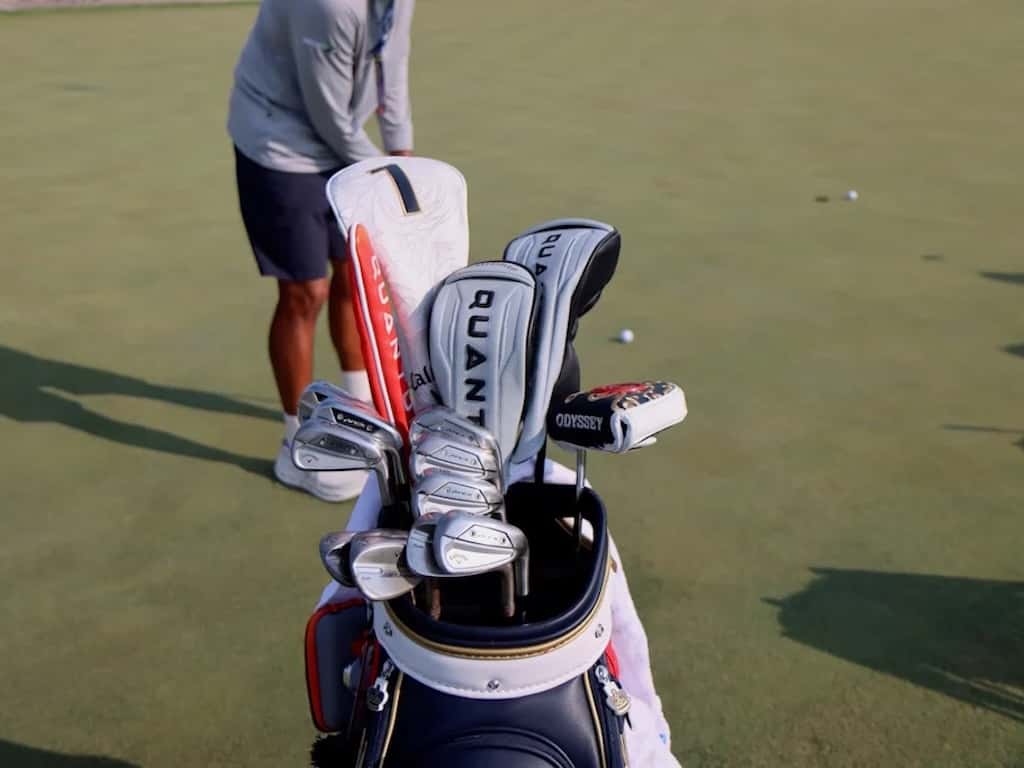
For about thirty years, the top of a good player's bag wrote itself.
Driver. Three-wood. Long iron or hybrid. You didn't deliberate over it any more than you deliberated over carrying a putter. The 15-degree 3-wood was furniture.
Walk a PGA Tour range in 2026 and that furniture has been rearranged. Not thrown out — rearranged. The best players in the world are pulling apart a club that used to do two jobs and handing those jobs to two different clubs, and the resulting bags look nothing like the ones their coaches grew up building.
It is the most interesting equipment story in professional golf right now. It is also, for once, a Tour trend that translates almost perfectly to competitive amateur golf — because the problem the pros are solving is a problem elite ams have too, and have mostly been ignoring.
The 3-wood isn't dying. Its job description is.
The traditional 3-wood was always a compromise club asked to cover two very different assignments.
Assignment one: the safe tee ball. Narrow hole, water down one side, wind off the left — take the driver out of play and put something in the fairway.
Assignment two: the long approach. Par 5 in two, or a 250-yard second shot into a par 4 that plays into the teeth of it.
Those assignments have almost nothing in common. One wants speed, forgiveness and a low, controlled flight from a perfect lie on a tee. The other wants launch, spin and a landing angle steep enough to hold a green — from a tight lie, or worse, out of rough.
For decades players accepted the compromise because there was nothing else to carry. Now there is. The mini driver took assignment one. The 5-, 7- and even 9-wood took assignment two. The 15-degree 3-wood is left holding the middle, and on a lot of weeks the middle isn't worth a slot.
The short version
A mini driver is 280–340cc and built to be teed. A 3-wood is roughly 150–175cc and built to be hit off both tee and turf. When you stop asking one club to do both, you get a better version of each.
Why the switch is happening now
1. Drivers got so good they ate the 3-wood's best excuse
The single biggest reason to reach for a 3-wood off the tee was fear. A miss with a 460cc driver used to cost you 40 yards and a penalty area. Today's heads — deeper CGs, wider MOI ranges, adjustable weighting, faces engineered to protect ball speed low and toward the toe — have shrunk that penalty dramatically.
When the bad driver is only modestly worse than the good 3-wood, the math stops favoring the layup. So players hit driver on holes where they used to hit 3-wood, and the 3-wood sits there logging fewer and fewer swings.
Ping's fitting research puts a blunt number on it, as PGA professional Jack Backhouse relayed to National Club Golfer: if you carry your driver more than 300 yards, your 3-wood is functionally a tee shot club, not a second shot club. That describes a large share of the Tour and a growing share of college and elite amateur golf.
2. Mini drivers took the tee shot outright
Once the 3-wood becomes a tee club, the obvious question is why it should look like a fairway wood at all.
Mini drivers answer that. Bigger head than a 3-wood, shorter shaft than a driver, lofts typically 11.5 to 13.5 degrees. You give up a couple of yards to driver and get back a swing you can make at 90 percent with a ball flight you can predict.
The category's growth is not a marketing story anymore, it's a count. Usage at the 2026 Dubai Desert Classic was up double digits year over year, with players like Dan Bradbury putting one in the bag for the first time. Titleist just replaced its 280cc GT280 with the larger, more forgiving 305cc GTS300 in July — a club shaped directly by feedback from Justin Thomas and Cameron Young, both of whom told the company the original was terrific off the turf but wanted more help on the mishit.
Thomas's use of it is the cleanest illustration of the whole trend. He deploys the mini on setups that don't demand a 3-wood off the deck — and because he has a reliable secondary tee club, he can run a longer, more aggressive shaft in his actual driver. The mini driver didn't just replace the 3-wood. It changed what the driver next to it could be.
Tommy Fleetwood, who has been carrying a TaylorMade mini since the original BRNR, sits in the other camp: he hits his off the deck too, and treats it as a genuine one-for-one 3-wood replacement. Those two models — pure tee club versus true replacement — are the two ways this decision goes, and knowing which one you are is the entire fitting conversation.
3. Landing angle beat distance in the argument nobody was having
Here is the part most amateurs still get wrong.
Less loft equals more distance is one of golf's most durable myths. Ball speed goes up with a stronger loft; carry only follows if you launch it high enough and spin it enough to keep it airborne. Fitters generally want a long-club landing angle somewhere in the 45-to-50-degree range. Below that, the ball lands hot, releases through the green, and the extra ball speed you paid for gets you nothing on a firm surface.
Tour setups in 2026 are firm and their greens are defended. A shot that lands at 38 degrees and runs is a bogey waiting to happen regardless of how far it flew. So players started adding loft — and discovered the higher-lofted woods were also easier to hit, easier from rough, and more forgiving on the heel and low-face strikes that make up most turf contact.
The tracking data backs it hard. Arccos, which logs shots from Tour level down to 25-handicaps, has found greens in regulation with a 7-wood running up to 70 percent higher than with a 3-hybrid from comparable distances. Over 20-plus rounds, GIR is about the best single predictor of your scoring average there is.
That is why the 9-wood — the club your grandfather was gently mocked for carrying — showed up at Augusta National this spring in Fleetwood's bag, with him describing it as a perfect 9-wood golf course. It launches high, lands steep, and stops. On a course built to reject shallow approaches, that's not a senior club. That's the correct club.
The evidence is in the winner's circle
If you want proof this isn't a range-only fashion, look at who won and what they carried in the top of the bag over the 2026 season's opening stretch:
Chris Gotterup — Sony Open and WM Phoenix Open, with a BRNR Mini and a 5-wood. No traditional 3-wood.
Scottie Scheffler — The American Express, carrying a 3-wood and a 7-wood.
Justin Rose — Farmers Insurance Open with a new 7-wood, alongside a 3-wood that's been in his bag since 2019.
Jacob Bridgeman — Genesis Invitational at Riviera with a high-launch 3-wood rather than a standard 15-degree.
Notice what that list actually says. Two of those four still carry a 3-wood. What none of them carry is a default 3-wood. Every one of those top-of-bag configurations was chosen against a specific set of golf courses. The trend isn't "abandon the 3-wood." The trend is that nothing at the top of the bag is automatic anymore.
The three architectures
The classic: Driver, 3-wood, hybrid, 4-iron. Still fine. Still the right answer for players who genuinely hit 3-wood off the deck and play in wind.
The specialist: Driver, mini driver, 5-wood, utility iron. Two dedicated tee clubs at the top, one dedicated approach wood, one club that flights down. Built for demanding driving courses.
The high-launch: Driver, 5-wood, 7-wood, 4-iron. No 3-wood at all. Built for firm greens and long par 4s where holding the surface matters more than reaching the par 5s in two.
A growing number of players rotate between the second and third depending on the week — mini driver at a tight, penal setup, swapped for another fairway wood when the golf course asks more approach questions than driving questions.
The RocketBallz hangover
There's a piece of history worth knowing here, because it explains why your own 3-wood may have quietly become unhittable.
When TaylorMade released the original RocketBallz fairway wood in 2012, it reset expectations for 3-wood distance and every manufacturer chased it. The category spent a decade optimizing for ball speed and low spin — great numbers on a launch monitor, and progressively harder to get airborne from a tight lie. Skeptics started calling the resulting flight "RollerBallz."
So when a competitive amateur says "I've never been able to hit my 3-wood off the ground," that's often not a swing flaw. It's a club that was engineered for a delivery most players can't produce, sitting in a bag because that slot has always said 3-wood.
What this actually means for competitive amateurs
Tour trends usually trickle down badly. This one doesn't — but it needs translating, because the elite amateur's situation differs from a Tour player's in four ways that matter.
You play worse lies than they do. Tour fairways are perfect and their rough is graduated. USGA qualifying rough is not, and neither is the second cut at your state am in August. The forgiveness argument for high-lofted woods gets stronger at your level, not weaker.
You don't have a truck. A Tour player reconfigures the top of the bag every Monday for free. You are buying a club and living with it for a season. That means you should fit for the courses where your season is decided — the qualifier, the state am, the club championship — not the course where you play your Tuesday game.
Your 14 slots are tighter. Pros can afford a club that plays four weeks a year. You can't. If a club isn't earning shots at the events that matter, it's taking a slot from a wedge you'd hit 40 times a season.
Your gaps are probably worse than you think. The most common finding when good amateurs get properly fit at the top of the bag isn't that they need a mini driver. It's that they have a 30-yard hole between their longest iron and their 3-wood, and a 12-yard overlap between their 3-wood and driver. That's exactly backwards.
The self-audit
Before you buy anything, go get five rounds of honest data. Then answer these:
How many times last season did you hit 3-wood off the deck — and how many of those finished on the green? If the answer is under ten swings, you own a tee club and should stop pretending otherwise.
What is your carry gap between driver and 3-wood? Under 25 yards and the 3-wood isn't buying you enough control to justify the slot. A mini driver, at 15 to 20 yards behind driver with meaningfully better dispersion, is a more useful gap.
What's your landing angle with your longest approach club? If it's under 40 degrees, you are not holding a firm green from 240 no matter how pure you strike it. Add loft.
Can you advance your longest iron or hybrid from rough? If not, a 7-wood is the single most valuable club you're not carrying.
Do the events that decide your season reward driving or approach play? A qualifier at a tight, tree-lined muni argues for the mini driver. A state am on a firm, long championship course argues for the high-launch build.
The case for keeping it
Honest counterpoint, because the trend piece nobody writes is the one where the old club is still right.
Keep the 3-wood if you play links or consistent wind — high launch is a liability when the ball has to be flighted, and a strong fairway wood you can hit low is a weapon at a coastal qualifier. Keep it if you genuinely hit it off the turf and reach par 5s with it, which for a legitimate plus-handicap is a real and repeatable shot. Keep it if you play drivable par 4s where you need something that carries 260 and stays under a tree line.
And if the only thing wrong with your 3-wood is that it launches too low, the cheapest fix in golf isn't a mini driver. It's a 16.5- or 17-degree high-launch head — sold as a 3HL, a strong 4-wood, or under whatever name your brand prefers. Most players lose two yards on their best strikes and gain ten on their average ones.
Worth noting: when a major gear outlet ran its 2026 staff through full fittings at every OEM, half the panel walked out with the same mini driver or 3-wood they already had. The trend is real. It is not a mandate.
Bottom line
The 3-wood isn't dead. It's been asked to justify itself for the first time in three decades, and on a lot of golf courses the honest answer is that two specialized clubs beat one compromise.
Tour players run that audit every week, with a truck, a fitter, and a launch monitor. You get to run it once, in the fall, before you build the bag you'll defend your season with.
So run it. Does your 3-wood still earn its spot — or has it just been there so long nobody's asked?