LIMA, PERU - It never rains at Lima Golf Club—ask anyone. Wedged between the Andes Mountains and the cold-water Humboldt Current of the Pacific, the coast of Peru is a climatological anomaly that continues to make it an attractive cradle of civilization. A foggy marine layer that burns away by mid-morning keeps the greens receptive and the flowers lush. The course has a modern sprinkler system, but in 1924 its keepers would simply flood the slightly higher northeast corner, by the hotel, and let the water gradually disseminate all 18. The city has built up around since, to the point the course is nearly shaded by high-rise condominiums. On the border holes, the incessant honking buzz of street life fills your backswing.
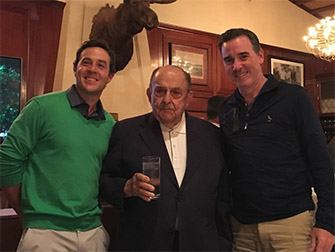
They have their own heroes. Carlos Raffo, 91, Jack Nicklaus called “the sweet swinger from Peru” on the range at the 1960 U.S. Amateur. The shine of Raffo’s trophy collection in the great room beside the bar is as overwhelming as any exhibit of pre-Colombian funerary headdresses at the national museum. Two of them are for winning the South American Amateur Championship, but you’re not sure which two.
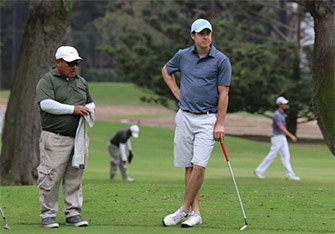
|
The author competing in Peru's International
Amateur Championship (Golf Digest photo) |
The other lost memo was about team uniforms. The duos from the Royal Ancient student team, the University of St. Andrews, and every country or club from South America dressed sharply in matching script. Our faux pas is awkwardly renewed each morning at the Country Club Hotel, when we sit down to a five-star breakfast of exotic fruits and see what everyone is wearing.
|
Welcome sign at Lima GC (Golf Digest photo)
|
Another team from the northern hemisphere is more suspicious. Bryan Hoops and Adam Walicki earned the right to represent the state of Arizona via a year-long points system, are veterans of this campeonato, and warn the sunlight is two-and-a-half times as powerful. One year an American didn’t apply sunscreen, no doubt lulled by the marine layer, and wound up in the hospital. Another silent killer is the effect of grain on breaking putts. Their parting shot is to beware the local drink, the pisco sour. The grape-based alcohol is mixed with lime, sugar and beaten egg white. It’s frothy and delicious with its potency dangerously masked.
|
Max Adler and Brian Krex with
Carlos Raffo (Golf Digest photo) |
Protecting you from such harm are the local caddies, who make $100 Sol (about $30 USD) per round. To witness one caddie rub sunscreen onto the forearms of a member playing a casual round is to briefly sense the weight of history, the punctuation point in this country being the 1533 slaying of the Incan emperor Atahuallpa by the Spanish conquistador Francisco Pizarro. But who serves who is a complex matter anywhere you go on this globe. To communicate with the caddie this week, you really only need to know five words; rapido (fast), despacio (slow), pare (stop), vuela (fly!) and ochenta (80). I’ll open with an ochenta, then follow with 76-76-71. If that sounds almost respectable, the problem is it adds up to +19.
About that strong connection with Lima Golf Club. In addition to a handful of shared members, Winged Foot’s director of instruction, Alicia Dibos, learned the game at Lima GC. The first two rounds we’re paired with Jaime Sarmiento, who grew up training alongside Dibos and forged his path to the United States with a golf scholarship to Southern Mississippi University. We have stories to trade about culture shock, but the thing about golf is that you find much more common ground. On overstuffed leather couches in the clubhouse, we watch live coverage of The Players Championship in Spanish with the sound muted. Perfecto.
Luis Fernando Barco, a homegrown talent of Lima GC and Peru’s highest ranked amateur golfer, won Winged Foot’s Anderson Memorial in 2014, and he’s the ganador of the 2018 Carlos Raffo and Manuela Prado Cups along with his partner, Konrad Brauckmeyer Sanchez (Barco shot 67 in the last round to overtake Rank, who carded 73: full scoring here). Barco plans to turn pro soon. His award ceremony morphs into a lively party. Women aren’t allowed in the main bar, but there’s a crush of females in fashionable clothes, presumably fans of Barco, and no one seems to mind.Like my putting, my Spanish was at its best in high school. On the shuttle to the airport, I have my most successful conversation of the week. Daniel Kenji Ishii tells me Gil Hanse’s Olympic course is in terrific shape and that he gets to play it nearly everyday with the Brazilian national team. Members of all golf clubs in Brazil can play it for $75 and out-of-owners for about $150.
That is the latest spikes-on-the-ground report from South America.