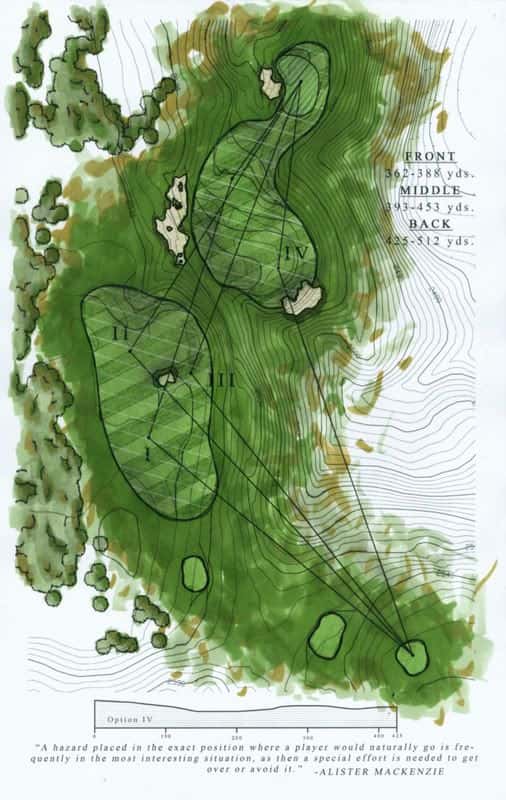


As a four-year-old, Jay Blasi drew golf holes in crayon on restaurant placemats. At 18, he told his local newspaper that his career goal was to design a course that would host a U.S. Open. Most kids' dreams don't survive contact with adulthood. Blasi's did: while still in his twenties, he was the project architect on Chambers Bay, the muscular links built on a reclaimed sand-and-gravel mine above Puget Sound that hosted the 2015 U.S. Open — the first newly built course in 45 years to land our national championship.
So how does that happen? How does a golf-obsessed kid actually become a golf course architect?
It's a question with no tidy answer, because the profession has no license, no bar exam, and — this surprises almost everyone — no degree.
"There's no real program for golf design. There's a few programs around the country that might have a professor who's been in the industry in some way, or might teach a class about it. But there's no kind of degree in golf course design."
The American Society of Golf Course Architects (ASGCA) says the same thing: no U.S. college offers a golf course architecture degree. Its members have arrived from landscape architecture, civil engineering, agronomy, golf course construction, and the professional game. But look closely at the résumés of the people actually building and rebuilding America's courses and three well-worn paths emerge: the drafting table, the bulldozer seat, and the maintenance barn. Blasi took the first. Here's how all three work — and how you'd get started on each.
- No degree exists. No U.S. college offers a golf course architecture degree — every architect assembles their own education.
- Three proven routes in: landscape architecture (the drafting table), shaping and construction (the bulldozer seat), and turfgrass science (the maintenance barn).
- The credential comes later. ASGCA membership requires 8+ years of experience, an in-person portfolio review, and three member sponsors.
- Renovation is the real job market. Most working architects restore existing courses — drainage, irrigation, and turf fluency win the commissions.
- The trade is taught master-to-apprentice. Get attached to a working architect, a shaping crew, or a maintenance barn.
Listen to the full podcast with Jay on the AmateurGolf.com Podcast:
The Drafting Table — Landscape Architecture and the Firm Apprenticeship
Blasi grew up in a golf family in Wisconsin — his father, a former caddie, put a plastic club in his crib, and a family friend who was a longtime club superintendent helped build a putting green in the backyard. He knew golf. What he didn't know was everything else.
"I knew golf, but I didn't know the difference between an oak or a maple tree," Blasi said. "Landscape architecture was the path that I had heard made the most sense. And so that's what I did. I enrolled at the University of Wisconsin and went into the landscape architecture program."
What a landscape architecture degree teaches is not golf — it's the underlying machinery of golf. "It taught you many of the necessary skills related to drainage and planning and scale," Blasi said. "Basically, as I was going through school, I was applying every lesson to golf. If we were doing drainage for a parking lot, I was thinking about how would that relate to a golf course. If we were designing a park, I would be translating that to what would that be like for golf."
That habit — translating everything to golf — is the real curriculum. Blasi worked at University Ridge, the University of Wisconsin's course, during high school. In college he talked a professor into an independent study designing a hypothetical second course there. He landed a summer internship with a Minneapolis golf architect. And when he graduated in 2000, that portfolio of self-directed golf work got him hired by Robert Trent Jones II, the Palo Alto firm led by one of the game's most famous names. He started on September 10, 2001, and stayed 11 years.
The firm apprenticeship is the classic version of this path, and it's how most of the big names came up. Kyle Phillips (Kingsbarns) earned a landscape architecture degree at Kansas State, then rose from design associate to vice president at the same RTJ II firm before going out on his own. Bruce Charlton, the firm's longtime chief design officer, came straight out of the University of Arizona's landscape architecture program. At Nicklaus Design, the traditional entry point is the production desk — drafting green details and routing studies by the hundreds; the firm has produced two dozen ASGCA members that way. Tom Fazio's shop gave starts to Beau Welling and to Jan Bel Jan, who spent more than 20 years there before opening her own practice.
Inside a firm, a young designer's job is to absorb everything and wait for a site. Blasi's came in 2003, when Pierce County, Washington, asked RTJ II to look at an exhausted gravel mine on Puget Sound. Blasi changed his holiday plans to walk the property two days before Christmas.
"Like many golfers who come now to play it, I was awestruck by the scale of the property," he said later. The firm's pitch, driven by the young project architect, was pure conviction about the land: "We had talked about creating a true links golf course, using fescue and not a watered-down Americanized version of a links course."
That instinct — read the site first, then get out of its way — became Blasi's signature. At Chambers Bay he pushed for a course with "no artificial drainage swales, minimal catchbasins, no artificial support mounding and no soft smooth bunkering." Even the tees: "I find tees to be the most unnatural part of the golf course. You never find a perfect flat circle or a perfect flat rectangle out in nature."

Since founding Jay Blasi Design in 2012, he has built a portfolio around maximizing what the land gives him. He led the celebrated renovation of SentryWorld in Stevens Point, Wisconsin — collaborating with his old mentors at RTJ II on the course Robert Trent Jones Jr. originally built in 1982, home of the famous flower-ringed 16th — and the course went on to host the 2023 U.S. Senior Open, with the 2028 U.S. Senior Women's Open on the calendar. At Santa Ana Country Club in Southern California, he rerouted an entire course on just 115 acres and cut more than 30 acres of irrigated turf. His logic travels well: "In golf, everything is site-specific — no two golf courses are the same. But the general idea or concept of only watering turf because it's in play? That translates anywhere." Recent work runs from Lakeside Country Club in Houston to two very public projects close to his adopted Bay Area home: the renovation of Golden Gate Park's nine-hole par 3 in San Francisco and the redesign of Poppy Ridge, the Northern California Golf Association's home course in Livermore.
If the drafting-table path appeals to you, the schools that matter are the accredited landscape architecture programs — and one of them towers over the rest as a golf pipeline. Cornell University has been producing golf architects since Robert Trent Jones Sr. arrived in 1928 and persuaded the school to let him invent his own course of study: landscape architecture, horticulture, surveying, agronomy, and art. (His papers — more than 200 boxes and 400 blueprints — now live in Cornell's library.) Two generations later, Cornell's Frederick Dreer Award funded both Tom Doak (1982) and Gil Hanse (1987) for a year abroad studying the great courses of Great Britain and Ireland; Hanse finished his Cornell master's in landscape architecture in 1989 and went to work for Doak before founding his own firm in 1993. When Hanse restored Los Angeles Country Club for the 2023 U.S. Open and built the Rio Olympic course, he was cashing checks written in Ithaca.
Beyond Cornell, the honor roll is scattered across the land-grant schools: Wisconsin (Blasi), Kansas State (Phillips), Kentucky (Drew Rogers, longtime Arthur Hills partner), and Virginia Tech, where Andrew Green — the man behind acclaimed restorations at Oak Hill, Congressional, and Inverness — completed the five-year landscape architecture degree and added a second degree in turfgrass science for good measure. No one hands you a golf specialty at any of them. Like Blasi, you bring the golf yourself.
The Bulldozer Seat — Shaping and Construction
Here is the path nobody's guidance counselor knows about: get on the machinery.
Modern golf design — especially the minimalist school that dominates today's acclaimed new courses — is done less on paper and more in the dirt, by "shapers" who sculpt greens, bunkers, and fairways with bulldozers and excavators. And the shaper's seat has become arguably the hottest on-ramp in golf architecture.
The lineage runs through Pete Dye, who famously built his courses by feel rather than blueprint. Bill Coore — who studied classical Greek at Wake Forest, about as far from turf science as a degree can get — joined Dye's construction crews in 1972 and spent roughly a decade building courses before designing his own. Tom Doak, after his Cornell year abroad (he caddied at St Andrews the summer of 1982, studying the Old Course from inside the ropes), went to work for Dye and learned to run a bulldozer. Coore & Crenshaw and Doak's Renaissance Golf Design then became academies themselves: their crews are stocked with shapers and associates who are now launching their own firms.
The examples keep multiplying. Keith Rhebb started with Landscapes Unlimited, the Nebraska giant that builds much of America's golf, before joining Coore & Crenshaw; his design-build renovation of the Winter Park 9, a humble Florida muni, became a national story and launched his partnership with fellow C&C alum Riley Johns. Kyle Franz studied turfgrass at Oregon State, worked construction on Pacific Dunes at 21, shaped on Coore & Crenshaw's 2010 restoration of Pinehurst No. 2, and parlayed that into his own celebrated restorations of Mid Pines and Pine Needles. Jim Craig, a longtime Coore & Crenshaw shaping specialist, is opening his first solo design at Sand Valley in Wisconsin. The pattern is consistent: years of anonymous, itinerant, physically demanding work — then a first small job, done brilliantly, that changes everything.
No path teaches you more about how a golf course actually gets built — and in the design-build era, the people with dirt under their fingernails are winning the commissions.
The trade-off is real. Shapers live on the road, follow construction seasons around the world, and may spend a decade executing other people's ideas. But no path teaches you more about how a golf course actually gets built, and in the current design-build era, the people with dirt under their fingernails are winning the commissions.
The Maintenance Barn — Agronomy and the Turf Schools
Blasi's story touches something aspiring architects consistently underestimate: how much of this profession is water, soil, and grass.
Drainage, irrigation, soil types — that knowledge has to come from somewhere, and the deepest reservoir of it is the turfgrass world. The turf schools are golf's other great feeder system, and they're a badly kept secret among people who actually run the industry. Penn State has offered its two-year golf course turfgrass management certificate since 1957, and its coursework goes far beyond mowing patterns — its irrigation and drainage course alone covers soil-water-plant relationships, water sources and quality, hydraulics, and system design. Michigan State's golf course certificate has been running since 1966 and has produced more than 2,000 graduates, with a curriculum spanning soils, irrigation systems, pathology, equipment, and even an introduction to course design. The Rutgers Professional Golf Turf Management School runs its famous "winter school" format — two 10-week classroom terms scheduled so students never miss a golf season on the job.
Plenty of architects have come out of that world. Michael Hurdzan, one of the most decorated architects of his generation, started with a turfgrass degree from Ohio State. Bobby Weed interned under Pete Dye, came up through the grow-in and superintendent side, and became the PGA Tour's chief architect before opening his own firm. Renaissance Golf Design's Brian Schneider spent his early years on the maintenance crews at Pine Valley, Augusta National, and Shinnecock Hills — a hands-on education in championship conditioning that most designers would kill for. And Andrew Green's turf degree, layered on top of landscape architecture, is exactly the double fluency that clubs hiring a restoration architect want in the room.
Even if you never push a fairway mower, understand what these programs teach, because you will be tested on it. When Blasi cut 30 acres of irrigated turf at Santa Ana, that was an agronomic decision as much as an aesthetic one. The architect who can't talk soils and water with a superintendent is a liability on site.
| Path | Typical education | First job | Names who took it |
|---|---|---|---|
| 1. The Drafting Table | Landscape architecture (Cornell, Wisconsin, Kansas State, Virginia Tech) | Design intern / production desk at a firm | Jay Blasi, Gil Hanse, Kyle Phillips, Andrew Green |
| 2. The Bulldozer Seat | None required — construction and shaping experience | Construction crew / shaper | Bill Coore, Tom Doak, Kyle Franz, Keith Rhebb, Angela Moser |
| 3. The Maintenance Barn | Turfgrass science (Penn State, Michigan State, Rutgers, Ohio State) | Maintenance crew / assistant superintendent | Michael Hurdzan, Bobby Weed, Brian Schneider |
The Credential: What ASGCA Membership Actually Takes
There's no license, but there is a fraternity — and its standards explain why this profession stays so small. The American Society of Golf Course Architects, founded in 1947 by a group that included Robert Trent Jones Sr. with Donald Ross as honorary president, requires prospective members to show at least eight years of practical golf-architecture experience, present a portfolio of completed work that members visit and evaluate in person, and secure sponsorship from three current members — a vetting process that typically takes about two years. Membership is a mid-career achievement, not an entry ticket. Only a few hundred people have ever earned it.
Europe took a different approach worth knowing about: the European Institute of Golf Course Architects runs an actual school — a two-year vocational qualification in golf course design combining online study, workshops, mentored placements with member firms, and a minimum of 80 days working under a practicing architect. For a young American willing to cross the Atlantic, it is the closest thing on earth to a golf design degree. (The University of Edinburgh once offered a postgraduate golf architecture program, but it has been discontinued.)
Is It Still a Man's World?
Honestly? Mostly, yes — the numbers are stark. A 2021 industry survey found just two women among the ASGCA's roughly 170 members, and only four women had ever been elected to the society in its history. But the women who have broken through have left outsized marks on the game.
Start with Alice Dye, who became the ASGCA's first female member in 1983 and its first female president in 1997. Working alongside husband Pete, she conceived the most famous hole in American golf — the island-green 17th at TPC Sawgrass — and her decades-long crusade for properly placed forward tees changed how courses serve the majority of golfers. Jan Bel Jan, who followed her as the society's second female president in 2019, came up through a landscape architecture degree at West Virginia and those 20-plus years with Fazio. And the historical record runs deeper than most golfers know: Marion Hollins, the 1921 U.S. Women's Amateur champion, was the developer and driving force behind both Cypress Point and Pasatiempo — when Alister MacKenzie doubted the ocean carry that became Cypress Point's legendary 16th, Hollins teed up a ball and carried the cove herself. She entered the World Golf Hall of Fame with the Class of 2021.

Today the pipeline finally shows signs of life, and tellingly, the women coming through are using all three paths described above. Angela Moser, a German landscape architecture graduate, built her career as a shaper for Tom Doak and served as his lead associate on Pinehurst No. 10 — running an 18-hole build at one of American golf's marquee resorts. Christine Fraser earned a master's in landscape architecture at Guelph, apprenticed five years under Martin Hawtree in England, and became the first woman to hold the lead design role on a Canadian course renovation. Kari Haug, a Minnesota landscape architect who trained in Scotland, practices as a member of the EIGCA. Cynthia Dye McGarey carries the Dye family tradition forward as a principal at Dye Designs. The field is still overwhelmingly male. It is no longer exclusively so, and every one of these women got in through a door — school, shaping, apprenticeship — that's open to anyone reading this.
The Honest Outlook — and How to Start
A dose of realism: this is a small profession attached to a cyclical business. The National Golf Foundation counts the current U.S. development pipeline as the busiest since 2013 — and yet that means roughly two dozen new-course openings in a good half-year, versus 400 a year during the late-1990s bubble. The everyday work of American golf architecture is renovation and restoration of existing courses, which is exactly why the drainage-irrigation-agronomy fluency Blasi describes matters so much. A renovation architect spends more time solving water problems than sketching dream holes.
So, distilled from every path above, the starter kit: play and study great architecture obsessively — travel is not optional, and nearly every architect in this story invested in a pilgrimage to the great courses of Britain and Ireland. Get any job that puts you near golf dirt: a maintenance crew, a construction company, a pro shop at a course being renovated. Learn to draw, learn CAD, and if you can, learn to run a dozer. Pick a degree — landscape architecture or turfgrass science — and do what Blasi did with it: translate every single lesson to golf. Then get yourself attached to a working architect, because this trade is still taught the medieval way, master to apprentice.
- Study great architecture obsessively. Travel is not optional — nearly every architect in this story made the pilgrimage to the great courses of Britain and Ireland.
- Get any job near golf dirt. A maintenance crew, a construction company, a pro shop at a course being renovated.
- Learn the tools. Drawing, CAD — and if you can, a bulldozer.
- Pick a degree and translate it. Landscape architecture or turfgrass science, applying every single lesson to golf, the way Blasi did.
- Attach yourself to a working architect. The trade is still taught the medieval way, master to apprentice.
And be stubborn about the dream, because the dream is the qualification nobody can teach. Blasi drew holes on placemats at four, declared his U.S. Open ambition at 18, and made good on it at Chambers Bay before his 30th birthday.
My passion is great golf. I don't have an interest in mediocre golf.
Somewhere out there, a kid is drawing golf holes on a placemat. This is the map.

Becoming a Golf Course Architect: FAQ
Do you need a degree to become a golf course architect?
No — no U.S. college offers a golf course architecture degree, and the profession has no license or exam. Most working architects earned degrees in landscape architecture or turfgrass science and applied every lesson to golf, while others came up entirely through construction and shaping.
What degree is best for golf course architecture?
Landscape architecture is the classic route — it teaches drainage, grading, planning, and scale. Cornell, Wisconsin, Kansas State, Kentucky, and Virginia Tech have all produced prominent golf architects. Turfgrass science is the other proven degree, and architects like Andrew Green hold both.
Is there a school specifically for golf course design?
Only in Europe. The European Institute of Golf Course Architects (EIGCA) runs a two-year vocational qualification combining online study, workshops, and a minimum of 80 days working under a practicing architect — the closest thing on earth to a golf design degree.
How long does it take to become a golf course architect?
Plan on a decade or more. ASGCA membership — the profession's credential — requires at least eight years of practical golf-architecture experience, an in-person portfolio review, three member sponsors, and a vetting process that typically takes about two years.
What is a golf course shaper?
A shaper sculpts greens, bunkers, and fairways with bulldozers and excavators, translating an architect's vision into dirt. In today's design-build era it has become arguably the hottest on-ramp into golf architecture — Bill Coore, Tom Doak, Kyle Franz, and Angela Moser all came up this way.
How do I get started with no experience?
Get near golf dirt: join a maintenance crew, a golf construction company, or a course mid-renovation. Study great courses obsessively, learn to draw and use CAD, learn to run machinery if you can, and work toward an apprenticeship with a practicing architect — the trade is still taught master to apprentice.