Disclosure: Fujikura is a sponsor of AmateurGolf.com. This guide uses manufacturer specifications and our editorial fitting recommendations. It is not a head-to-head player test.
A competitive amateur does not need a new 7-iron that occasionally flies eight yards farther. He or she needs to know which swing produces the stock number, what happens on a thin strike, and whether the flighted shot still finishes pin-high.
That is the standard an iron-shaft change should meet. A great feel in the fitting bay is a promising start. It is not the entire case for rebuilding the set.
A recent golfer question captures the decision: a player using KBS $-Taper 120 S, reporting a 7-iron speed around 89–90 mph, wanted to choose between Fujikura AXIOM 105X and 125S. The player asked what should go in the wedges, too. It is a useful starting point, but the bigger question matters to more tournament golfers: what should you test before moving from familiar steel shafts to graphite?
AXIOM 105X and 125S are worth comparing if both are realistic fitting candidates. Treat the lighter model as a test of a different weight setup, not an automatic distance upgrade. Include 125X when your current heavy X-flex build or fitting results justify it. Judge the finished clubs by repeatable carry, playable misses, and the shots you use in competition.
Fujikura AXIOM 105X vs. 125S: what actually changes?
The comparison changes weight and flex together. It cannot isolate what either variable does to your swing. A preference for one build does not prove that lighter is better, or that an X label is the reason it worked.
| Published specification | AXIOM 105X | AXIOM 125S | AXIOM 125X |
|---|---|---|---|
| Flex designation | X | S | X |
| 7-iron taper-tip shaft weight | 103g | 123g | 124g |
| 7-iron taper-tip torque | 1.4° | 1.5° | 1.3° |
| Manufacturer launch category | Mid/low | Mid/low | Mid/low |
| Manufacturer spin category | Mid/low | Low | Low |
Source: Fujikura AXIOM specifications, checked November 14, 2026. These are listed shaft specifications, not assembled club weights or measured ball-flight results. All three 7-iron entries above use the taper-tip table.
For the player asking this question, our suggested first comparison would be the current club against a 125S build, then a 105X build. That provides a heavier graphite reference before testing the larger move in weight. Reverse the order on a later block so familiarity and fatigue do not get mistaken for a shaft advantage.
For a golfer happy with a 130g X-flex steel setup, the shortlist deserves a fresh look. There is no reason to exclude 125X just to preserve an internet debate between two other models. Ask the fitter to choose candidates around the current club and the problem being solved.
Moving from KBS $-Taper 120: define the reason first
KBS lists $-Taper S at 120g and describes the family as mid-trajectory and low-spin. Those descriptions do not establish equivalence with an AXIOM model. Use your existing assembled iron as the control club, with its actual length, loft, lie, grip, total weight, and swingweight recorded.
Write down the reason for changing before hitting the first demo. Is the concern effort late in a long day? Strike consistency? An uncomfortable impact sensation? A long iron that is difficult to flight? A shaft change should answer something more concrete than a desire to try graphite.
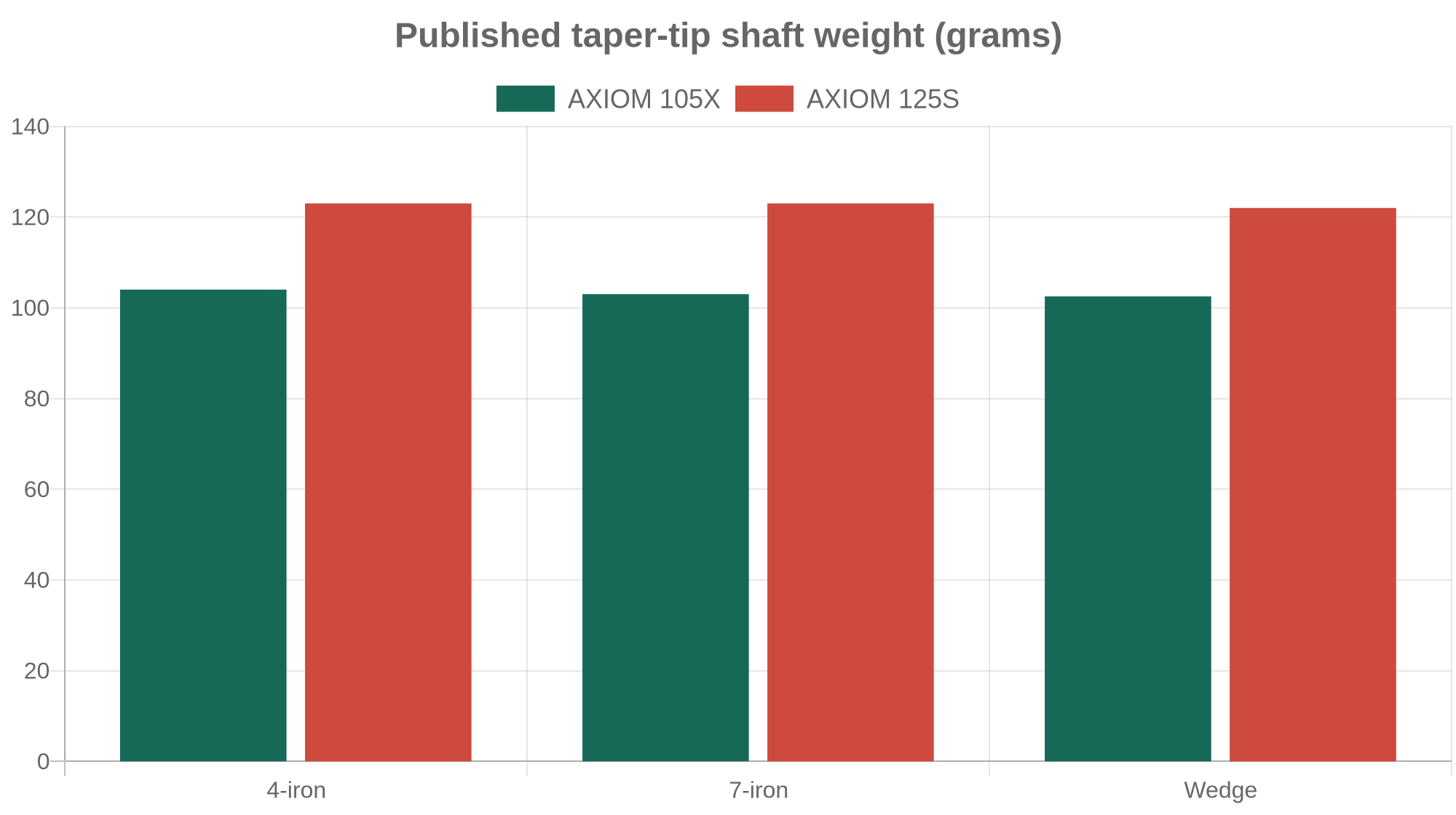
The fitting question is what the weight change lets you repeat. Does the lighter build make your normal swing feel easier without widening your carry pattern? Does the heavier build make the head easier to locate through transition? Does either force you to manufacture a tempo that will be difficult to trust on the 17th hole?
Do not treat “easy to swing” and “easy to score with” as interchangeable. Record both.
What VeloCore brings to the conversation
Fujikura describes VeloCore as a multi-material bias-core construction intended to improve stability through transition and impact. AXIOM uses an iron-specific application of that technology. Those are design claims; they do not supply a measured dispersion advantage for the golfer reading this story. See Fujikura’s technology and education overview.
For our audience, the value of that engineering is the opportunity to test a different combination of weight and response. The fitter still has to demonstrate that the resulting club serves the player.
That distinction makes a stronger case for a premium shaft than promising it will beat steel for everyone. A tournament golfer can accept a product that needs fitting. A claim that every player gains distance and accuracy deserves much more evidence.
Why torque is not a dispersion score
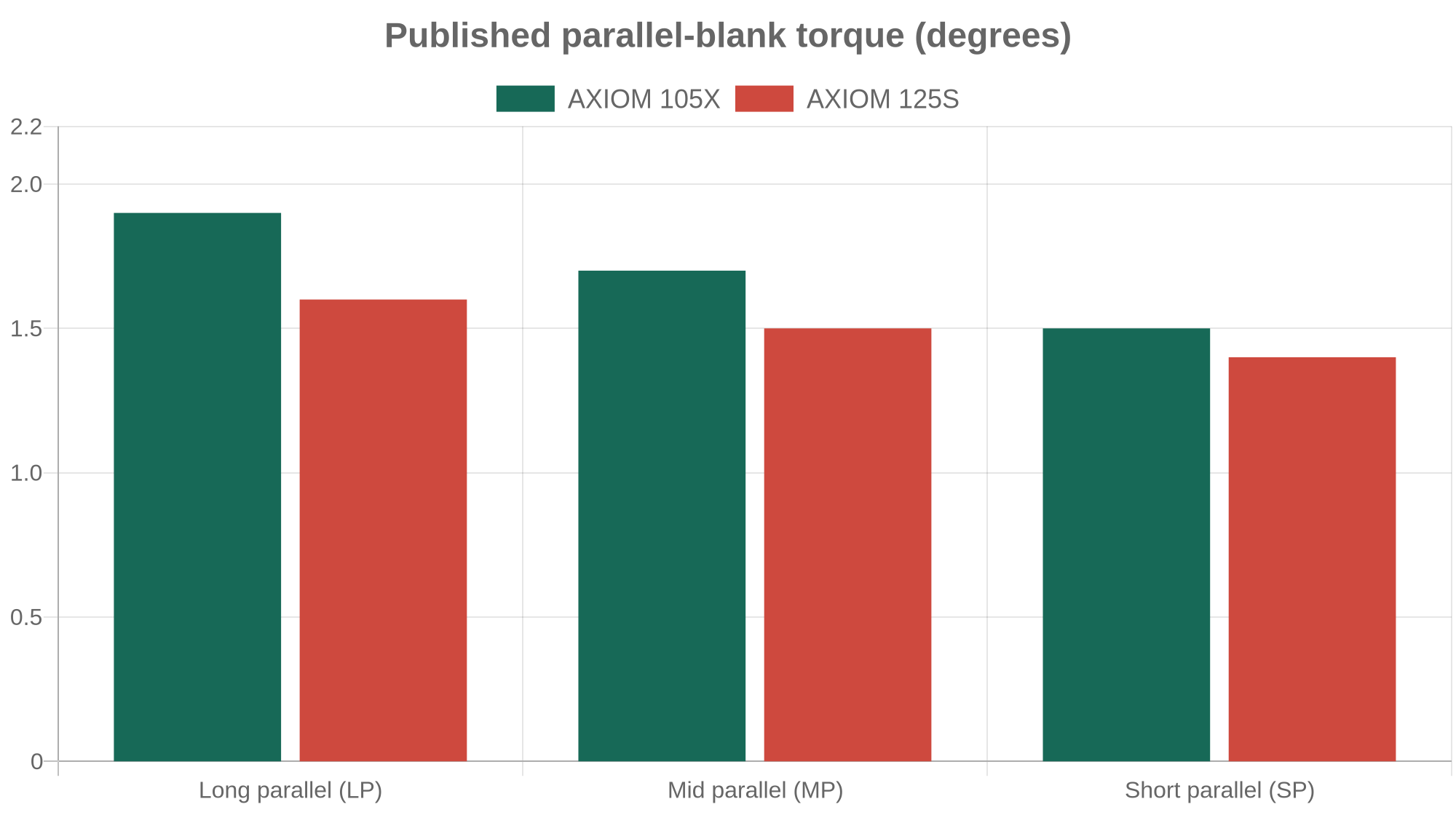
A specification chart helps identify what is being compared. It cannot tell you which club will keep a tucked flag in play.
Keep the configuration attached to every number. The 7-iron taper-tip entries and the mid-parallel blanks are not interchangeable rows. Neither table is a measured map of the ball’s landing positions.
We have not established a controlled 105X-versus-125S performance result for this article. There is no defensible basis here for drawing a tighter shot pattern around one model, assigning it extra yards, or promising a spin reduction in rpm. The charts show product specifications only.
The fitting scorecard for competitive amateurs
Our recommendation is to decide what a successful fitting looks like before the session. The following scorecard keeps attention on the shots that matter when a scorecard is in your pocket.
| Test | Record | Decision it supports |
|---|---|---|
| Stock 7-iron | Median carry, carry spread, left/right finish, strike location | Can you trust the stock yardage and miss? |
| Flighted approach | Launch, peak height, carry and intended finish | Can you take speed off without losing the shot? |
| Longest iron you use into greens | Carry, landing angle and strike pattern | Does the club still serve its approach role? |
| Short iron | Distance variation and directional misses | Does the change work in the scoring clubs? |
| Late-session repeat | Same stock-shot measurements, plus effort | Does the early preference survive another block? |
| Partial wedge | Carry at familiar swing lengths and strike quality | Does the bottom of the bag retain useful spacing? |
Median carry gives you a central number. The spread tells you how often the club delivers something close to it. Keep short/long and left/right variation separate; a tidy average can hide misses on both sides.
Watch the poor strikes you are likely to hit in competition. A fitting that retains only flushed shots answers a much narrower question. Mark obvious measurement failures and interruptions, but agree on exclusions before looking at which shaft benefits.
A longer median is useful only if the new gaps and stopping behavior work. A single impressive shot should never decide a full-set purchase.
How to run a useful AXIOM test
- Start with the gamer. Warm up, then record a baseline using the ball model you play.
- Control the build. Use the same head model, measured loft, playing length and grip for the candidates. Have the fitter record total weight and swingweight rather than assuming they match.
- Alternate short blocks. As a practical starting point, use three blocks of five recorded shots per candidate, with rest and a changing order. This is a fitting screen, not a statistically conclusive experiment.
- Keep a shot-level record. Save the launch-monitor export and mark the intended shot. Do not mix stock swings and knockdowns into one average.
- Retest the finalists. Bring back the current club. Confirm the preference with a long iron, a short iron and partial shots, ideally across a second session and from turf.
If the fitter adjusts head weight to improve one build, document it. That may produce the best club, which is the objective. It changes the claim you can make: the finished build won your test; the shaft alone was not isolated.
What shafts should go in the wedges?
The wedge question in the original post belongs in the fitting, not at the checkout counter. Our suggested approach is to separate the pitching wedge or full-swing gap wedge from the clubs used mostly for touch shots.
Test three routes: continue the iron-shaft setup into the appropriate wedges, keep a current steel wedge setup that already performs, or fit a dedicated wedge shaft. None should win on matching graphics alone.
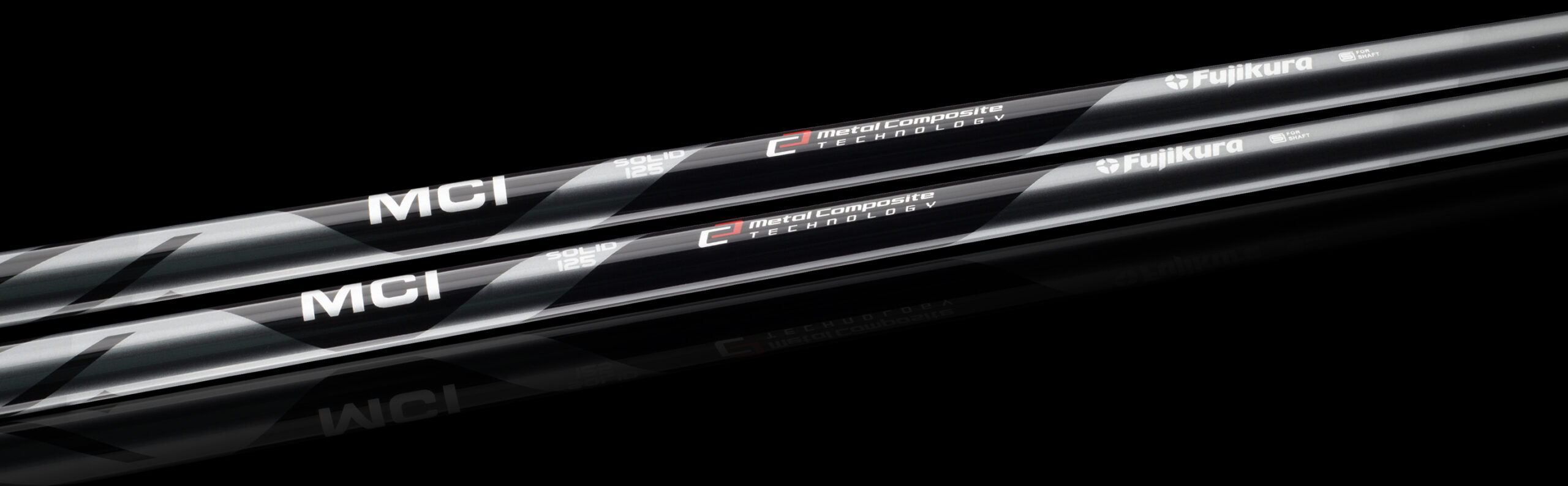
Fujikura offers MCI Wedge in Solid and Mild versions, positioning Solid for more spin than Mild. Those are manufacturer descriptions, not a guarantee about your half-wedge. Confirm the exact model and weight with the fitter; the current page’s introductory weight labels and specification-table labels are inconsistent.
For the wedge you hit at a full number, test the gap from the preceding iron. For the sand and lob wedges, use familiar landing spots, partial swing lengths, bunker shots and open-face shots. Record whether the new build makes those tasks easier to repeat.
Installation matters here. Fujikura publishes a distinct AXIOM trimming sequence that restarts across the long-, mid- and short-parallel groups. Have the builder identify the exact shaft configuration and follow its instructions. Do not apply a generic trimming recipe to an already prepared taper-tip shaft.
Is the switch worth the cost?
Fujikura’s published AXIOM MSRP range is $105–$125 per shaft. At that range, seven shafts represent $735–$875 before labor, grips, tax and any other build charges. This is arithmetic from the published range, not a quote for a particular model or set.
Ask for an itemized build quote and a written specification sheet. Compare the price with the improvement the fitting actually showed. If the result is mostly a feel preference, decide whether that preference earns the expense. If the current clubs remain the strongest performers, keeping them is a valid outcome.
Frequently asked questions
Is AXIOM 105X or 125S better at a 90 mph 7-iron speed?
That speed alone does not decide the fit. Our recommendation is to test both against the current iron, then judge strike, carry variation, flight control and effort. Do not use the number as an automatic X-flex requirement.
Should a competitive amateur consider AXIOM 125X?
Yes, when it is a sensible candidate for the current build and the player’s response. A golfer moving from heavy X-flex steel should not assume the 105X/125S shortlist covers every useful option.
Will graphite make my irons go farther?
This article does not establish a distance gain. Test the finished club, then check whether any change in carry improves the set’s gaps and approach performance.
Do graphite irons require graphite wedge shafts?
Our fitting recommendation is to compare the wedge setups on their own merits. Keep a successful steel setup in the test, and judge full and partial shots before changing it.
The decision that belongs on the course
AXIOM 105X versus 125S is a worthwhile fitting question. It is not a contest with a universal winner.
For a competitive amateur, the stronger question is whether a new build gives you a stock shot, a flighted shot and a predictable miss that you trust under pressure. If an AXIOM fitting demonstrates that, the switch has a clear purpose. Make the case with those shots.
Find a Fujikura fitter and bring your current irons and wedges to the session.
Related reading: AmateurGolf.com’s introduction to Fujikura AXIOM.
Sources and research notes
- Fujikura AXIOM: current taper-tip and parallel specifications, product information and MSRP.
- KBS $-Taper: current product specifications.
- Fujikura education: composite shaft design and technology.
- Fujikura tip-trimming instructions.
- Fujikura MCI Wedge: product information and specifications.
- The golfer question that prompted this guide. Self-reported equipment and swing speed are context, not test evidence.
Research checked November 14, 2026. Charts reproduce selected manufacturer specifications; fitting procedures and purchase judgments are AmateurGolf.com editorial recommendations. No new player testing or manufacturer interview was conducted for this guide.