

Editor’s note: The CPKC Women’s Open and Nexo Championship were still in progress at publication. Romero’s position and Daly’s result below are through 36 holes.
The first guaranteed paycheck of Kiara Romero’s professional career could be a large one.
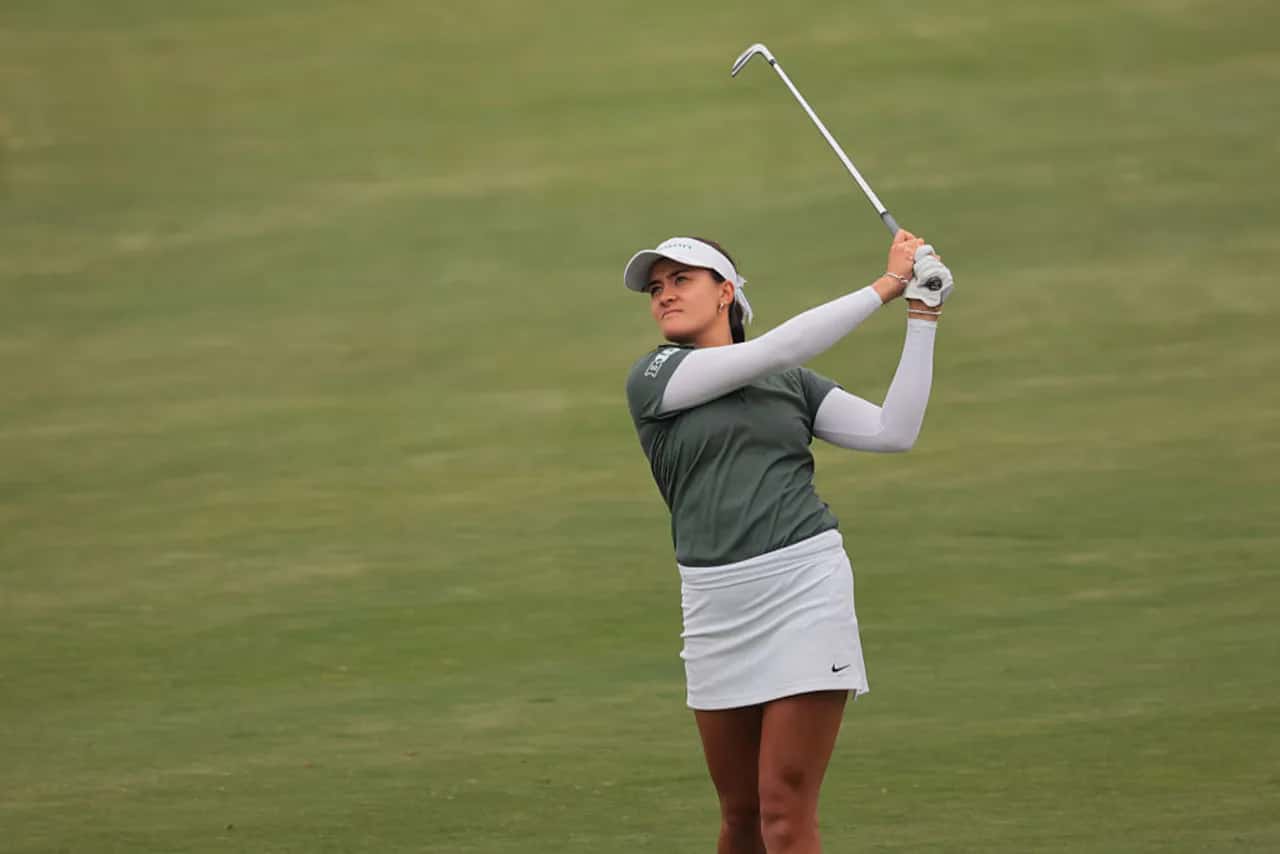
Romero opened with rounds of 64 and 67 at the CPKC Women’s Open, reaching 9 under and sharing second place as Friday’s afternoon wave continued at Royal Mayfair Golf Club in Edmonton. It was her first LPGA Tour start since becoming a professional and an emphatic answer to one of golf’s oldest questions: How quickly can an elite amateur’s game travel?
For Romero—and for several members of golf’s class of 2026—the answer appears to be almost immediately.
The 20-year-old arrived on Tour through the LPGA Elite Amateur Pathway after earning the 20th and final point needed for membership. The clinching point came with a second consecutive McCormack Medal as the world’s leading women’s amateur, making Romero only the second golfer to move directly from college to the LPGA through the pathway, following Lottie Woad.
There were no visible first-week jitters in Canada. Romero made six birdies without a bogey in her opening 64, then followed with five birdies and two bogeys on Friday. Her brother Kyreece, a former Oregon golfer, was on the bag. Her sister Kaleiya is second in the Epson Tour’s Race for the Card, giving the family a chance to place two sisters on the LPGA Tour at the same time.
Romero’s start is the latest evidence that the distance between elite amateur golf and the professional tours is shrinking. The pathways are clearer, the players arrive with more tour experience and the best of them increasingly look less like rookies than fully formed contenders.
Jackson Koivun: From a missed cut to a PGA Tour victory
No player has made the point more forcefully than Jackson Koivun.
The former Auburn star missed the cut in his professional debut at the John Deere Classic, shooting 73-70. Three weeks later, he was a PGA Tour winner.
Koivun shot 25-under 259 at the 3M Open, including a third-round 61, and held off world No. 1 Scottie Scheffler by three strokes. The victory came 24 days after Koivun turned professional and in only his third start as a pro. He became the first player to win on the PGA Tour after accepting membership through PGA Tour University Accelerated.
The victory was spectacular, but the preparation was years in the making. Koivun won 11 college tournaments, helped Auburn capture two NCAA team championships and became the first player to win college golf’s Haskins, Hogan and Nicklaus awards more than once. He had also made nine PGA Tour starts as an amateur before accepting membership.
His first two professional events illustrate the volatility of the transition better than any theory could: a missed cut followed by a win over the best player in the world.
Ben James: A Friday lead and a weekend lesson
Ben James’ professional debut compressed the same lesson into four days.
James, the No. 1 player in the 2026 PGA Tour University ranking, opened the RBC Canadian Open with 67 and then shot a bogey-free 63. The second round included an eagle and five birdies and gave the former Virginia standout the 36-hole lead in his first start as a professional.
Then came Saturday.
James shot 78 in the third round before closing with 69 to finish tied for 54th. The final position did not erase the significance of Friday. In his first professional event, James proved that the game which made him a four-time first-team All-American could place him above a PGA Tour field—even if learning to stay there would be the next assignment.
Megha Ganne: A steady first full-field test
Megha Ganne took a different route into the summer.
The four-time Stanford All-American turned professional after helping the Cardinal win another NCAA team championship and made her pro debut at the U.S. Women’s Open. Last week’s Standard Portland Classic was her first regular-season LPGA start as a professional, earned through the Juli Inkster Senior Award.
Ganne made the cut and finished tied for 32nd at 9 under, posting rounds of 71, 68, 67 and 73. It was not the leaderboard jolt produced by Romero, but it was a solid four-round performance against an LPGA field and another successful step from college golf into the professional game.
Grace Summerhays: Back where it began
Grace Summerhays made her professional debut closer to home.
The former Arizona State golfer began at the Utah Women’s Open after spending a year away from college golf while recovering from a wrist injury. Summerhays had won the Utah Women’s State Amateur at 16 and chose the state open as the place to begin a professional career that will next take her toward qualifying school.
She opened with 71, closed with 67 and tied for fourth at 6 under.
The location and the surname supplied an easy storyline. Her brother Preston and uncle Danny have both played professionally, and the Summerhays family has long been part of Utah golf. But a top-five finish after a long competitive interruption gave the debut substance beyond the family connection.
John Daly II: A familiar name in unfamiliar conditions
John Daly II’s week requires one important distinction: the Nexo Championship is his DP World Tour debut, not his first professional tournament.
The 23-year-old turned professional in June and had already played twice on the Korn Ferry Tour. He also made the cut in the Puerto Rico Open earlier this year while still an amateur. Scotland, however, offered a different test.
Playing in heavy wind and links rough at Trump International Golf Links, Daly opened with a level-par 72. He reached the weekend at 5 over after negotiating brutal Friday conditions and making par when he needed it at the finish.
The surname guaranteed attention. The DP World Tour’s side-by-side comparison of father and son supplied the perfect social clip: John Daly’s long, unmistakable backswing next to his son’s shorter and more conventional move. But Daly II’s short game—and the patience required to survive two difficult days—made a stronger case than resemblance alone.
A shorter learning curve—or better preparation?
Calling this group fearless misses the more interesting explanation.
Romero, Koivun, James and Ganne did not arrive at professional events without context. They played majors and tour events as amateurs. They competed in national championships, NCAA pressure and international fields. New pathways such as LEAP and PGA Tour University did more than award membership; they gave players a reason to test themselves against professionals before leaving amateur golf.
That experience does not make the transition automatic. Koivun missed his first cut. James followed a 63 with a 78. Every new professional still has to learn unfamiliar courses, travel, scheduling and the reality that a poor week now affects a livelihood.
But the class of 2026 is making one point unmistakable: the best amateurs are no longer arriving simply hoping to belong.
Some of them are arriving ready to lead. One has already won. And as Romero showed through two rounds in Canada, another may not be far behind.