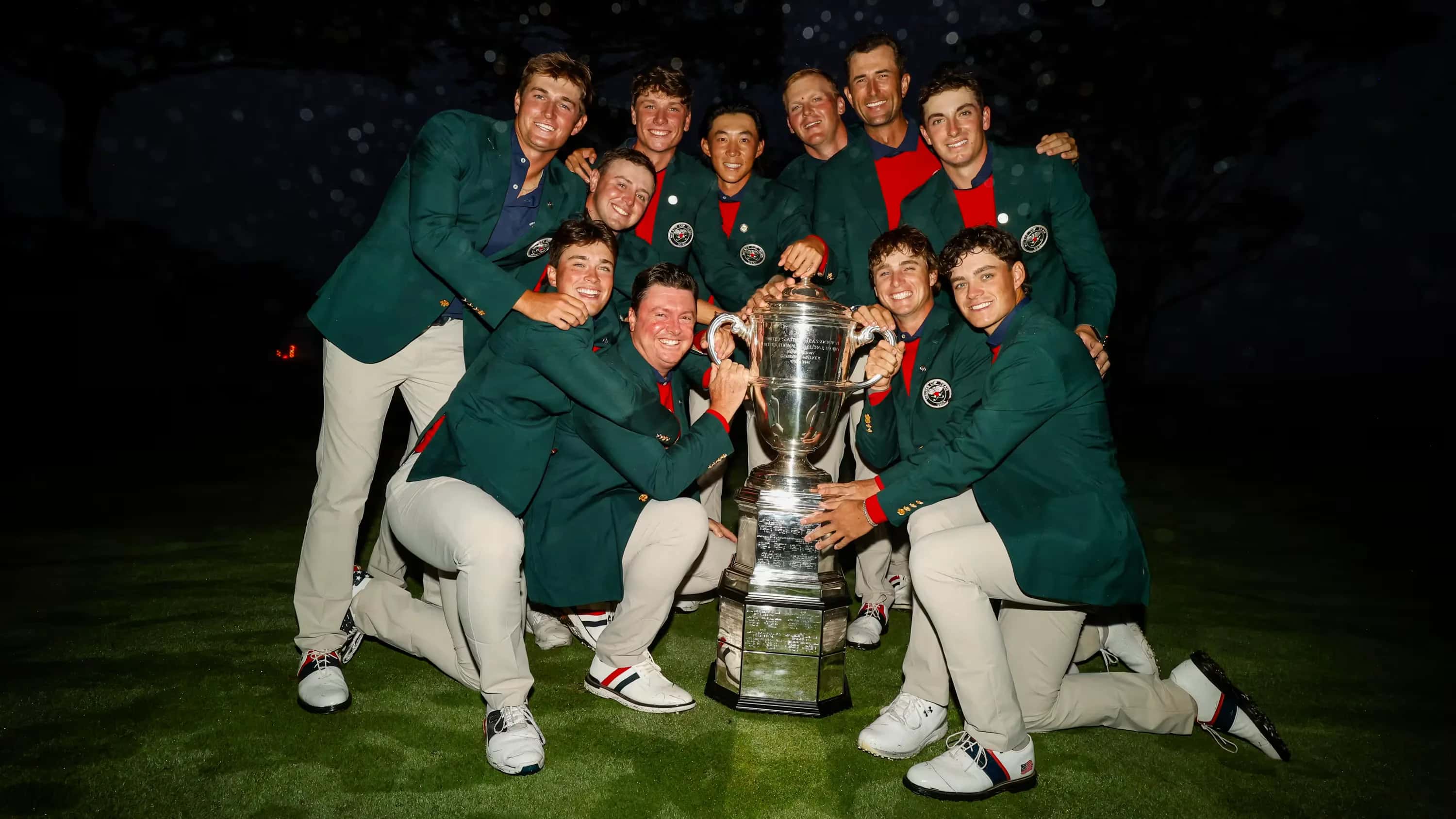
The 2026 Walker Cup teams are set, and the first scoreboard has already arrived.
Seven of the 10 Americans selected for the September 5-6 match at Lahinch are ranked among the top 10 in the World Amateur Golf Ranking. Great Britain and Ireland, meanwhile, is trying to stop a five-match U.S. winning streak with a roster that includes the reigning U.S. Amateur champion, the reigning Amateur champion and six players who experienced last year’s 17-9 defeat at Cypress Point.
It is a compelling matchup. It also revives an uncomfortable question that has followed the Walker Cup for decades:
Should Great Britain and Ireland finally become Europe?
The Ryder Cup comparison is impossible to ignore
The argument almost writes itself. The United States leads the Walker Cup series 40-9-1 and has held the trophy since 2017. Its 2026 roster includes world No. 1 Preston Stout, teenage standout Miles Russell, Amateur champion Ethan Fang, U.S. Amateur runner-up Jay Leng Jr. and six-time Walker Cup selection Stewart Hagestad.
That looks familiar because professional golf once had essentially the same problem.
The Ryder Cup began as the United States against Great Britain. Ireland was incorporated before players from continental Europe joined in 1979, opening the door to Seve Ballesteros and eventually transforming a lopsided match into one of the most competitive events in sports. Europe owns the better Ryder Cup record in the modern era.
If adding Spain, Germany, France, Sweden, Denmark and the rest of the continent saved one transatlantic cup, why would it not strengthen the other?
There is no shortage of talent to add. Germany’s Tim Wiedemeyer won the 2026 European Amateur Championship. France’s Lev Grinberg won The Open Amateur Series. Continental programs routinely produce players who become major champions, Ryder Cup stars and standouts in American college golf.
A true European side would also give more countries a direct emotional stake in the match. That means more fans, more storylines and more young golfers who can picture themselves wearing the colors in the future.
On the surface, expanding the Walker Cup feels less like radical change than finishing a job the Ryder Cup started 47 years ago.
The inconvenient result nobody should ignore
Then comes the result that complicates the entire argument.
In July 2025, many of the same GB&I players who would later lose 17-9 at Cypress Point faced the Continent of Europe in the St Andrews Trophy. GB&I won 16½-8½.
Read those scores again:
GB&I 16½, Continent of Europe 8½
USA 17, GB&I 9
Simply combining two teams does not automatically create a Ryder Cup-style superpower. Team golf depends on partnerships, course fit, form and chemistry. A 10-player European roster would replace some GB&I players with continental players; it would not place 20 golfers on the first tee.
The St Andrews Trophy is also more than a convenient statistical rebuttal. First played in 1956, it gives GB&I and the Continent of Europe their own international match and history. Former R&A chief executive Peter Dawson cited that competition when the Europe question was raised in 2011, saying there was no demand to change a Walker Cup format that had produced close matches.
That institutional logic remains intact: the Walker Cup is not merely an amateur copy of the Ryder Cup. It is a match rooted in the relationship between the USGA and The R&A, with its own traditions and identity.
Expanding one team could strengthen the talent pool while weakening the very thing that makes the event distinct.
Has the recent golf actually been uncompetitive?
Five consecutive American victories sounds conclusive. The margins tell a more complicated story.
2025, Cypress Point: USA 17, GB&I 9
2023, St Andrews: USA 14½, GB&I 11½
2021, Seminole: USA 14, GB&I 12
2019, Royal Liverpool: USA 15½, GB&I 10½
2017, Los Angeles Country Club: USA 19, GB&I 7
Two of those matches were decided by three points or fewer. At St Andrews in 2023, GB&I took a three-point lead into Sunday before the Americans rallied. At Seminole in 2021, the outcome remained unsettled until late in the singles session.
The United States has been better. It has not rendered the competition pointless.
And Lahinch may be the ideal test of the existing format. The County Clare links will ask different questions than most American championship venues. Wind, uneven lies, alternate-shot decision-making and local links experience can shrink a ranking advantage quickly.
The GB&I team is not short on credentials. Jack Whaley just won the U.S. Amateur at Merion. Stuart Grehan won The Amateur Championship and previously captured the South of Ireland at Lahinch. Connor Graham is making his third Walker Cup appearance at 19. Luke Poulter, Tyler Weaver, Eliot Baker and Niall Sheils Donegan all return from Cypress Point.
If that group wins on home soil, the expansion debate cools instantly.
The deeper divide may be structural
The more meaningful question is not whether continental Europe can supply several elite golfers. It can.
It is whether any 10-player team can consistently match the depth generated by the American development system.
U.S. college golf brings many of the world’s best amateurs into deep fields, high-level training environments and pressure competition almost every week. The American selection pool is enormous. Its stars can turn professional and seemingly be replaced by another wave of ranked players.
Many of GB&I’s best players use that same system—Whaley and Weaver at Florida State, Graham at Texas Tech, Poulter at Florida and Sheils Donegan at North Carolina. The modern divide is not simply America versus Europe. It is also about access to elite competition, resources and depth.
Changing the name on the team bag does not solve all of that.
Our verdict: not yet—but the question is now legitimate
The Walker Cup should not expand simply because the Ryder Cup did. The current match has produced recent drama, the St Andrews Trophy preserves a meaningful place for continental Europe, and last year’s result between GB&I and the Continent makes the “instant superteam” theory look far less certain.
But tradition cannot be the only answer forever.
If the United States wins a sixth consecutive match at Lahinch—especially another one-sided contest—the USGA and The R&A should openly review the format. That review could examine a European expansion, a future exhibition involving all three teams, or other ways to make the continent’s best amateurs part of the Walker Cup conversation without erasing the St Andrews Trophy.
For now, Lahinch becomes more than a fight for the trophy. It is a referendum on whether GB&I still has enough depth to keep one of amateur golf’s oldest international rivalries exactly as it is.
What do you think?
Should the Walker Cup remain USA vs. Great Britain and Ireland—or should continental Europe be invited?
Keep the traditional format
Create USA vs. Europe
Wait until after the 2026 match
The 51st Walker Cup will be played September 5-6 at Lahinch Golf Club in County Clare, Ireland.