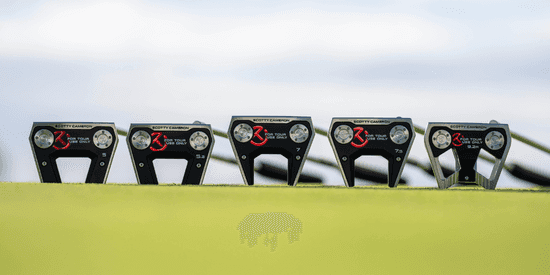
Scotty Cameron’s next generation of Phantom mallet putters has officially arrived on the PGA TOUR, debuting this week at the season-opening Sony Open in Hawaii with new Phantom 5, 7, and 9R head designs and expanded neck and shaft configurations built for modern putting strokes.
The latest Phantom lineup represents the evolution of one of Scotty Cameron’s most successful mallet families—shaped directly by feedback from the world’s best players and validated by wins across the PGA TOUR in recent seasons.
Built on Tour-Proven Success
Phantom mallets have already earned their place at the highest level, with PGA TOUR victories from players including Russell Henley (Phantom X 5), Justin Thomas (Phantom 5), Cameron Young (Phantom 9.5R), Michael Brennan (Phantom 7.2), Ryan Gerard (Phantom 5.2), and a former U.S. Open champion who has relied on a Phantom 5.
That Tour pedigree continues with the new Phantom 5, 7, and 9R designs—each offering high-MOI stability, refined shaping, and multiple neck options that allow players to dial in toe flow, face balance, and alignment preference without changing head size or overall profile.
Why Players Keep Choosing Phantom Mallets
One of the defining traits of the Phantom family is its forgiveness and stability, created by a larger mallet footprint that boosts MOI while also opening the door to more sophisticated alignment solutions.
Rather than relying solely on bold sightlines, Phantom mallets incorporate subtle design cues—angles, contours, and head geometry—that help players square the face naturally at address.
“There’s an element of forgiveness to it that just, in my head, makes sense,” said Cameron Young, one of the PGA TOUR’s most loyal Phantom users. “I’ve just grown to like the way that [Phantom mallets] look. I look at a blade now and I have more trouble lining it up.”
Cameron Young’s Phantom Evolution
Young has used a Scotty Cameron Phantom putter throughout his entire PGA TOUR career, experimenting with multiple head shapes and neck configurations since turning professional in 2021.
Early in the 2025 season, he made a notable switch at the RBC Heritage, moving within the Phantom 9R head shape from a plumbing neck to a jet neck—introducing more toe flow to better match his natural stroke.
“He’s always wanted to feel flow in the putter,” explained Scotty Cameron Tour Rep Brad Cloke. “We’ve started in face-balanced mallets for him, and we’ve kind of worked our way down to a point where he’s felt comfortable enough to feel the toe flow the way he wants it and get the release of the putter that he wants.”
The results spoke for themselves.
Young delivered the best putting season of his career, finishing 7th on the PGA TOUR in Strokes Gained: Putting (+0.642 per round), T6 in Putting Average (1.704), and 4th in One-Putt Percentage (44.57%).
What It Means for Competitive Amateurs
For serious amateurs, the continued expansion of the Phantom family underscores a broader trend in modern putting: mallets that don’t sacrifice feel or flow for forgiveness. With multiple neck options now available across similar head shapes, players can fine-tune performance characteristics without abandoning a look or setup they trust.
More details on consumer availability, specifications, and retail launch timing are expected as the rollout continues.
Stay tuned to Titleist and Scotty Cameron social channels as the new Phantom mallets make their way across the PGA TOUR and professional tours worldwide—and keep an eye on AmateurGolf.com for full specs, photos, and amateur-focused breakdowns as they become available.