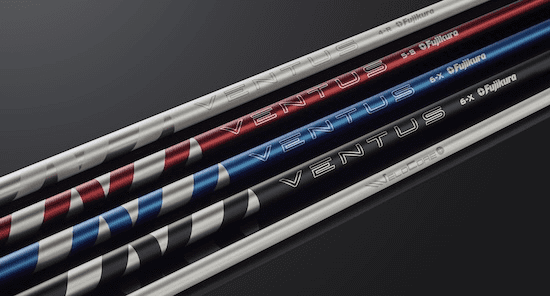
If a player who just earned a PGA Tour card handed you his driver and told you he played a Fujikura VENTUS 6-X, you might think you had enough information to order the same shaft. In this year’s graduating class, that description fits four drivers. You’d still have to ask which one.
Two players used VENTUS Black. One used TR Blue. The fourth played Red. All four earned cards for the 2027 PGA Tour season through the international route, according to Fujikura’s Nov. 23 equipment report. They make up four of the 10 graduates. Look closely at the company’s graphic and you’ll see the same weight class and flex printed beside three different profiles.
For a competitive amateur trying to decide what belongs in the bag, the player with the Red might be the most interesting of the four. Fujikura puts Red on the higher-launching side of its lineup and Black at the low end. A player can have the speed for an X-flex and still have good reason to want the ball to climb. We’ve seen that combination turn up much closer to home.
The mid-am who wanted more height
Kish Israni went to Fujikura’s Carlsbad headquarters with a fairway finder he liked and a flight he wanted to change. The brief for his fitting was a tricky one. Could he hit the ball higher and swing faster without giving up the accuracy that made driver a strength?
Israni ended up in a VENTUS Red 6-X with VeloCore+, the model listed for one of those four graduates. In his session he saw a higher flight and picked up more than three miles per hour of clubhead speed, touching 110 for the first time. What stuck with him was how often the fitter changed course when a shot produced numbers he hadn’t expected.
Chris Cayford came to our panel test fighting excess driver spin. His fitting ended with a slightly lighter TR Blue 6-X. His distance stayed put. He reported an easier time squaring the face, and his smash factor improved. Those two sessions make a good pair to read together. Start with the flex and you could mistake these golfers for candidates for the same build. Start with the tee shot each wanted back and the choices make sense. Read Pete Wlodkowski’s report on all three amateur fittings.
Where the college count fits in
Fujikura counted five more driver shafts among graduates from the American circuit, a quarter of that group. Its list includes a SPEEDER TR alongside several VENTUS builds. Further back on the path to a Tour card, the company says nine of the top 10 players in the Division I college rankings it tracked played a Fujikura driver shaft. That is a brand count. The release does not identify nine college players using one VENTUS model or say how their results changed after a fitting.
What the counts give a tournament golfer is a short list of questions to take to the range. Pick the tee shot at your home course that gives you trouble. Is it the carry over a bunker that makes you press, or the drive that starts on line and runs through the far side of a dogleg? Bring your current driver, use your tournament ball and give the fitter that problem. Keep the ordinary swings in the comparison. Those are the ones you’ll have to play in a qualifier. Our guide to the VENTUS TR profiles breaks down the flight each is designed to produce.
If you leave with the same driver you brought in and a better idea of which bunker you can carry, that’s a perfectly good fitting, too.
Fujikura and Club Champion are AmateurGolf.com partners. Equipment counts come from Fujikura. The amateur panelists received their fittings at no cost.