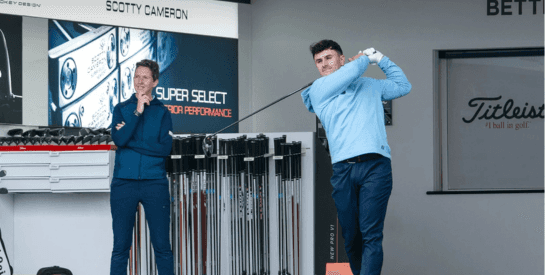
Fitting Isn’t About Clubs First
Walk into a fitting studio and the first thing you notice is the equipment: walls of shafts, multiple clubheads, launch monitors tracking every metric imaginable.
But inside Titleist, there’s a clear belief that cuts through all of that: their greatest differentiator is their people.
Being a Titleist fitting professional is considered one of the most important jobs at the company because fitters are on the front lines every day—working directly with golfers to translate technology into performance that holds up on the course.
On the Front Lines of Performance
Titleist fitters aren’t there to judge your swing. They’re there to gather information—often subtle, sometimes uncomfortable—that can genuinely enhance your game.
Every swing, every ball flight, every reaction gives the fitter another data point. Their role is to recognize which pieces matter and which ones don’t.
That ability to filter information is what separates a great fitting from a generic one. Numbers alone don’t make decisions—interpretation does.
Mastery in a Complex Equipment Landscape
Modern fitting can feel overwhelming. Dozens of shafts. Multiple head designs. Endless combinations of weight, flex, torque, and build.
Titleist fitters are trained to master that complexity. Golfers often leave fittings with the same realization:
“He knows exactly what every single one of those does.”
That knowledge allows the fitter to narrow options quickly and confidently—building a setup that fits the golfer instead of forcing the golfer to fit the club.
Solving the Puzzle, One Piece at a Time
Titleist often describes fitting as solving a puzzle. Each swing provides a piece: launch, spin, strike location, descent angle, feel, and feedback.
The fitter’s job is to combine those pieces into a clear picture—one that better shapes the golfer’s game.
This approach explains why Titleist fitters value mishits and imperfect swings. Those shots reveal the truth about what equipment will protect performance under pressure.
Teaching Without Teaching
One of the most distinctive aspects of the Titleist fitting experience is that it educates without instruction.
Instead of swing tips, golfers learn through outcomes. The fitter adjusts equipment variables, and the golfer sees immediate changes in ball flight and dispersion.
This is especially valuable for competitive amateurs who are already working with instructors. The fitting supports the swing you have today—without interfering with long-term development.
Why the Fitter Matters More in Competitive Golf
Tournament golf exposes weaknesses quickly. Wind, nerves, uneven lies, and fatigue all test your equipment.
A skilled fitter builds protection into the bag—clubs that maintain ball speed, manage dispersion, and produce predictable launch and descent even when the swing isn’t perfect.
That’s why Titleist views fitting as the fastest way to get better. With the right guidance, golfers don’t just gain distance or tighter patterns—they gain trust.
The Outcome: Confidence Built on Understanding
The ultimate responsibility of the fitter is simple: show the golfer what works best and explain why.
When golfers love every club in the bag and understand the reason it’s there, confidence follows naturally.
That confidence is what allows competitive amateurs to commit fully—to swings, to targets, and to decisions when it matters most.
Read next: Titleist Fitting Philosophy — The Competitive Amateur’s Fastest Path to Lower Scores
See how fitter expertise, mishits, and the 3Ds come together across the entire bag.