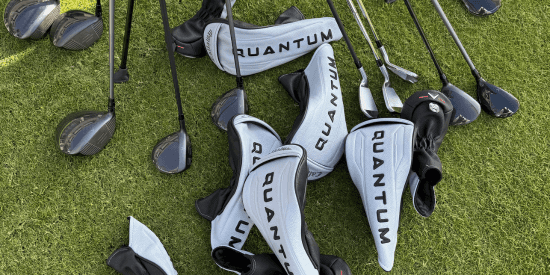

Build: 9° head · Fujikura Ventus Blue w/ VeloCore+ 6S · ~105–120 mph swing window
The Short Version
The Quantum TD Max is the rare "players" driver that actually got easier to hit while picking up speed. Coming out of last year’s Elyte Triple Diamond, I gained 2–3 mph of ball speed, dropped meaningful spin, and — critically — kept the dispersion tight enough to attack tee shots in competition. Six months and a state-am qualifier later, it’s staying in the bag.
Where this started
My 2025 gamer was the Elyte Triple Diamond, and it was a good driver — but it had one nagging trait: it ran a touch spinny for my speed. That extra spin was a double-edged sword. It kept me in the fairway because the ball held its line, but it cost me carry and turned into a ballooning miss when I got quick. So when Callaway dropped the Quantum line in 2026, the Triple Diamond family was the first thing I wanted on a launch monitor.
I did the head-to-head in January: Elyte TD as the baseline, then the new Quantum TD and Quantum TD Max back to back. The Elyte sat at roughly 159 mph ball speed and 266 yards of carry. Both Quantum heads bumped me up 1–2 mph immediately — I saw 161–162 mph, with the standard Triple Diamond carrying around 271 and total numbers pushing 288. The standard TD was the lowest-spinning, lowest-launching of the group, exactly as advertised. Callaway positions the TD Max as the Triple Diamond shape with added forgiveness and slightly higher launch and spin — and that’s exactly how it played. It gave up almost nothing in speed but handed back a little more backspin, and that was the number I actually wanted: enough spin to hold a tee shot in the fairway without bleeding distance. That trade is why the Max won the fitting.
It’s also the same call a lot of competitive players are making, and for the same reason. On the firm, fast setups you see in tournament golf, the absolute lowest-spin head isn’t actually the goal — you need just enough spin to hold carry and keep the ball from running out of the fairway. That’s the gap the TD Max fills: a low-spin head wrapped in a forgiving 460cc shell, slotted right between the standard Triple Diamond and the full game-improvement Max. For someone playing qualifiers on baked-out spring courses, that middle ground is the sweet spot, not a compromise.
What the tech is actually doing
Quantum is Callaway’s biggest 2026 launch, and the whole platform is built around one idea: speed is the separator. That’s not arbitrary — viewed through strokes gained driving, distance tends to be roughly twice as impactful as accuracy, because ball speed raises your ceiling and creates more scoring chances over a round. The catch is that modern driver design already lives at the edge of CT limits and durability, so the only way forward is a smarter face. That’s where the Tri-Force Face comes in, and unlike a lot of marketing-speak this one shows up on the launch monitor.
At impact a face deals with two opposing forces — compression on the striking surface and tension behind it as the face deflects inward — and no single material handles both well. Tri-Force splits the jobs across three materials: titanium stays the striking surface, where it’s strongest under compression and delivers the solid feel; carbon fiber reinforces the back of the face, where it excels under tension to help it flex and recover faster; and a military-grade Poly Mesh™ binds the system together, adding strength and durability without adding stiffness the way epoxy would. Backing the titanium this way let Callaway push the face 14% thinner than the Elyte while staying conforming and durable, and the whole system is rated about 17% more responsive. That tracks with my numbers — the 2–3 mph of ball speed I picked up over my Elyte TD came directly from this face.
Speed only becomes distance if spin stays in a playable window, and that’s the part I appreciate most. Callaway’s next-gen AI face mapping accounts for how the three materials deflect differently and tunes micro-deflections zone by zone: low-face strikes that normally spin too much get pulled back toward optimal, and high-toe strikes that tend to fall out of the air get enough spin to stay airborne. The goal isn’t perfect contact — it’s consistent carry regardless of where I catch it, and in practice my off-center strikes hold ball speed far better than the Elyte ever did.
The place I notice it most is the toe miss. With my old gamer, a toe strike meant lost ball speed and a spinny shot that fell out of the sky or hooked into trouble. With the Max I can feel that I caught it off the toe, but the ball flight doesn’t agree — speed holds, the spin doesn’t balloon, and the shot still finishes in play. Same story on my right-side misses: instead of spinning up into the 3,000s and ballooning, they stay in a controllable window and curve far less. For a tournament player, that’s the difference between a reload and a green in regulation, and it’s exactly what I’ve heard echoed by other skilled players who’ve put this head through real testing — the off-center spin consistency is the headline, not the center-strike numbers everyone already maxes out.
The other piece is the 360° Carbon Chassis — Callaway’s lightest and strongest to date, with a woven carbon sole. Pulling weight out of the crown and skirt frees up discretionary mass to position the CG precisely, and in the Max that mass is used for stability and a tighter, more forgiving footprint inside a full 460cc head. That’s the engineering reason the Max is more playable than the standard TD without ballooning the spin: it’s a 460cc shape with a deliberately managed center of gravity rather than a small, punishing one.
For dialing it in, the OptiFit hosel gives independent loft (up to +2°/-1°) and lie adjustment across eight settings, and there’s a 10g adjustable perimeter weight to set a neutral or fade bias. One word of advice if you’re coming to this head: it genuinely is low spin, so don’t be afraid to loft up. A setup that looks perfect flat-out on a launch monitor can run a touch too low on the course, where you want spin to help hold carry into wind and on firm turf. I’ve seen plenty of skilled players add loft or move the back weight to bring spin up a few hundred rpm once they get outside. I started neutral at 9° and have left it there — that’s where my numbers and ball flight landed for my speed — but the adjustability is there precisely so you can tune spin to your conditions rather than chase the lowest number on a screen.
The shaft is half the story
I’m in the Fujikura Ventus Blue with VeloCore+ in 6S, and it’s a big reason the spin numbers landed where they did. VeloCore+ is a multi-material bias-core build using full-length Pitch 70 Ton carbon — Fujikura rates it stiffer and more stable than T1100g — wrapped with 40 Ton bias layers for feel. The Blue profile is mid-launch, low-to-mid spin, and the 6S is built for the 105–120 mph range with a stiffer butt, slightly softer mid, and firmer tip. Translation: the tip keeps the face from over-rotating and adding spin, while the stable core resists the twist that turns a heel strike into a big miss. Pairing a low-spin head with a low-spin, stable shaft could go too far for some players, but with the Max’s slightly higher spin profile it nets out perfectly — penetrating flight that still has enough lift to carry and hold a fairway.
My build at a glance
| Head | Quantum Triple Diamond Max, 460cc |
| Loft / setting | 9°, neutral (OptiFit +2°/-1°, 8 settings) |
| Face | Tri-Force: ultra-thin titanium + Poly Mesh™ + carbon, AI-mapped |
| Body | 360° Carbon Chassis, woven carbon sole, 10g adjustable weight |
| Shaft | Fujikura Ventus Blue VeloCore+ 6S (mid launch / low-mid spin) |
| Ball speed | ~161–162 mph (up 2–3 from Elyte TD) |
| Spin vs. Elyte TD | Noticeably lower; flight is lower and more penetrating |
Look, sound, and feel
At address the Max just fits my eye. The topline and crown shape sit beautifully square — clean, slightly compact for a 460, with enough of a footprint to look confident behind the ball without nagging me into manipulating it. It frames the ball the way a Triple Diamond should: looks like a players head, behaves like something more forgiving. The woven carbon sole is a nice touch but it’s the topline that matters when I’m standing over a tight tee shot, and this one inspires commitment.
Sound and feel are firm and muted — a solid, compact crack rather than the hot, high-pitched ping some carbon-heavy heads produce. Center strikes feel noticeably different from toe and heel misses, which I want; the face gives me honest feedback even though the numbers stay forgiving.
Six months and a state-am qualifier later
Launch-monitor gains only matter if they survive contact with competition, and this is where the Max earned its keep. The lower spin showed up as real distance on firm spring fairways, and the tighter dispersion meant I was hitting driver on holes where the Elyte had me reaching for a 3-wood. That added aggressiveness off the tee was a direct factor in a strong early season — capped by qualifying for the Arizona State Amateur. When you have to make a number on the back nine of a qualifier, having a driver you trust to start on line and hold the short grass is worth more than any single launch-monitor stat.
Durability has been a non-issue — the face feels as lively as day one, and the setting hasn’t crept. If I’m nitpicking: this is still a Triple Diamond, so it asks for speed and a repeating strike to reward you. A higher-handicap player would be better served by the standard Quantum Max. And if your only goal is the absolute lowest spin number, the standard Triple Diamond will beat the Max — I just preferred the Max’s slightly higher spin because it keeps me in play.
Bottom Line
The Quantum Triple Diamond Max is the best driver I’ve gamed. It delivered exactly what the Elyte TD couldn’t: more ball speed and less spin, without giving up the control a competitive player needs. Paired with the Ventus Blue VeloCore+ 6S, it’s a low-spin, stable, fairway-finding setup that fits my eye and my game.
Verdict: in the bag through the rest of 2026. As always — get fit. The Max won my fitting; the standard TD or standard Max might win yours.