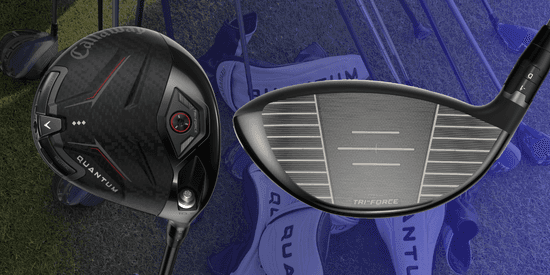
Callaway is opening 2026 with its largest equipment launch of the year, introducing the all-new Quantum family—a complete lineup of drivers, fairway woods, hybrids, and irons built around one defining idea the company believes will shape performance going forward: Speed is everything.
Late last year, we spent time with Callaway’s product and R&D teams to better understand what Quantum really represents. The takeaway was clear: this isn’t a cosmetic refresh or a single-club story. Quantum is a full-line platform, designed to deliver speed in ways that actually hold up in real golf—especially when contact isn’t perfect.
The Quantum family officially launches Friday, January 16, 2026, with retail availability following in February.
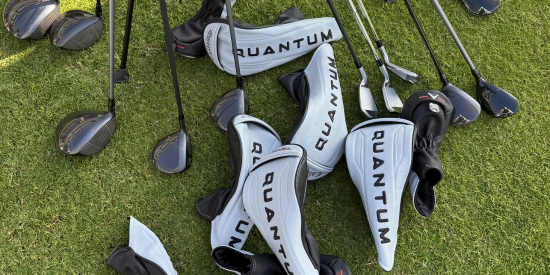
Why Speed Became the North Star for 2026
Callaway’s focus on speed isn’t arbitrary. It’s grounded in performance data.
When viewed through the lens of strokes gained driving, distance consistently proves to be a major separator—often twice as impactful as accuracy. That doesn’t mean forgiveness and control stop mattering. But it does mean that ball speed raises a golfer’s ceiling, creating more scoring opportunities over the course of a round.
The challenge is that modern club design lives right at the edge of what’s allowed. CT limits, durability requirements, and material constraints force real tradeoffs. Quantum exists because Callaway believes it found a new way forward—by building around those limits instead of fighting them.
Quantum Drivers: A New Face Technology Built for Speed and Consistency
The centerpiece of the Quantum launch is the Quantum driver lineup, featuring Callaway’s most significant face innovation in years: Tri-Force Face.
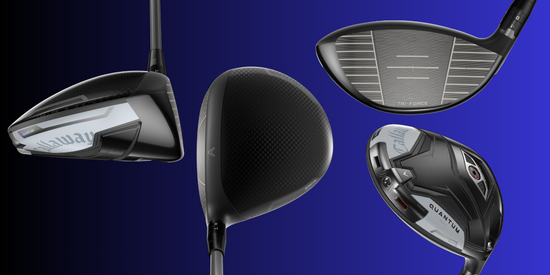
Rather than relying on a single material to handle every force at impact, Tri-Force uses a three-material system, each chosen for a specific role during the collision between club and ball.
Tri-Force Face, Explained
At impact, a driver face experiences two opposing forces: compression on the striking surface and tension behind the face as it deflects inward. No single material excels at both. Tri-Force separates those jobs:
- Titanium remains the striking surface, where it excels under compression. It delivers the fast, solid feel players expect and allows Callaway to continue using AI-driven face optimization.
- Carbon Fiber reinforces the back of the face, where it performs best under tension—helping the face flex and recover faster.
- Poly Mesh, a military-grade polymer, binds the system together. Unlike traditional epoxy, it adds strength and durability without adding stiffness, preserving face flex and speed.
This multi-material construction has never been used before in a driver face design.
Thinner, Faster, and Built to Last
By reinforcing titanium with carbon fiber and Poly Mesh, Callaway was able to push the titanium face 14% thinner than Elyte, unlocking more ball speed while maintaining durability and conformance.
The system is described internally as being 17% more responsive, a reflection of stronger stress tolerances and improved energy transfer—key to turning speed into usable distance.
AI Optimization and Spin Control Across the Face
Speed only turns into distance if spin stays in a playable window. With Tri-Force, Callaway’s next-generation AI modeling accounts for multiple materials that deflect differently, allowing engineers to fine-tune micro-deflections across the face.
- Low-face strikes that traditionally spin too much are pulled back toward optimal spin.
- High-toe strikes that tend to fall out of the air receive enough spin to stay airborne longer.
The goal isn’t perfect strikes—it’s more drives finishing with consistent carry and total distance, regardless of impact location.
Quantum Driver Models
The Quantum driver lineup is designed to fit golfers from everyday amateurs to elite Tour professionals, with multiple head shapes and performance profiles:
- Quantum Max – The most forgiving, all-around model for a wide range of players
- Quantum Max D – Built-in draw bias with higher launch and spin
- Quantum Max Fast – Lightweight construction for easier speed and launch
- Quantum Triple Diamond – Compact, tour-inspired head for low spin and neutral flight
- Quantum Triple Diamond Max – Triple Diamond shape with added forgiveness and slightly higher launch/spin
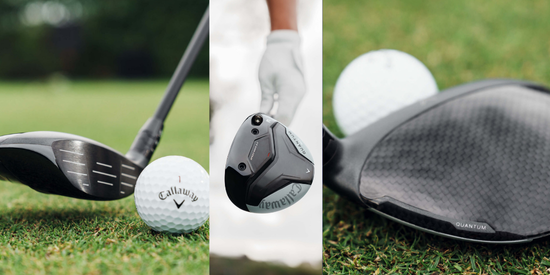
Quantum Fairway Woods and Hybrids: Speed Where Golfers Actually Miss
Fairway woods and hybrids are often the hardest clubs to strike consistently, and Callaway’s Quantum updates focus on where golfers actually lose speed and consistency.
At the center is Speed Wave 2.0, a completely re-engineered internal structure that positions mass low and forward to increase face flex—especially low on the face, where most misses occur. The result is faster ball speeds and more consistent launch from both the tee and turf.
Step Sole and AI Optimization
Quantum fairway woods and hybrids also feature an advanced Step Sole Design, which reduces unnecessary sole contact through impact. Cleaner turf interaction helps keep the face square and promotes more consistent center-face contact.
A next-generation AI-Optimized Face further supports consistent speed, launch, and spin across the hitting area.
Unified Tech and Modern Adjustability
One key theme we noticed is Callaway’s push to align fairway woods and hybrids on the same technology platform, making it easier for golfers to blend the two seamlessly in their bags.
- OptiFit 4 hosel with seven loft/lie options
- Ability to adjust two degrees upright or flat, especially useful for hybrids and left-miss control
- Adjustable 3-woods and 5-woods across every fairway model
- Expanded high-loft fairway options reflecting modern gapping trends
Fairway Wood Models: Max, Max D, Triple Diamond, Max Fast
Hybrid Models: Max, Max OS, Max Fast
Quantum Irons: Speed Reimagined as Greens Hit
Quantum irons approach speed differently. Rather than simply chasing more distance, the focus is on speed consistency and forgiveness across the face, helping golfers hit more greens.
At the core is Callaway’s Modern 360 Undercut, a new two-piece cavity-back construction that creates extreme perimeter weighting and a fully exposed undercut. By moving the weld line farther back, Callaway unlocked more sole flex and face activity—helping protect ball speed and carry on off-center strikes.
Quantum irons also feature a Progressive Tri-Sole Design, with unique sole geometry throughout the set to promote cleaner turf interaction, efficient speed retention, and more consistent contact—even on heavy strikes.
Iron Models: Quantum Max (game improvement), Quantum Max OS (super game improvement), Quantum Max Fast (lightweight, easy launch)
Availability and Pricing
- Drivers, Fairway Woods, Hybrids: Available at U.S. retail beginning February 13, 2026
- Irons: Available at U.S. retail beginning February 27, 2026
The Big Picture
Quantum is Callaway’s clearest statement yet about where the brand is headed in 2026. Drivers introduce a new multi-material face system designed to push ball speed while managing spin more consistently. Fairway woods and hybrids target the low-face miss and improve turf interaction. Irons bring speed consistency to the parts of the face golfers actually use.
It’s not about chasing perfect swings—it’s about building equipment that performs when golf gets real.