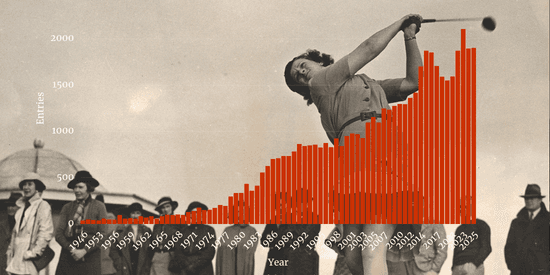
When Patty Berg won the inaugural U.S. Women’s Open in 1946, the championship drew 39 entries.
In 2023, that number reached a record 2,107.
That growth — nearly 5,000% over eight decades — is more than a statistic. It’s a reflection of how the women’s game has evolved, expanded globally, and opened doors for generations of players who once had no pathway to a national championship. The U.S. Women’s Open has always been exactly what its name suggests: open. But the scale of participation today is something even early pioneers of the game could hardly have imagined.
The Early Years: Building a Championship
For decades, entry numbers were modest. Through the 1950s and 1960s, the championship typically drew fewer than 100 players. Even by 1970, entries were still just 131. Growth was steady, but incremental.
The 1980s marked a turning point. Entries climbed into the 300s and 400s, then surpassed 700 by the late 1980s. By 1990, the championship attracted 785 players.
What changed? A few forces began to stack in the same direction:
- More consistent television and media exposure
- Greater professional structure and stability
- Rising international participation
As the LPGA Tour gained visibility and the USGA continued to elevate the championship’s stature, more players worldwide began to view the U.S. Women’s Open not just as a tournament — but as a career milestone.
The Modern Acceleration
The real inflection point came in the 2000s. In 2000, entries reached 953. By 2012, they were 1,364. In 2014, they jumped to 1,702.
Then came the 2020s. Despite the pandemic-related all-exempt field in 2020, interest surged in the years that followed. In 2023 at Pebble Beach, entries hit 2,107 — the highest in championship history.
That milestone wasn’t random. It aligned with:
- Increased investment and spotlight around women’s professional golf
- Iconic venues that elevate the “major” feel
- Expanding junior pipelines feeding the elite amateur and collegiate ranks
- A global competitive landscape where more players see a realistic pathway to qualifying
A Truly Global Championship
Recent winners and contenders underscore a modern truth: the U.S. Women’s Open is no longer defined by geography — it’s defined by opportunity.
With qualifying sites across the United States and international qualifiers in key regions, the pathway is accessible in a way few major championships are. That accessibility drives entry volume — and it deepens the field.
Unlike invitation-heavy majors, the U.S. Women’s Open still offers a merit-based door for elite amateurs and professionals through 36-hole qualifying. Birdie Kim’s victory in 2005 — after advancing through qualifying — remains the ultimate reminder of what “open” can mean at this championship.
What the Purse and Prestige Signal
Entry growth tends to follow prestige. As the U.S. Women’s Open has continued to cement itself as the premier test in the women’s game, the incentive structure has broadened — not just financially, but in terms of career value, visibility, and status.
Bigger stages attract deeper fields. Deeper fields attract more aspiring qualifiers. And when the championship visits iconic venues, it further strengthens the gravitational pull for players worldwide.
What the Numbers Really Show
The entry data suggests three distinct phases:
From 39 players in 1946 to nearly 2,000 annually today, the trend mirrors the broader rise of women’s sports: more opportunity, more depth, and more players chasing the biggest stages.
Looking Ahead to Riviera
In 2026, the U.S. Women’s Open heads to The Riviera Country Club for the first time. If recent trends hold, entries will again approach — or surpass — the 2,000 mark.
The venue is iconic. The field will be global. And the qualifying system ensures that dreamers still have a pathway. The U.S. Women’s Open has grown not because it closed doors, but because it kept them open — and the numbers prove it.
Data courtesy of the USGA (usga.org).