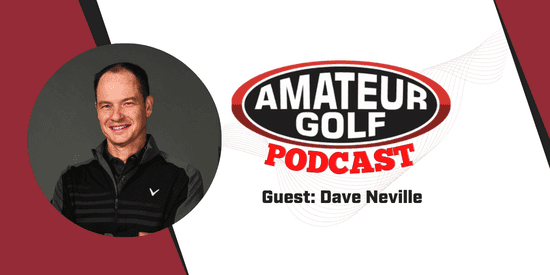
AmateurGolf.com Podcast Episode 24: 10-year Callaway veteran Dave Neville
3/2/2023 | by Sean Melia of AmateurGolf.com

Sr. Director of Brand & Product Management at Callaway talks TopGolf, A.I. for club design, and the influx of golf influencers
Dave Neville has been with Callaway for nearly a decade. TopGolf has exploded over the last few years, and Neville tells us how much that has impacted Callaway. He talks about the new sponsorship signings of influencers like Good Good and Bob Does Sports and what it means to help golf continue to grow.
As Callaway rolls out its Paradym line, he talks with us about what makes this line the best he has seen from Callaway. Neville and I discuss how Callaway is using A.I. to build their clubs, and what it takes to get the driver sounding and looking, and performing just right. Finally, we take a walk down memory lane and learn about a club that surpassed Neville’s expectations when it initially launched.
On adding influences to Callaway:
We had the pyramid of influence. You pay the tour players and they influence the PGA pros and the PGA pros influence their members and then the members buy things. I think what Callaway led the charge on is really changing that to a sphere of influence where everybody's talking to everybody. A good example of that would be our partnerships with God Good Golf, and Bob Does Sports. These influencers are just having a huge impact on the growth of the game. They have bigger followings than most PGA Tour players. And they're much more engaged on social media with the average golfer. You're not really going back-and-forth on social media with a Tiger Woods or something like that.
On how A.I. helped build the new Paradym line:
When people think of A.I., they think of software applications of AI; they think about improving your Google searches or driving the car for you, or recommended stuff on Amazon This is a hardware application; we're actually building the clubs. So what it allows us to do is create prototypes, in ways that we could never do before. So if you took a driver face, we would try to make the best possible driver face, we had three or four different versions, maybe five at the most, and then we pick the best one and go with it. Now we can do 20 or 30,000 variations using A.I. and machine learning. And every time we do a new prototype, the machine, the supercomputer, learns and gets better and produces a better and better face. So that's why our face is really kind of unique topology that really an engineer couldn't come up with on their own.
Listen on Spotify
Listen on Apple Podcasts
As Callaway rolls out its Paradym line, he talks with us about what makes this line the best he has seen from Callaway. Neville and I discuss how Callaway is using A.I. to build their clubs, and what it takes to get the driver sounding and looking, and performing just right. Finally, we take a walk down memory lane and learn about a club that surpassed Neville’s expectations when it initially launched.
We had the pyramid of influence. You pay the tour players and they influence the PGA pros and the PGA pros influence their members and then the members buy things. I think what Callaway led the charge on is really changing that to a sphere of influence where everybody's talking to everybody. A good example of that would be our partnerships with God Good Golf, and Bob Does Sports. These influencers are just having a huge impact on the growth of the game. They have bigger followings than most PGA Tour players. And they're much more engaged on social media with the average golfer. You're not really going back-and-forth on social media with a Tiger Woods or something like that.
On how A.I. helped build the new Paradym line:
When people think of A.I., they think of software applications of AI; they think about improving your Google searches or driving the car for you, or recommended stuff on Amazon This is a hardware application; we're actually building the clubs. So what it allows us to do is create prototypes, in ways that we could never do before. So if you took a driver face, we would try to make the best possible driver face, we had three or four different versions, maybe five at the most, and then we pick the best one and go with it. Now we can do 20 or 30,000 variations using A.I. and machine learning. And every time we do a new prototype, the machine, the supercomputer, learns and gets better and produces a better and better face. So that's why our face is really kind of unique topology that really an engineer couldn't come up with on their own.
Listen on Spotify
Listen on Apple Podcasts
Most Popular Articles

2025 PGA TOUR Q-School Guide: Sites, Scores, and Who Advanced
Dec 5, 2025Second Stage is complete and Final Stage awaits at Sawgrass — follow every Q-School leaderboard and the players still chasing
2025 LPGA TOUR Q-Series: Final Qualifying Stage FINAL SCORING
Dec 8, 2025Helen Briem earns medalist honors, 31 players headed to the LPGA next year
2025 PGA TOUR Q-School Final Stage: Ewart Leads Five New TOUR Card Winners
Dec 14, 2025A.J. Ewart topped Final Stage at TPC Sawgrass, leading five players who secured PGA TOUR membership for 2026.
Australian Open at Royal Melbourne: Preview, amateur bios, and how to watch
Nov 30, 2025Rory McIlroy headlines one of the championship's top fields in years - at least four amateurs will have their chance at gloryInside Gil Hanse’s Restoration of Baltusrol’s Upper Course: A Return to Tillinghast’s
Dec 11, 2025Renowned architect Gil Hanse reveals how he brought Baltusrol’s Upper Course back to life by honoring A.W. Tillinghast’s originalLoading latest news...
