Loading article...

Loading...
Loading...
Loading article...
see also: Equipment Reviews
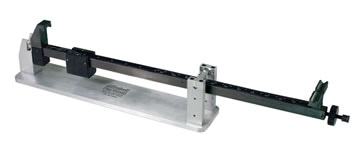
Can you define swingweight? We take a look at the concept, and provide a review of the best scale on the market
I recently acquired a golf accessory that you might want to consider for yourself, a Mitchell Golf TourGAUGE swing weight scale. In this post I will tell you why I consider it so worthwhile, and explain a bit about swingweight. This is not meant to be a technical discussion -- for that I suggest you pick up a copy of Ralph Maltby's Classic "Golf Club Design, Fitting, Alteration, and Repair."
I was first given a copy of this book in 1978, when I discovered the hobby of refinishing old persimmon woods. (My blog is called "Pete's Workshop" for good reason.) In Chapter 33, Maltby explains swing weight as "The measurement of a club's weight distribution about a point which is established at a specified distance from the grip end of the club."
There have been two distances used over the years -- the 14" balance point of the so-called Lorythmic scale being prevalent today. If you have even the smallest interest in custom fitting you have probably seen one of these scales, and are familiar with the readings which come in the form of alphanumeric combinations such as "D3" or "C9." The farther down the alphabet you go, the higher the swingweight.
Because a constant length balance point is used, shorter clubs in the set need heavier heads to swing weight the same. An 8-iron head weighs more than a 7-iron, for example. I like to think of swing weight as an easy-to-control part of the fitting process. Since most players aren't in the habit of changing out iron shafts very often, the clubs that are most important to monitor are the hybrids, fairways, and driver.
Changing grips, as an example, can effect swing weight, and changing shafts can do so even more. Even two shafts marked with the same gram weight, cut to the same length, can produce different swing weights (and therefore produce a different feel). I can't even begin to understand, let alone explain, all the intricacies of counterbalancing; suffice to say it's something pros did years ago by wrapping lead tape under the grip and it's still done today with more sophisticated end-plugs.
So what did I do the minute my Mitchell swing weight scale arrived? I pulled all the clubs from my bag and measured them one by one. it turns out one of my hybrids came out lighter on the scale than the others, the result of a mismatched shaft. A fairway wood I had recently reshafted checked in at D0, which is lighter than the D2 in my other long clubs. A couple of strips of lead tape helped me feel the club head a bit more the next time I played.
As for the scale itself, it's a thing of beauty. It is CNC-machined, and has substantial weight to not get easily shifted around on whatever surface you choose to place it. (I once had a "cheap" scale and it felt that way.)
Like any scale, it needs to be "zero-balanced" to adjust to give a proper reading, and the combination of putting the quality pieces together and balancing it takes just minutes. Place the grip in the holder, let the club dangle, balance the weight, and take a reading. A second function is measuring the overall weight; to do this simply place the club perpendicular to the scale using the cradle at the end to hold the shaft. The Mitchell scale reads in grams or ounces.
Now that we have truly arrived at the day of user-exchangeable shafts, and lightweight shafts start becoming more popular, it's important to have a basic understanding of swing weight. As always, I recommend visiting a clubfitter like Hot Stix Golf, a Titleist Fitting Works professional, or a True Temper Performance Center.
Oh, yes, one more thing. If you would like a scale of your own, or any other piece of quality club making equipment from the best in the business, visit Mitchell Golf Equipment Company at www.mitchellgolf.com. Mitchell also offers club repair and shaft performance schools.

2026 U.S. Open Local Qualifying Results: All 109 Sites + Leaderboards
May 14, 2026Live results from all 109 U.S. Open Local Qualifying sites. Site-by-site medalists, amateurs, and alternates
RESULTS: 2026 U.S. Open Final Qualifying
May 18, 2026A deep-dive into all 13 final qualifying venues from Walton Heath, England to Sacramento, California
Ellison & Scheck Win 2026 U.S. Women's Amateur Four-Ball in 19 Holes
May 6, 2026The No. 3 seed snaps a five-year teenage-champion streak. Carter & Snyder, both 15, fall in sudden death after
Why Pinehurst Is the Ultimate Place to Play a Two-Man Championship
May 19, 2026Competitive golfers take on Pinehurst during the AmateurGolf.com Two Man Links and Father & Son Championship presented by Titleist
How to Watch the 2026 NCAA Golf Championships
May 20, 2026Everything you need to tune into the men's and women's NCAA Division I golf championships at Omni La CostaLoading latest news...