Loading article...

Loading...
Loading...
Loading article...
see also: The Masters Tournament, Augusta National Golf Club
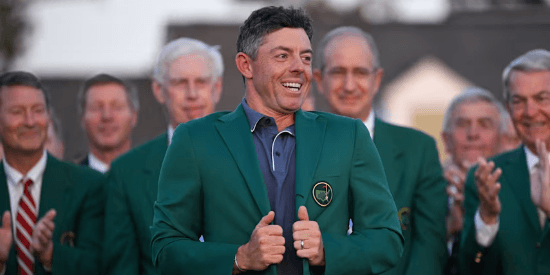
The blueprint behind his back-to-back win—and what competitive amateurs can learn from it
Rory McIlroy didn’t overpower Augusta National.
He didn’t lead every category. He didn’t put on a putting clinic. And he didn’t cruise to the finish.
Instead, he did something far more instructive for competitive amateurs: he built a winning week on structure, discipline, and selective aggression.
After nearly letting a six-shot lead slip away, McIlroy steadied himself on the back nine Sunday and closed out his second straight Masters victory. But the real story isn’t the drama—it’s how he played.
When you study the numbers, a clear pattern emerges: Rory didn’t need to dominate one statistic. He just stayed strong in the areas that matter most under championship pressure.
The blueprint: Rory used distance to create easier approach shots, hit enough greens to stay in control, putted just well enough to avoid mistakes, and relied on his short game only when absolutely necessary.
McIlroy’s driving distance gave him a major edge all week. He averaged 341 yards in Round 1, 327 in Round 2, 343 in Round 3, and 325 in Round 4. That consistently put him well ahead of the field.
But the more revealing number is this: Rory hit just 55 percent of his fairways, while the field average was around 72 percent.
For a lot of amateurs, that sounds like a problem. At Augusta, it wasn’t.
McIlroy understood that power only matters if it creates better scoring opportunities. By being 20 to 30 yards ahead of much of the field, he was able to hit shorter clubs into greens, control spin more effectively, and attack pins that other players had to respect. He wasn’t swinging hard for the sake of it. He was using speed to improve his second shot.
The lesson for competitive amateurs is simple: distance is only valuable if it leads to better position, better angles, and more realistic birdie chances. Bombing driver without a purpose is just noise. McIlroy’s power worked because it served the rest of his game.
If there was one stat that truly held Rory’s week together, it was greens in regulation.
He hit 48 of 72 greens, good for 67 percent, slightly better than the field average of roughly 63 percent. That number may not look overwhelming at first glance, but it is the foundation of nearly every winning tournament performance. It means fewer stress-filled pars, fewer scrambling situations, and more makeable birdie opportunities.
His round-by-round GIR performance tells the story even better:
Even during the one round where he dipped, Rory never completely lost control of his ball-striking. That matters. Great tournament players do not need to be perfect every day. They need to avoid collapse.
That is exactly what McIlroy did. When Sunday tightened and the tournament started moving around him, he stayed in it by continuing to hit enough greens to keep the pressure manageable.
If amateurs want one stat to care about more deeply, this is it. Birdies are exciting, but greens in regulation are what keep your rounds from unraveling.
One of the most useful takeaways from Rory’s week is that he did not need a magical putting performance to win.
He averaged 1.54 putts per green in regulation, compared to a field average of 1.65. That is better than average, but it does not suggest he was stealing strokes from everywhere on the greens. It suggests something more repeatable: he was steady.
His round-by-round putting numbers looked like this:
There was no outrageous spike. No round where he made everything. No stretch where he survived entirely with the flatstick. Instead, Rory did what the best players do in major championships: he made enough, missed very little, and avoided compounding mistakes.
That is a valuable reminder for good amateurs. You do not need a miracle putting week to win a tournament. You need control. You need to eliminate three-putts, convert your share of makeable chances, and stay calm when the round gets tense.
Rory recorded just six sand save chances all week, converting four of them for a 67 percent success rate.
That detail matters because it shows the difference between elite short game and survival golf. McIlroy did not need to rely on his short game often. His long game prevented that. But when he was forced into a recovery situation, he delivered.
That included a perfect 2-for-2 performance in Round 3, the day his week was least tidy.
Tournament total: 4 of 6 | 67%
Round 1: 0/0 Round 2: 1/2 Round 3: 2/2 Round 4: 1/2
The takeaway is not that amateurs should obsess over bunker stats. It is that the best players minimize the need for scrambling, then rise to the occasion when scrambling becomes unavoidable.
That is a much healthier model than building a game that constantly depends on heroic recoveries.
McIlroy’s scoring breakdown may be the clearest explanation for how he went back-to-back at Augusta:
No eagles. No statistical outlier. No absurd scoring burst that hid weaknesses elsewhere.
What won this tournament was a card built on clean management: enough birdies to separate, enough pars to stay stable, and very few mistakes that truly hurt him.
That is what high-level tournament golf usually looks like. It is not chaos. It is control.
For competitive amateurs, this is one of the most useful truths to remember. Winning golf often feels less spectacular than it looks from the outside. It is usually a matter of stacking smart holes, maintaining patience, and refusing to make doubles.
McIlroy’s week was statistically sound, but major championships always ask for one more thing: a shot that settles everything.
On Sunday, that moment came at the par-3 12th.
With the tournament slipping and pressure coming from every direction, Rory hit his tee shot to inside seven feet—the closest shot anyone hit there all day. He made birdie, regained control, and stopped the emotional drift of the round.
That swing matters because it connects the stats to the moment. All week, he had built a game stable enough to hold up under pressure. Then, when he absolutely needed one precise, committed iron shot, he delivered it.
That is the final stage of tournament golf. Structure gets you there. Trust closes it out.
If Rory McIlroy’s back-to-back Masters titles offer a blueprint, it is not one built on perfection. It is built on priorities.
That is the part of Rory’s Masters win that should resonate most. He did not rely on magic. He relied on a game built to survive pressure, recover from small mistakes, and create just enough chances to win.
For competitive amateurs, that makes this victory more than memorable. It makes it useful.
Because the real lesson from Augusta is not that you need Rory McIlroy’s speed or talent to play better golf.
It is that the smartest tournament golf still follows a simple formula: hit enough greens, stay patient, putt solidly, and never let one mistake turn into three.

One of Golf's four professional majors traditionally invites amateurs who have reached the finals of the US Amateur, or won the British Amateur or the US Mid Amateur. Also included are the winners of the relatively new Asia Pacific Amateur and Latin ...
2026 U.S. Open Local Qualifying Results: All 109 Sites + Leaderboards
May 14, 2026Live results from all 109 U.S. Open Local Qualifying sites. Site-by-site medalists, amateurs, and alternates
RESULTS: 2026 U.S. Open Final Qualifying
May 18, 2026A deep-dive into all 13 final qualifying venues from Walton Heath, England to Sacramento, California
How to Watch the 2026 NCAA Golf Championships
May 20, 2026Everything you need to tune into the men's and women's NCAA Division I golf championships at Omni La Costa
Why Pinehurst Is the Ultimate Place to Play a Two-Man Championship
May 19, 2026Competitive golfers take on Pinehurst during the AmateurGolf.com Two Man Links and Father & Son Championship presented by Titleist
Stanford Wins 4th NCAA Women's Golf Title, Tops USC
May 26, 2026The Cardinals closed a dominant week at La Costa with another match-play crown — their fourth national title