Loading article...

Loading...
Loading...
Loading article...
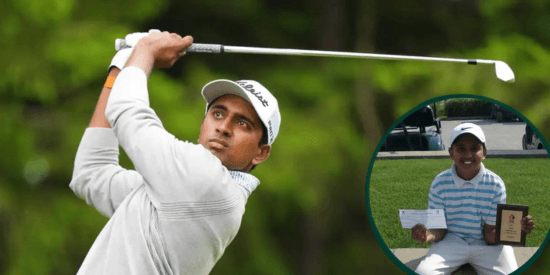
The self-taught Canadian’s rise offers a fresh lesson in how great amateur careers are built.
There’s a moment in every amateur golfer’s journey where the path feels unclear.
Coaches, academies, college golf, swing systems—there are more “right ways” than ever to chase the game at a high level. And then there’s Sudarshan Yellamaraju.
At the 2026 Players Championship, one of the most demanding tests in golf, the 24-year-old PGA Tour rookie didn’t just survive—he contended. A final-round 68 secured a tie for fifth at 9-under, instantly putting him on the radar as one of the game’s most intriguing new names.
But from an AmateurGolf.com perspective, the story isn’t what he did at TPC Sawgrass.
It’s how he got there.
Yellamaraju’s journey begins far from the typical American junior golf pipeline.
Born in India and raised in Winnipeg, he was introduced to the game at age six with rental clubs that didn’t fit—steel shafts, oversized length, and minimal guidance. His development wasn’t shaped by elite coaching or structured programs, but by curiosity.
He and his father learned the golf swing the modern way: YouTube.
Tiger Woods. Rory McIlroy. Adam Scott.
Watch. Try. Adjust. Repeat.
That process—trial and error, feel over formula—became the foundation of his game.
Even his competitive beginnings were modest. He shot 101 in his first tournament round at age nine. It remains the only time he’s failed to break 100.
From there, the climb was steady but unconventional.
Every elite amateur has a moment where potential becomes proof.
For Yellamaraju, it came early.
At just 16 years old, he won the Ontario Men’s Amateur—one of Canada’s premier championships—becoming the youngest player in the field and closing with a birdie on the 72nd hole.
From an AmateurGolf.com lens, that win matters.
It tells us two things:
But unlike many players who parlay that success into Division I opportunities, his path diverged.
This is where Yellamaraju’s story becomes especially relevant to today’s amateur landscape.
Despite his amateur success, scholarship opportunities weren’t strong enough financially. Instead of forcing the traditional route, he made a difficult decision: he turned professional at 19.
No college golf. No structured team environment. No built-in schedule or support system.
Just mini tours, qualifying schools, and a long climb.
For many amateurs, this would be a cautionary tale.
For Yellamaraju, it became an accelerator.
His progression mirrors what we often see—but rarely fully appreciate—from the outside:
There were no shortcuts.
No exemptions. No instant success.
Just incremental improvement against increasingly stronger fields.
From an amateur standpoint, this reinforces a key truth:
Development doesn’t stop when you turn pro—it often begins there.
In a modern game dominated by TrackMan numbers, biomechanics, and swing coaches, Yellamaraju stands out.
He doesn’t have a full-time coach.
His swing feedback loop comes from his caddie, his father, and video comparison to elite players.
And most importantly—his own feel.
That showed up at The Players, where he posted a top-five finish, ranked fourth in strokes gained: putting, 14th in approach, and tied for second in driving distance at more than 311 yards.
This is not a player lacking technical ability.
It’s a player who has learned to self-organize his game.
Yellamaraju’s journey isn’t a template—but it is a powerful counterpoint.
Elite junior golf, college golf, academies—these are proven routes. But they are not the only routes. Yellamaraju proves that adaptability and persistence can outweigh structure when paired with talent.
Because he was self-taught, he owns his swing. He understands cause and effect. He experiments. He adjusts. That level of ownership is something many coached players never fully develop.
One of his most telling comments after The Players was that once you do something, you know you can do that or better. That’s the difference between belief and proof. Amateur golfers often chase confidence through mechanics. Yellamaraju built it through performance.
No coach. No academy. Limited financial backing. Instead: YouTube, observation, and repetition. In today’s world, information is everywhere. The separator is how you use it.
His Ontario Amateur title at 16. His Korn Ferry win in 2025. At every level, he proved he could close. That trait translates.
Sudarshan Yellamaraju is not just a breakout PGA Tour rookie.
He’s a case study.
In a time when the pathway to elite golf feels increasingly defined—and expensive—his journey is a reminder that the game still leaves room for creativity, resilience, and individuality.
From rental clubs in Winnipeg to contending at The Players Championship, his rise is not just unlikely.
It’s instructive.
And for the amateur golfer wondering if their path is “right,” it might be exactly what it needs to be.
AmateurGolf.com takeaway: Yellamaraju’s story reinforces that while structure can guide development, self-awareness, adaptability, and competitive experience are still the ultimate differentiators in the modern game.
FINAL RESULTS: 2026 Junior Invitational at Sage Valley
Mar 14, 2026Miles Russell surged with a closing 67 to reclaim the boys title while Asterisk Talley dominated the girls division at Sage Valley
Mark Your Calendars: Key USGA Entry Dates for 2026
Mar 12, 2026For players mapping out a competitive schedule, knowing exactly when USGA entries open and close is critical
Meet the Amateurs in the 2026 Masters: Six Different Paths to Augusta National
Mar 22, 2026From teenage phenoms to seasoned dreamers, the amateur class at the 2026 Masters brings six compelling stories to Augusta
San Francisco City Championship: Champions Crowned
Mar 22, 2026Joey Hayden, Gianna Singh, Bob Niger, and Jeff Thomas capped championship week with title-winning performances at Harding Park.
Six Amateurs at the Puerto Rico Open: John Daly II, Miles Russell and Round 4 Scores
Mar 8, 2026Kihei Akina closed with a 2-under 70 to finish T16 at 10-under (68-70-70-70).Loading latest news...