Loading article...

Loading...
Loading...
Loading article...

Stableford can favor mid-handicaps—but with the right attack plan, a 0 handicap can win.
Stableford is golf’s “points league.” Instead of adding up strokes across 18 holes, you earn points on each hole based on your score. The format changes the psychology of competition: one disaster hole doesn’t torpedo your entire round, and a streak of birdies can catapult you up the leaderboard.
If you’re a 0 handicap playing a club Stableford tournament, you’ve probably heard some version of: “Stableford favors the higher handicaps.” That can be true—especially in net Stableford—but it’s not the whole story. Stableford rewards a specific style of scoring, and once you understand where the points come from, you can build a plan that gives you a real chance to win.
Traditional Stableford typically awards points like this (your club’s exact version may vary slightly):
| Score vs Par | Points | What it Encourages |
|---|---|---|
| Double bogey or worse | 0 | Pick up and move on |
| Bogey | 1 | Damage control |
| Par | 2 | Steady progress |
| Birdie | 3 | Separation holes |
| Eagle | 4 | Round-changing swings |
| Double eagle (albatross) | 5 | Lightning strike |
The headline feature is the floor: a triple or quad is still just 0 points. That’s why players tend to swing more freely and why scoring can be volatile.
Modified Stableford changes the game by making birdies more valuable and mistakes more costly. A common version looks like this:
| Hole Score | Points | What it Encourages |
|---|---|---|
| Double bogey | -3 | Avoid big numbers |
| Bogey | -1 | Clean up mistakes |
| Par | 0 | Baseline scoring |
| Birdie | +2 | Go hunting |
| Eagle | +5 | Take calculated risks |
| Double eagle | +8 | Massive upside plays |
In Modified Stableford, you can’t “coast.” Bogeys can actively hurt your total, and birdie-making becomes the premium skill.
Important: In net Stableford, higher handicaps don’t automatically win—but they often have more “point-scoring pathways.” A 14-handicap can turn a lot of ordinary holes into net pars and net birdies, which rack up points quickly.
This range frequently performs best because it balances two things:
Mid-handicaps can pile up points with a round that doesn’t look special in stroke play. In Stableford, those steady net pars add up, and a couple of net birdies can be the difference.
High handicaps can be dangerous in Stableford because they receive strokes on many holes. That means a gross bogey can still be a productive net par. But there’s a catch: high handicaps also tend to have more “wipeout” holes. In traditional Stableford, a wipeout is capped at zero, but too many zeros make it hard to win unless the player produces multiple spike holes.
As a 0 handicap, you typically get little to no scoring assistance. Your pars are worth the same as everyone else’s baseline point holes, and you don’t get the “automatic lift” of turning a bogey into a net par.
That’s why many scratch players feel like they’re chasing. In a net event, you often need to create separation with birdies—and you need to do it on the right holes.
Stableford is not “about avoiding bogeys.” It’s about avoiding zeros and building runs.
In net events, handicaps shape the distribution of point outcomes. Players getting strokes will naturally produce more net pars and net birdies—especially on holes ranked #1–#8 on the scorecard.
In stroke play, you might accept a safe par. In Stableford, especially net, you often need to push for 3-point holes. Your goal isn’t a clean card—it’s a card with enough birdies to offset the strokes other players receive.
Look at the handicap rankings on the card. Those are the holes where your opponents are most likely to receive a stroke. In net Stableford, those holes can function like “moving targets.”
Most Stableford winners—especially low handicaps—separate themselves on par-5s. If you’re a 0 handicap, your par-5 strategy should be built around creating eagle looks or stress-free birdie opportunities. Even one eagle in traditional Stableford can feel like a two-shot swing against the field.
Stableford is liberating because you don’t need to grind every hole into the ground. When you’re out of position or short-sided, the mindset is:
For a scratch golfer, the “bad hole” you can live with is often a bogey (1 point). The hole you can’t afford is the unnecessary double (0 points).
Modified systems typically punish bogeys and reward birdies/eagles more aggressively. That format often narrows the handicap advantage and can benefit strong ball-strikers because upside is rewarded and mistakes are penalized. In that case, your job is simple (not easy): give yourself more birdie chances than the field.
Because clubs use different point systems (and net vs gross changes everything), there’s no universal target. But a useful way to think about it:
As a 0 handicap in a net Stableford, you’re usually trying to produce more birdies than feels normal—and to do it without donating too many zeros.
In traditional net Stableford, mid-handicaps (roughly 10–18) often have the built-in advantage because they receive enough strokes to convert ordinary holes into point-scoring holes while still maintaining some consistency.
But a 0 handicap can absolutely win by playing the format as it’s intended: hunt high-value birdie chances, be disciplined when you’re out of position, and avoid turning “one-point bogeys” into “zero-point doubles.”
If you want to tailor this perfectly to your event, plug in your club’s exact scoring table (traditional or modified) and whether it’s net or gross—then set your strategy around the holes where the field is most likely to gain strokes.
Before the round, circle the top 6–8 handicap holes on the scorecard. Those are the holes where you’re most likely “playing against a net birdie.” Build your aggression plan around them, and keep the rest of the card clean.
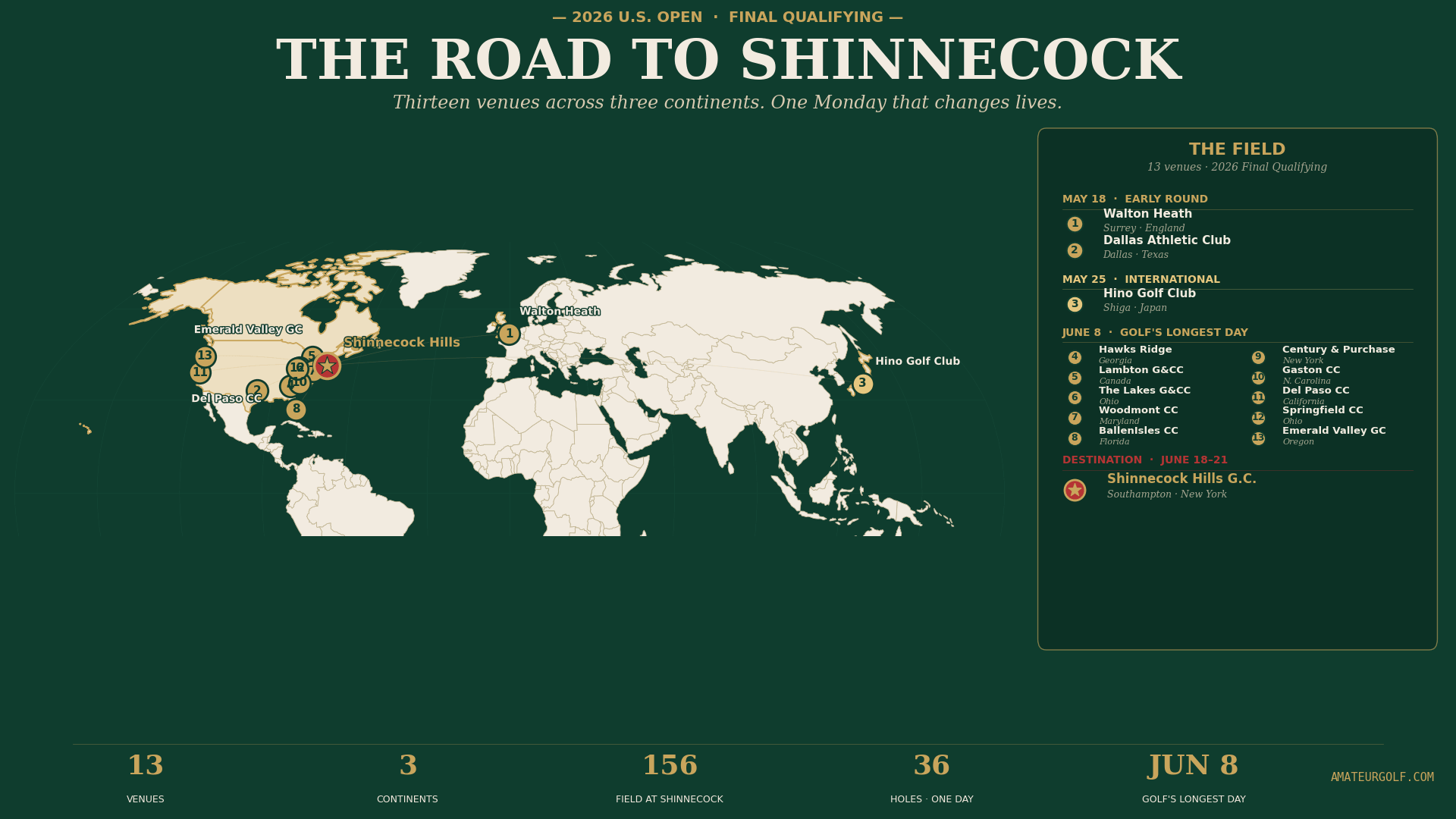
GOLF'S LONGEST DAY: 2026 U.S. Open Final Qualifying Monday June 8
Jun 5, 2026Follow along from 10 locations - our team is on the ground looking for the best stories
2026 U.S. Open Final Qualifying: A final rundown from Golf's Longest Day
Jun 8, 202612 amateurs qualified for Shinnecock at 10 sites around the country on June 8. Two of them were medalists.
2026 NCAA Men's Golf Championship: Live Coverage, Field & Daily Updates from La Costa
Jun 3, 2026Auburn defeats UCLA at La Costa to capture its second NCAA men’s golf championship in three years.
U.S. Open: Meet the Amateurs at Shinnecock Hills
Jun 14, 2026An amazing group of 19 amateurs in 2026 include 11 who qualified and another 8 who were exempted on various criteria
TEAM USA WINS THE 2026 CURTIS CUP
Jun 14, 2026Team USA reclaims the Curtis Cup at Bel Air Country Club!Loading latest news...