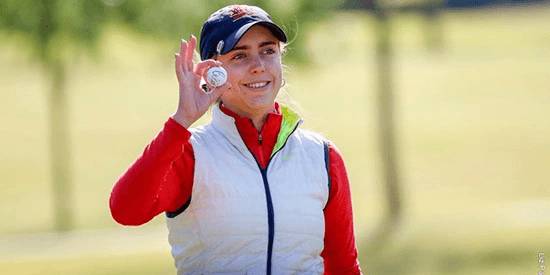
Late January is the quiet season for competitive golfers. The courses are emptier, the practice sessions are lonelier, and the work is mostly invisible—range balls in cold air, short-game reps on quiet greens, and focused rounds squeezed in between life and daylight. For those chasing qualifiers, invitationals, college lineups, or a mid-am schedule, this is the time when progress is built in solitude.
It’s also a moment that naturally brings certain stories back to the surface—stories that remind us what the game asks of competitors, and what we owe each other as a community.
AmateurGolf.com covered the shocking loss of Iowa State standout Celia Barquín Arozamena in 2018, when the golf world struggled to make sense of an unthinkable tragedy. We’re revisiting her story now not to reopen wounds, and not to sensationalize what happened, but to remember Celia as the competitor she was—and to connect her legacy to the reality so many serious golfers live today: the quiet, determined pursuit of excellence.
A Champion’s Rise
Celia Barquín Arozamena was the kind of player competitive golfers recognize immediately: disciplined, driven, and fully invested in getting better. A standout from Spain who came to the United States to compete at Iowa State, she grew into one of the most accomplished golfers in Cyclones history—earning respect not just for results, but for the way she carried herself as a teammate and competitor.
In 2018, she reached a new level. Barquín won the Big 12 Championship and later claimed the European Ladies Amateur Championship, confirming what those around her already knew: she was built for high-level golf, and her trajectory was pointing forward.
- Big 12 Champion (2018)
- European Ladies Amateur Champion (2018)
- Elite collegiate performer at Iowa State
She was also finishing a demanding civil engineering degree—an identity that mattered to her and spoke to the type of long-game focus that separates great amateurs from good ones. Her days were full: training, studying, traveling, competing, preparing for what came next.
The Competitive Golfer’s Life: Solitude, Routine, Belief
Every serious amateur understands the rhythm: the early tee times alone, the quiet practice rounds, the “one more bucket” mentality. The best players often spend the most time by themselves, sharpening edges that few people will ever see. Improvement is private. Commitment is personal.
That’s one reason Celia’s story lands so hard with competitive golfers. She wasn’t chasing attention. She was chasing progress—like so many of us do. A practice round can feel like the purest version of golf: no scoreboard noise, no gallery, no distractions. Just you, your swing, and the next shot.
For many, January embodies that. It’s the season of preparation. The season of building. The season of quiet belief.
September 17, 2018
On September 17, 2018, Celia Barquín Arozamena was killed in Ames, Iowa while out on a golf course. The loss devastated her family, her teammates, Iowa State, and the wider golf world.
Her death also changed something in the way many golfers—especially women—think about solitude in the game. Golf has long been viewed as a refuge, a safe place where the worst outcomes are measured in strokes. Celia’s story forced an uncomfortable truth into the open: even in broad daylight, even in familiar places, safety cannot be assumed.
It’s important to say clearly: Celia’s story is not a cautionary tale meant to create fear. It is a reminder that the community around the game matters. Awareness matters. Looking out for each other matters.
What Her Legacy Asks of Us
If you compete in amateur golf long enough, you learn the sport isn’t only about talent. It’s about habits. Preparation. Resilience. The ability to stay committed when nobody is watching.
That’s part of what makes remembering Celia meaningful in January. This is when many golfers are most often alone—training in quiet conditions, chasing improvement, setting goals for a season still months away.
Celia lived that rhythm. She embodied it. And while her life was taken far too soon, her impact remains deeply present in the amateur golf world—not just in the wins she earned, but in the example she set as a competitor and teammate.
For competitive golfers, the lesson isn’t fear. It’s awareness, community, and a renewed commitment to looking out for one another—on the range, on the course, and in the spaces where we train alone.
A January Reminder for the Competitive Golfer
As this season approaches—qualifying schedules filling up, invitations arriving, practice plans tightening—take a moment to remember why we grind in the quiet. We do it because we love the game, because we believe in getting better, and because competition gives shape to our days.
Remember Celia Barquín Arozamena the way competitive golfers should: as a champion, as a relentless worker, as a rising amateur with a future she was actively building. And let her story be a reason, in the middle of the quiet season, to strengthen the one thing golf can always offer when it’s at its best:
A community that shows up for its own.