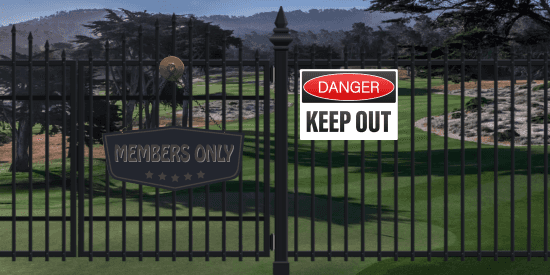
For a long time, the cost to join a private golf club lived in the same category as locker-room chatter and scorecard excuses: everyone talks about it, almost nobody shows you the actual numbers.
Then a simple question on Reddit blew the doors open:
“How much do you pay for a membership and where do you live?”
Within hours, golfers from Berlin to Scottsdale, Stockholm to South Carolina started posting what they actually pay—initiation, monthly dues, cart plans, food minimums, military deals, muni season passes, even the odd $500,000 initiation in Scottsdale or Hong Kong.
Layer that thread on top of industry data and a clear picture emerges:
- American “country club life” has become a genuine luxury product.
- Outside North America, club golf is often priced like a normal hobby.
- The gap isn’t just cultural—it’s baked into how clubs are structured and how they make money.
If you’re thinking about joining a club—or wondering if your dues are insane—this is the landscape you’re really choosing between.
The Big Picture: What Membership Really Costs
Step back from individual clubs, and a few broad truths stand out:
- Millions of golfers worldwide belong to private or semi-private clubs.
- In the U.S., the average membership might fall in the mid four figures per year, but that “average” hides a massive spread—from $1,000 muni passes to country clubs that cost more than a house.
- At many private U.S. country clubs, initiation fees in the tens of thousands are now routine, with annual dues easily reaching $5,000–$20,000 or more.
- Since COVID, demand has outstripped supply at popular clubs; long waitlists and steady price hikes have become normal rather than rare.
Now add the raw numbers from the Reddit thread:
- Germany: €1,800 a year for unlimited play on 27 holes near Berlin, with plenty of similar clubs in the €1,300–€2,300 range.
- UK & Ireland: full memberships between about £700 and £1,500 at very good clubs, with some Scottish links down in the £300–£800 range.
- Nordics & Europe: Sweden, Denmark, Finland, the Netherlands, Austria and Portugal regularly show memberships around €600–€1,500 for unlimited play on one or more 18- or 27-hole courses.
- U.S. & Canada: everything from “$1,200 for unlimited golf at a nice muni” to “$600,000 initiation and $2,700+/month in Scottsdale.”
Same sport, very different financial realities.
Two Worlds of Membership
Looking across both the data and the first-hand stories, club golf splits into two main models.
1. The American Country Club Model
In the U.S., especially in high-growth markets like Scottsdale, Southern California, Florida, New York and New Jersey, the club is rarely just a golf course. It’s a lifestyle package:
- Full-service clubhouse and multiple dining outlets
- Resort-style pools and kids’ programs
- Tennis and pickleball centers
- Fitness facilities and sometimes spa services
- A packed social calendar with member events
The bill reflects that. From the Reddit thread alone, you see:
- Northern New Jersey: initiations in the $55,000–$75,000 range with $1,200–$2,000/month dues, plus food minimums and capital fees.
- Dallas / Nashville / SoCal: multiple clubs with $75,000–$300,000 to join and annual spending easily topping $25,000 once everything is included.
- Scottsdale: examples of $500,000+ initiation fees and multi-thousand-dollar monthly dues at top-tier desert clubs.
And yet, in the same country, you’ll also find:
- Midwestern / smaller metros: $4,000–$10,000 initiations, $400–$800/month dues at solid private clubs.
- County and muni passes: $1,000–$3,000/year for unlimited or heavily discounted play at multiple public courses.
The American model is really a spectrum—from “full resort with a golf course” to “golf-first with a modest grill room”—all priced according to the amenities and the zip code.
2. The International Golf Club Model
Outside North America, the tone shifts. In much of Europe and parts of the rest of the world, the club exists primarily to provide golf, not to function as a private resort.
From the Reddit responses:
- UK & Ireland: many strong member clubs—some used for national events—sit in the £700–£1,500/year range. A handful of ultra-elite clubs charge far more, but they are the exception, not the norm.
- Germany & the Netherlands: annual fees of €800–€1,800 are common for 18- or 27-hole clubs, usually with no or modest joining fees.
- Scandinavia: Sweden, Denmark, Finland and Norway show repeatedly in the €600–€1,500 band for unlimited play, often across multiple courses—tempered by a 6–7 month season.
- Portugal, Spain, South Africa, New Zealand, Australia: well-regarded clubs frequently land between roughly $1,000 and $3,000 (local currency equivalent) for annual play, with initiation fees far lower than those typical in U.S. gateway cities.
Many of these clubs see themselves as part of the town’s fabric: community hubs rather than luxury status symbols. The clubhouse is there to support the golf, not the other way around.
What the Reddit Stories Reveal
Industry reports give you averages. The Reddit thread gives you texture.
A few snapshots:
- Rural Iowa: $800 for a family membership at a 9-hole course, pool included.
- Berlin area: €1,800/year for unlimited play on 27 holes, no initiation fee.
- North Jutland, Denmark: a couple paying just over €2,000 total to play 4–5 times a week across 10 different courses.
- Texas muni pass: about $1,100/year for three city-owned 18-hole courses, effectively $15–$20/round for a heavy player.
- Phoenix, Arizona: the “most affordable” private or resort option around $3,000/year for a golf-only membership at a resort, while fully private clubs in the same metro ask for five- or six-figure buy-ins.
The patterns are hard to miss:
- Price cliffs in the U.S.: in major metros there’s often nothing between “expensive public golf” and “very expensive private golf.”
- Community vs. luxury: Scottish, Swedish, Danish and German clubs regularly describe themselves as community institutions; U.S. clubs at the high end describe themselves more like boutique resorts.
- Waitlists and FOMO: multi-year waitlists are now normal at many desirable U.S. clubs.
- Younger players get creative: under-35 or “young professional” tiers—at lower initiation and dues—are often the only sane way into elite clubs for golfers early in their careers.
Equity vs. Non-Equity: Who Really Owns Your Club?
One of the biggest structural differences—rarely spelled out in marketing—comes down to ownership:
Equity (Member-Owned) Clubs
- Your initiation acts like a share in the club.
- Members elect a board and vote on major projects and policies.
- You may get some or most of your initiation back when you resign and a new member takes your place.
- You’re exposed to special assessments for renovations, course work or financial shortfalls.
In good times, equity can work like an investment. One Redditor detailed how a $14,000 equity membership, combined with a major renovation, appreciated to a market value near $100,000, making his effective cost per round over a decade surprisingly low.
In bad times, you’re writing checks for assessments you didn’t necessarily vote for.
Non-Equity (Corporate-Owned) Clubs
- Your initiation is a sunk cost; you don’t own any part of the club.
- The owner is responsible for major capital projects and long-term finances.
- Your leverage is your ability to leave if you don’t like the direction or the value.
From a cash-flow perspective, non-equity often looks simpler and more predictable. Equity gives you more say—and more risk.
How to Judge Whether a Membership Is Worth It
If you’re staring at a dues sheet and wondering whether to sign, here’s a practical framework drawn from both the data and the first-hand accounts.
1. Calculate Your Real Cost Per Round
Don’t just look at dues. Use a simple formula:
(Initiation amortized per year + annual dues + mandatory fees) ÷ realistic rounds you’ll play
- If you’re realistically playing 80–100 rounds a year, a $6,000–$10,000 all-in cost can be comparable to paying $80–$120 in green fees every time you tee it up.
- If you’ll only get out once a week or less, it’s easy for that number to creep past $150 per round.
Plenty of golfers in the Reddit thread realized—after doing this math—that a muni pass or semi-private membership gave them 90% of what they wanted at 30–50% of the cost.
2. Decide What You’re Actually Buying
Be honest with yourself: are you paying for…
- Fast, uncrowded golf?
- A pool and kids’ programs?
- Business networking and social capital?
- A convenient home course 5 minutes from your driveway?
A modestly priced Scottish or Danish membership might give you world-class golf and walk-on access but zero buzz in your U.S. business circle. A six-figure initiation in Dallas might flip that equation completely. Neither is “wrong,” but the better fit depends on your life off the course.
3. Watch the “Hidden” Line Items
Beyond initiation and dues, ask explicitly about:
- Capital assessments: how many in the last 10 years, and for what? Course renovation? Clubhouse expansion?
- Food & beverage minimums: how much per year? Does alcohol count? Do events count?
- Cart and range: is walking encouraged or penalized? Can you buy a range pass? Store your own cart?
- Guest fees: especially important if you expect to host family, clients or out-of-town friends.
Several U.S. golfers in the thread quoted headline numbers like “$600/month,” only to admit that carts, capital fees and bar minimums pushed their real spend closer to $1,200–$1,500 per month.
4. Exploit Young-Member and Off-Peak Options
If you’re under 35–40, your best value almost everywhere is:
- Young professional / junior executive tiers: reduced initiation and dues that ramp up over time.
- Weekday-only or twilight memberships: perfect if you have flexible hours or prefer quieter times.
- Multi-course muni or county passes: $1,000–$2,000/year for several courses can be an incredible deal for volume players.
From Sweden to Canada to suburban New Jersey, the thread is full of younger golfers who’ve made high-quality membership work specifically by using these categories.
5. Remember: Geography Is a Pricing Engine
Golf economics are heavily local. The same quality of course might cost:
- $600–$2,500/year in a small U.S. or Canadian town,
- €800–€1,800/year in much of Europe,
- or $20,000+ in initiation alone in certain U.S. or Asian gateway cities.
If golf is a core part of your lifestyle, where you choose to live can be as important as which club you join.
So… Is Club Life Worth It?
Here’s the bottom line after sifting through both the numbers and the personal stories:
- If you’re chasing elite competition, consistent access and a golf-centric calendar, membership still makes a lot of sense—but only if you’re clear on the true all-in cost and how often you’ll actually play.
- If you’re a volume golfer who just wants a lot of good golf, a high-quality muni or semi-private pass, a reasonably priced private club outside a major metro, or a European-style membership will often deliver the best return on investment.
The Reddit thread confirmed what many international golfers already suspected:
You don’t have to spend six figures to live a great golf life.
In much of the world, golf clubs are still about golf first and status second. In the U.S., especially at the high end, it’s often the other way around.
Neither model is inherently better—but if you understand the differences, the data, and your own priorities, you can pick the version of club life that fits your game, your budget, and your ideal Saturday afternoon.