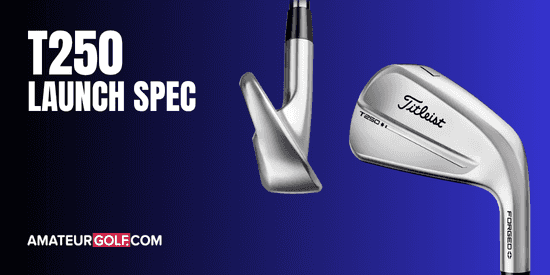
Titleist’s new T250 Launch Spec irons occupy an unusual but important space in modern iron fitting. They aren’t about chasing distance; they’re about achieving the right height, spin, and descent angle for players who struggle to stop approach shots. For many competitive amateurs and moderate-speed golfers, these clubs can be the missing piece in a well-constructed blended set.
Why the Launch Spec Exists
The T250 Launch Spec (or “LS”) came from a common challenge fitters see every day: players who hit their irons too flat. They generate enough speed to play a players-distance head like T250, but their launch and descent angles are too low to hold firm greens. Historically, these golfers had two imperfect choices: switch to a compact, high-lofted iron like the T100 (often too demanding) or move to a stronger, high-speed model like the T350 (which lowers launch even more).
“It’s for the player who needs more height,” explained Titleist’s Marni Ines, Director of Iron Development. “They didn’t really have a choice before. The Launch Spec combines the right technology with the right loft to give them proper performance.”
Engineering a Higher Launch
The T250 Launch Spec starts with the same chassis as the standard T250 — a hollow-body, forged-face design built for speed and feel — but makes two major engineering changes:
- Lighter headweight: roughly six grams lighter than standard, helping players generate slightly more clubhead speed.
- More loft: each iron is roughly 2–3° weaker, increasing launch and steepening descent angles without requiring swing changes.
Together, these adjustments create a higher peak height and softer landing profile — particularly useful for mid- and short-irons where stopping power is critical. As Ines noted, “This is one of the first products for us where adding more loft actually worked with the technology, not against it.”
Performance Characteristics
Inside the head, the forged L-Face and V-Taper design maintain speed and launch even on low-face strikes. Titleist’s Max Impact Technology improves energy transfer for consistent yardage gaps, while more aggressive mid- and short-iron grooves help regulate spin from fairway or rough.
Dual split tungsten weights stabilize the head at impact, giving the Launch Spec a surprisingly forgiving flight for its size. The overall look remains compact and clean—closer to a players iron than a game-improvement model—but with extra help built quietly into the design.
Who It Helps Most
The Launch Spec is not a high-handicap club. It’s designed for skilled golfers who strike the center often but need help achieving proper trajectory and spin. These players usually fall into one of two groups:
- Competitive amateurs with lower ball flight who want better stopping power into firm greens.
- Moderate-speed players who prefer a compact look but need a higher launch window without switching to super-strong lofted distance irons.
It’s not meant for high-speed players chasing raw distance — those golfers will spin it too much and lose yardage. Instead, it fits perfectly for those seeking to balance trajectory and control across their iron set.
Building a Blended Set
The most effective way to use the T250 Launch Spec is as part of a blended set. Many fitters now pair the Launch Spec in the short and mid-irons with standard T150 or T250 long irons. This configuration allows players to maintain their preferred distance and speed in the longer clubs, while gaining higher flight and better spin control where it matters most.
Long Irons (4–6)
Use T150 or T250 to retain speed and distance through the top of the bag.
Scoring Irons (7–P)
Transition to T250 Launch Spec for higher launch, softer landings, and predictable spin.
This kind of thoughtful blending is increasingly common on professional and elite amateur tours, where players often mix models to fine-tune launch and spin gaps. The Launch Spec makes that approach accessible to skilled amateurs who want to control their trajectory through the set.
Key Specifications
Available in 5–P and W, the T250 Launch Spec ranges from 27° (5-iron) to 47° (pitching wedge), with lie angles between 60.5° and 64°. Each club maintains the same premium construction as the T-Series line, only tuned for higher launch and easier carry. The result is a players-distance head that looks classic but performs like a precision tool for controlling height and spin.
Final Thoughts
The Titleist T250 Launch Spec isn’t a distance iron—it’s a trajectory solution. For the right golfer, it can transform approach play by optimizing launch and descent without changing swing mechanics. In blended setups, it bridges the gap between traditional player’s irons and modern distance models, making it one of the most educational examples of where iron fitting is headed in 2025.