Loading article...

Loading...
Loading...
Loading article...
see also: Equipment Reviews
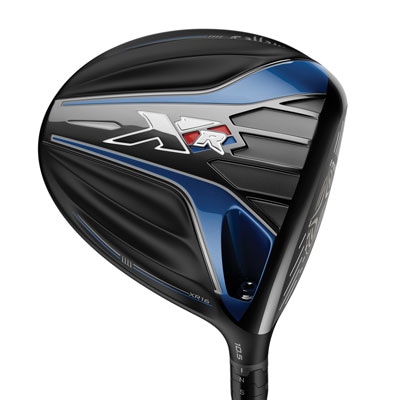
Working with the aerodynamics experts at Boeing, Callaway is redefining what's possible with its faster, more forgiving XR16 and XR16 Pro drivers.
Leveraging a long-standing relationship they have with Boeing, Callaway put some high-tech aerospace engineering concepts to work on their new XR16 and XR16 Pro drivers, redesigning the crowns to improve airflow and reduce drag. But they didn’t stop there. The new drivers also feature a completely re- engineered next-generation R*MOTO face that is lighter and thinner, helping to push the center of gravity to a lower and deeper position in the head.
“One of the things we realized first of all is that we wanted to improve our understanding of the airflow over the driver during the downswing,” said Dr. Alan Hocknell, Senior Vice President of R&D at Callaway. “We decided it was time for us to step up our game and partner with people who do this all the time. The best aerodynamic experts in the world work for the Boeing company and we were fortunate enough to expand on a relationship we had with them for some time.”
|
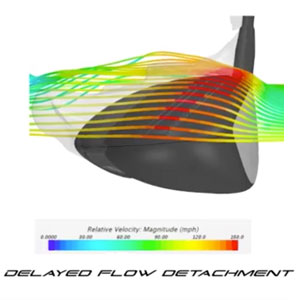
The woods team at Callaway worked closely with the engineers at Boeing to study how head shape influences airflow efficiency of the club when it’s swung into impact. One of the many challenges all equipment companies face in driver design is maintaining a reasonable level of forgiveness. In order to do that, you want to maintain a relatively large face-to-back dimension, said Hocknell. Of course, that sort of design consideration tends to run counter to the primary goal of reducing drag and improving clubhead speed.
In order to conquer the problem, Callaway and Boeing concentrated on the area of the crown immediately behind the face of the driver extending about a half inch or so rearward. Their studies on airflow simulation revealed that the design of that tiny area had immense impact on drag.
 |
“We wanted to create a situation where we make the flow stay close to the crown surface for a longer time as it moves from the face towards the back,” said Hocknell.
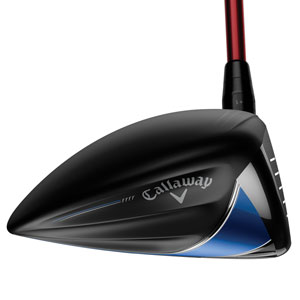
The team took advantage of a feature from last year’s XR driver, the Speed Step Crown, refining its properties to improve airflow. The new Speed Step (a pair of uniformly-placed bars on the crown’s surface) are ever so slightly raised and sit even closer to the leading edge than ever before. Hocknell noted that such a little change produced a substantial result.
“It makes the air transition to turbulent flow closest to the crown,” he said. “That turbulent flow effectively sticks to the crown better than other types of airflow and in doing so it delays the flow detachment and we get less drag.”
 |
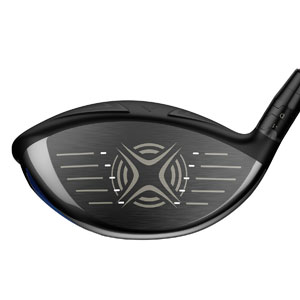
Continuing with their mission to build a faster and lighter driver, the XR16 models were outfitted with a thinner and lighter R*MOTO face. The weight that was saved in the new construction was repositioned towards the back of the head to increase the forgiveness of both driver models. As for the head itself, the chassis of the XR16 line is constructed from new Titanium 8-1-1 material; it’s a strong and lightweight alternative that gave engineers an additional two grams to play with.
“It might seem like two grams isn’t a whole lot but when you’re dealing with driver design our woods team is constantly fighting for fractions of a gram that can add up to whole grams that they can put into useful places in the head,” said Hocknell. “So a two-gram savings gained by changing body material is significant in our design world.”
Features at a glance:
The XR16 driver ($349.99 MSRP) will be available in three loft configurations (9, 10.5 and 13.5 degrees). The driver comes stock with a Fujikura Speeder Evolution 565 shaft. By comparison, the XR Pro model ($399.99 MSRP) features a slightly lower spinning 450cc head. The XR Pro comes in nine and 10.5 degree lofts and ships with a tour-proven Fujikura Evolution II TS 665 shaft. Both models feature Callaway’s OptiFit adjustable hosel allowing you to adjust the loft and lie to fit your swing. The new drivers will be available in stores on January 29th.

2026 U.S. Open Local Qualifying Results: All 109 Sites + Leaderboards
May 14, 2026Live results from all 109 U.S. Open Local Qualifying sites. Site-by-site medalists, amateurs, and alternates
2026 U.S. Amateur Qualifying: Dates, Sites, Registration Info, and How to Enter
Apr 30, 2026Registration for the 2026 U.S. Amateur is opening soon. Explore every local and final qualifying site
2026 U.S. Open Final Qualifying: Inside Every Course on Golf's Longest Day
May 11, 2026A deep-dive preview of all 13 final qualifying venues — from Walton Heath to Del Paso
Ellison & Scheck Win 2026 U.S. Women's Amateur Four-Ball in 19 Holes
May 6, 2026The No. 3 seed snaps a five-year teenage-champion streak. Carter & Snyder, both 15, fall in sudden death after
How the NCAA Golf Championships Work
Apr 28, 2026From conference tournaments to match play under the Carlsbad sun — a complete guide to the road that ends at Omni La CostaLoading latest news...