Loading article...

Loading...
Loading...
Loading article...
see also: Equipment Reviews
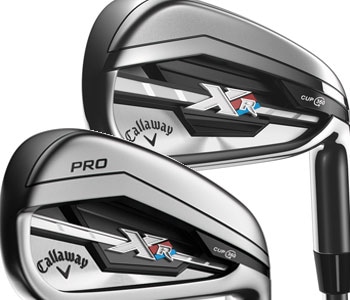
A distance iron? A player's iron? Callaway's XR line of irons are not your run-of-the-mill game improvement clubs. Blending technology that gives you more distance with cutting-edge design, the XR irons will appeal to a broad spectrum of golfers.
Callaway’s line of XR irons are clearly intended to help golfers hit the ball farther with better contact, but they aren’t designed to look like the traditional, oversized game improvement clubs we used to see a few years back. Considering the small iron chassis and the relatively narrow sole widths they had to work with, the amount of technologies Callaway packed into these clubs to make them long and forgiving is no small accomplishment.
Borrowing from tech that first appeared in the company’s fairway woods and drivers, the XR irons use Callaway’s Cup 360 and Internal Standing Wave to allow the face to flex at impact and increase ball speed for added distance.
Both the XR and XR Pro irons are made from a two-piece cavity-back construction that’s been dual heat treated ensure a precise look and feel. The 360 face cup is a single piece of thin metal that wraps around the perimeter and acts like a spring on shots hit low on the face and pretty much anywhere else contact is made. Both sets of irons also benefit from Callaway’s Internal Standing Wave - a thin, metal weight pad that lowers the center of gravity while increasing the club’s MOI.
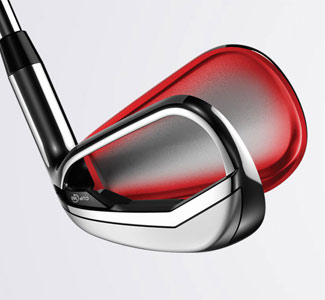 |
Callaway's Face Cup technology
surrounds the perimeter of the XR iron. |
It’s worth noting that Callaway debuted both the face cups and Internal Standing Wave in their Big Bertha irons earlier this year. The biggest difference between those clubs and the XR irons is without a doubt the size. The Big Berthas are designed to help high handicappers almost exclusively. They feature thick top lines, massive soles and generous offsets. Contrast that with the more compact and visually appealing XR irons. Mid- handicappers will definitely consider playing them, but so will some single digit players who require a little more forgiveness than what their existing set of long irons are able to offer them.
Performance:
When swinging the XR irons, you get the immediate sense of easy distance with these clubs. They’re very lively at impact, practically “whippy”, and the slightly larger head shapes (compared to Callaway’s Apex irons for instance) instill plenty of confidence.
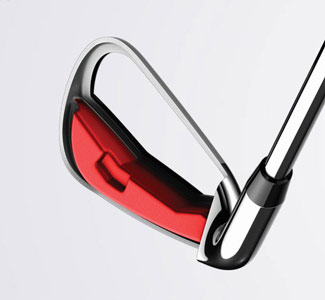 |
The
Internal Standing Wave pad lowers the CG while raising the club's MOI |
As far as the design of these distance irons go, the long irons in both sets have larger head shapes that naturally taper down as you move into the scoring clubs which de- emphasize distance (at least slightly) in favor of accuracy.
While the technology plays a big role in explaining the distance gains, golfers need to be aware that the lofts on the XR and XR Pro irons are generally stronger than sets geared exclusively for single-digit players. This is the case throughout the bag but the most significant changes in loft occur in the long irons. For instance, my current five iron has 27 degrees of loft as compared to 23 degrees on the same club in the XR, and 24 degrees in the XR Pro.
The fact that Callaway skews the lofts shouldn’t matter, especially in regards to the numbers you post on your scorecard. I think any uproar over stronger lofts pipes down the moment a golfer strides up confidently to their ball on a long approach and reaches for a six iron as opposed to something up to two clubs longer.
Be that as it may, the design of these irons combined with stronger lofts does affect the flight characteristics of your shots namely the launch angle, spin rate, carry distance and height. I used a seven iron from both sets of clubs to get some comparative data on a Foresight launch monitor. Not surprisingly, the XR Pro launched slightly higher, sustained a greater peak height, spun more and carried a couple of yards less than the regular XR model.
Aside from the fact that the numbers reveal that the playing characteristics differ slightly between models, I didn’t get the sense that one iron set was better than the other. Both sets of clubs are really easy to swing and have just enough workability to suit all but the most accomplished players.
| XR 7 iron | XR Pro 7 iron | |
| Club Head Speed | 72 mph | 71 mph |
| Ball Speed | 105.3 mph | 104.1 mph |
| Launch Angle | 18.0 degrees | 18.6 degrees |
| Total Spin | 5178 RPM | 5430 RPM |
| Carry Distance | 150.22 yards | 147.11 yards |
| Total Distance | 165.94 yards | 162.18 yards |
| Peak Height | 25.95 yards | 26.14 yards |
Look and Feel:
Sometimes you pick up a game improvement iron and your first impulse is to put it back where you found it. They’re big, they’re bulky and often times they look very uninspiring.
As I hinted earlier, Callaway did a bang up job making the XR irons look like a top shelf set better players will find appealing. The cavity backs on these babies is pretty modest; so is the badge design. Both sets feature relatively narrow sole widths. Compared to the XR, the Pro models have a slighter thinner top line and less offset when looking down at them at address.
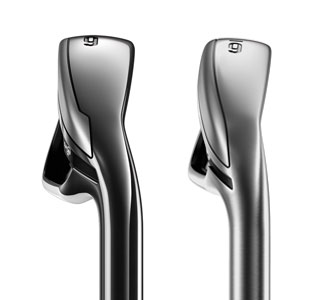
|
The XR
Pro iron (right) has less offset and narrower sole width |
When making contact with the ball, both sets of irons sound pretty good - less hallow than I expected from a cavity back. In terms of feel, they can’t compare to Callaway’s Apex line, especially the muscle back iron I had a chance to fool around with. A club like that feels too good to describe when you make pin- point contact on the center of the face. But when you don’t, look out.
The XR irons on the other hand, will maintain that solidly-struck-shot feel no matter where on the face contact is made. Sure, you lose some of that enhanced feel and workability that comes from swinging a muscle back, but that’s the price you pay for the high level of forgiveness that these irons offer. Given all that you gain in terms of performance, the cost doesn’t seem all that high to me.
Takeaway:
When it comes to game improvement irons, I really think Callaway has nailed it with the XR and XR Pro irons. For a set of distance clubs aimed directly at mid-to-high handicappers, the XR line doesn’t skimp on quality, good looks and playability.
Some players will do better with the standard XR model. Other golfers, those who are little more accomplished, will seek out the more compact XR Pros. Either way, Callaway has developed a set of irons that satisfy the needs of most golfers in an attractive package that no one can claim is designed for Joe Average.

2026 U.S. Open Local Qualifying Results: All 109 Sites + Leaderboards
May 14, 2026Live results from all 109 U.S. Open Local Qualifying sites. Site-by-site medalists, amateurs, and alternates
2026 U.S. Amateur Qualifying: Dates, Sites, Registration Info, and How to Enter
Apr 30, 2026Registration for the 2026 U.S. Amateur is opening soon. Explore every local and final qualifying site
Ellison & Scheck Win 2026 U.S. Women's Amateur Four-Ball in 19 Holes
May 6, 2026The No. 3 seed snaps a five-year teenage-champion streak. Carter & Snyder, both 15, fall in sudden death after
2026 U.S. Open Final Qualifying: Inside Every Course on Golf's Longest Day
May 11, 2026A deep-dive preview of all 13 final qualifying venues — from Walton Heath to Del Paso
How the NCAA Golf Championships Work
Apr 28, 2026From conference tournaments to match play under the Carlsbad sun — a complete guide to the road that ends at Omni La CostaLoading latest news...