Loading article...

Loading...
Loading...
Loading article...
see also: Equipment Reviews
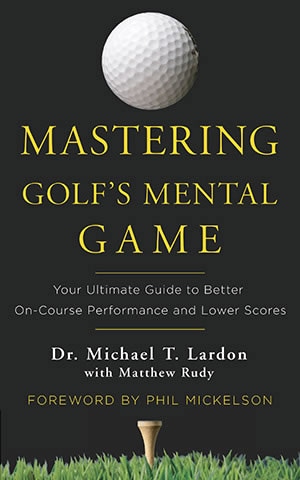
Dr. Lardon's mental techniques helped Phil Mickelson score a breakthrough win at the 2013 British Open -- his unique Mental Scorecard is particularly fitting for amateur golfers
As the story goes, the first time he hit a 50 yard shot (that backed up ten feet) with one of Roger Cleveland's new wedges to a small green at the Ely Callaway Performance Center in Carlsbad, Lefty said "THAT's my mack daddy wedge!" The name stuck. And after hearing about Dr. Michael Lardon's system for tracking a golfer's mental performance during a round of golf, Mickelson immediately started referring to it as a "mental scorecard." Lardon had a light bulb moment and went with it.
The mental scorecard and pre-shot pyramid form the core of Dr. Lardon's new book, "Mastering Golf's Mental Game." Lardon is a Stanford-educated psychiatrist who has worked with Olympic athletes and caddied for his brother Brad on the PGA Tour. His previous book, "Finding Your Zone, Ten Core Lessons for Achieving Peak Performance in Sports and Life," was a best-seller.
Catchy names aside, the concept of keeping track of how well you played the mental side of the game is uniquely suited to the competitive nature of golfers. But exactly what are we keeping track of?
Lardon's focus is on everything you do in those key moments before you hit a golf shot. Master the process, and you should be able to eliminate most of the mind-traffic that can lead to shots that are, let's just say, suboptimal.
Rather than focus on the physical movements in a pre-shot routine -- Keegan Bradley may look funny but he does the same thing every time -- Lardon describes in detail a "pre-shot pyramid." that consists of calculating, creating, and executing each shot. He explains how each part of the pyramid involves a different part (or both parts) of your brain; the logical side, the creative side, and a combination of both at the moment just prior to execution. Ideally, the mind stays clear at the moment of truth, but Lardon is OK with you taking one calming swing thought with you, as more of a security blanket than anything.
 |
Dr. Michael
Lardon |
For many amateurs, a lot of the big errors come into play early in the process when we often miss the simple clues we should be paying attention to. Maybe we forget to check the wind, or think about the consequences of being short or long of a green when pulling a club. I'm convinced that thinking about that part of the mental pyramid, (and keeping track of it using the score card) during my practice rounds will help me to get into the routine of "calculating" (as Lardon calls that part of the pyramid) each and every shot.
Calculating a shot is just the first part of the pyramid. Getting into the next two, creating and executing, is really what the book is about. Lardon provides plenty of real-life stories from his clients on the PGA Tour (and other sports) to drive home his approach. Some of his best stories involve interactions with non-clients, such as a player who was paired with his brother who was having trouble making a shot choice and moving confidently into his routine. After receiving some (free) advice, that player went on to become a winner.
What I found different from other books about the mental side of the game is how Lardon brings into the discussion some pretty advanced science, such as cognitive behavioral therapy, without turning it into "Psychology 401." The mental scorecard and pre-shot pyramid parts of the book are preceded by chapters that discuss things like attitude, motivation, and concentration. If you're like me, you'll find pieces in these chapters you'll want to refer back to often (and Lardon provides some homework to remind you to do so). For example, Lardon explains that our "fear response" may have helped humans survive as a species, but it can ruin our chances of hitting a tight fairway:
"There's no real survival-of-the-species reason for you to be fearful of a tight tee shot with water and out-of-bounds areas on either side, but your brain registers the fear the same way it would process physical danger. Your biology tricks you into thinking the risks are similar when they obviously aren't."
We've all tried to convince (or trick) ourselves into thinking that "this shot is no big deal" -- Lardon's book provides a number of constructive ways to avoid the need for that kind of last-minute self-talk. And there are even some breathing exercises for when anxiety really gets out of hand. (There's an app for that, really.)
"Mastering's Golf's Mental Game" provides a solid foundation to build upon as you're trying to maximize the results of your hard work and practice. (What, you don't practice? There's even a chapter that addresses motivation and burnout.) Like the wonderful book "Golf is a Game of Perfect" by Dr. Bob Rotella, it's a volume that stirs a number of aha moments and almost begs you to keep it handy as a reference. Dr. Lardon has a companion website www.drlardon.com with a blog (his latest post is an excellent analysis of the USA Ryder Cup team's dilemma) as well as a number of related resources including a downloadable visualization exercise that Lardon developed for a Division I college golf team.
You can, of course, also purchase Mastering Golf's Mental Game on the drlardon.com website, and I strongly recommend you do. It might be the best $25 (under $20 on Amazon) you'll spend on your game.
MORE ON DR. LARDON AND PHIL MICKELSON
Lardon is also a nationally-ranked table tennis
player who, as a Christmas gift from Phil's brother
Tim, taught Mickelson a few table tennis tricks he
could use in the Ryder Cup team room. Which is how
their story started, but not how it ended. After
learning more about Lardon's techniques, Mickelson
was able to absorb a tough loss at the 2013 U.S.
Open at Merion and bounce back with a win at the
British Open. In the forward to "Mastering
Golf's Mental Game" Mickelson wrote, "I
went to Muirfield with more confidence than I had
going into previous British Opens. I played the
Scottish Open the week before and won in a playoff,
which confirmed many of the things we had talked
about. Then I played some of my best golf to win the
Claret Jug. It's one of the most satisfying victories of
my career."
Masters: Memorable performances by amateurs in the last 40 years
Apr 2, 2026A Mid-Amateur legend and a 14 year old have won low-amateur honors at Augusta National over the years
Meet the Amateurs in the 2026 Masters: Six Different Paths to Augusta National
Mar 22, 2026From teenage phenoms to seasoned dreamers, the amateur class at the 2026 Masters brings six compelling stories to Augusta
San Francisco City Championship: Champions Crowned
Mar 22, 2026Joey Hayden, Gianna Singh, Bob Niger, and Jeff Thomas capped championship week with title-winning performances at Harding Park.
Gary Woodland Wins Houston Open in Emotional Comeback After Brain Surgery
Mar 30, 2026Gary Woodland’s Houston Open win is a reminder of why perseverance matters in golf
2026 Augusta National Women's Amateur: Full Field Preview, Favorites & How to Watch
Mar 30, 202648 of the top 50 players in the world. Two past champions. One teenager who lost by a single stroke last year.Loading latest news...