
TaylorMade M1 and M2 Driver Comparison and Review
3/1/2016 | by AmateurGolf.com Equipment Panel
see also: Equipment Reviews
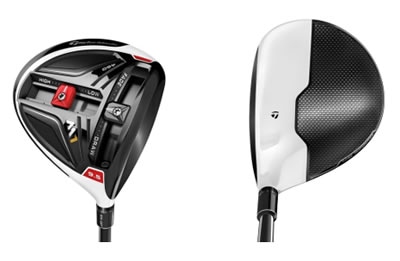
AGC Equipment Panelist Donnie Baucom puts the M1 and M2 to the test on the launch monitor. He was conflicted at the beginning but he's not anymore.
We’ve all had it, that uncomfortable feeling of a conflicted mind that can’t choose between two seemingly contradictory beliefs. Psychologists call it cognitive dissonance and it’s what TaylorMade fans might be experiencing ever since the company released its new M1 and M2 drivers. Luckily, AmateurGolf.com equipment panelist Donnie Baucom is here to bring harmony to your conflicted mind.
The launch of the new M1 driver earlier this year brought huge hype with its new look. It uses what looks like a piece of carbon fiber taken straight from a racecar and molded into the back of the driver, added another adjustment slot and claimed to be the number one driver again. Then TaylorMade decides to release an M2 driver that looks identical to the M1 without the adjustments and with a price difference of $100 ($499.99 vs. $399.99). I’ve done the research and the testing so let’s take a look at the differences in construction and performance.
TAYLORMADE M1 DRIVER
TaylorMade’s R15 was a very successful
driver. It wasn't record breaking as far as distance
went but it was good enough to put in your bag. The
R15 had 11 PGA Tour wins in 2015, not too shabby.
Most of those wins came from Jason Day who
averaged 313.7 yards off the tee and finished 3rd in
driving distance. Dustin Johnson, using the
AeroBurner TP, topped the charts with 317.7 yards.
The distance came with a cost, however, as Jason
Day and Dustin Johnson both finished 162nd in
driving accuracy, hitting just 55 percent of fairways.
Let's hope with the new M1 and M2 we can find
some more fairways as well as hit it a long way.
As far as construction goes, what's this bad boy
made of? The answer is in the name of the driver. M
stands for Multi-Material and TaylorMade claims this
is the key to their drivers’ performance. The
construction is highlighted by a proprietary 7-layer
Carbon Composite Crown that is precision-formed
and built ultra-thin, ultra-light and high strength to
maximize weight savings. This allows for a better
constructed weight-loaded sole and more overall club
head weight lower for a more efficient power
transfer. So in layman's terms, more boom.
New for the M1 is the T-Track system that consists
of both a front and back track with 25 grams of
adjustable weight:
- Front Track: 15 gram weight to provide multiple draw, neutral and fade settings
- Back Track: 10 gram weight adjusts for multiple high, medium and low launch and spin settings
TaylorMade claims this to be a more "personalized" system to cater to multiple swings. I decided to give it a test to see if I could maximize my performance. After every adjustment possible, I found that where you put the weights had no significant effect on any drive hit. I even did a blind test to see if we could change the ball flight with draw and fade setting and nothing changed. I’m not convinced that a change in ball flight due to weight adjustments is anything more than a placebo effect. See launch monitor numbers below.
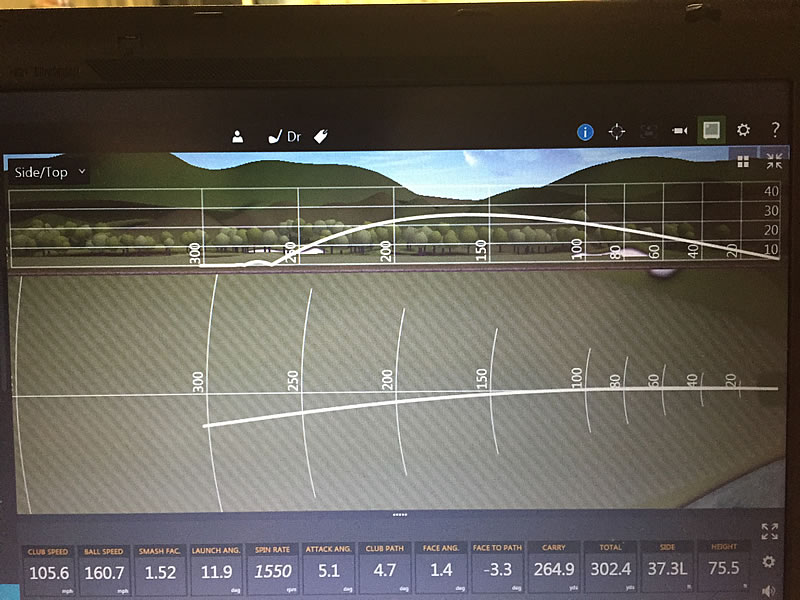
After hitting a few drives with the M1 I noticed some vast fluctuations in trackman numbers. I would either have very little spin or too much. I couldn't find that sweet spot of 2000-2300 spin that maximizes distances and accuracy. Too low of spin and you get the knuckleball effect that floats. Yes, a knuckleball is ideal for max distances but it's the hardest ball flight to control. When hit perfectly straight it goes forever, but when miss-hit, it squirts and won't ever come back. It requires perfect robot like swings in order to capitalize on this. If you have too much spin, then the ball balloons and won't roll when it hits the ground. As you can see in the pictures the carry distance of a 1600 rpm ball only carried 265 but rolled out to 302 and the 2700 rpm ball carried but still only went 305.
The M1 was probably the least forgiving driver I have hit in a long time. It was actually quite frustrating how hard it was to maximize distance. In order to create more accuracy I had to sacrifice ball speed. When doing this the M1 just became an average driver that was harder to hit. Keep in mind that your results might vary, and based on the number of M1's in play on Tour and with better amateur golfers, it's likely that my results are specific to my swing type and preferences.
TAYLORMADE M2 DRIVER
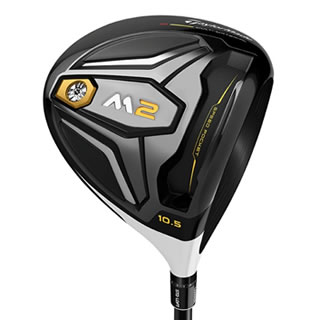
Side by side the M1 and M2 look identical from the
top. The M2 is basically an M1 without the
adjustment slots on the bottom and is $100 cheaper
than the M1 at $399.99. Does it hold its weight
against its big brother of the M1 or is it just a high
handicapper driver with big boy looks?
On paper what's actually different? The M2 still has the same Multi-Material construction that the M1 has. TaylorMade claims to have added a massive sweet spot which includes a higher MOI (moment of inertia), inverted cone technology and a better designed speed pocket. Another key feature is the internal acoustic engineering which controls vibrations and pitch to produce a solid, hot and crisp sound. Just when I thought I was actually hitting solid shots I learned I was being tricked with some acoustic engineering.
Actually, I really was hitting it solid and the numbers below prove it. I was blown away with how the M2 outperformed the M1. It was very forgiving, hot and produced great distance with optimal spin rates.
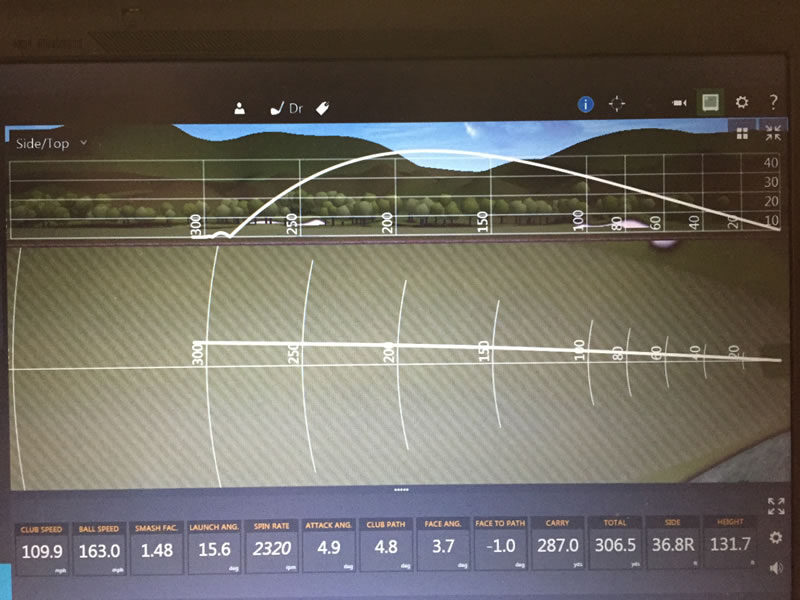
The M2 produced very consistent smash factor numbers and proved straighter, more forgiving and longer than the M1. I felt that I didn't have to swing perfectly every shot to maximize its performance. Instead, the club allowed me to swing freely and the ball flew the way it's supposed to. I was consistently around 2000-2300 rpm almost every swing and even the miss-hits outperformed M1's solid shots. It makes me wonder if TaylorMade made a mistake somewhere introducing this club at a lower price point. Between the two clubs the M2 definitely fits me better.
Which is exactly the point.
TaylorMade has two drivers in the "family" as they're calling it, and if you go out and grab the one that most Tour players have in the bag (The M1) you might be missing out on a club that's $100 less expensive and fits your swing better. That's the way it worked out for me. I can manage to sacrifice some adjustable weights and spend $100 less to get better performance. With the money I saved, I’ll buy a new stylish outfit or some new shoes. You need to look good when you are dead center and deep in the fairway.
Most Popular Articles
2025 PGA TOUR Q-School Guide: Sites, Scores, and Who Advanced
Dec 5, 2025Second Stage is complete and Final Stage awaits at Sawgrass — follow every Q-School leaderboard and the players still chasing
2025 LPGA TOUR Q-Series: Final Qualifying Stage FINAL SCORING
Dec 8, 2025Helen Briem earns medalist honors, 31 players headed to the LPGA next year
Australian Open at Royal Melbourne: Preview, amateur bios, and how to watch
Nov 30, 2025Rory McIlroy headlines one of the championship's top fields in years - at least four amateurs will have their chance at glory
Luke Ringkamp Cruises to Rolex Tournament of Champions Title at TPC San Antonio
Nov 26, 2025One week after committing to Pepperdine, Luke Ringkamp won the Rolex Tournament of Champions by nine shots.
Inside Gil Hanse’s Restoration of Baltusrol’s Upper Course: A Return to Tillinghast’s
Dec 11, 2025Renowned architect Gil Hanse reveals how he brought Baltusrol’s Upper Course back to life by honoring A.W. Tillinghast’s originalLoading latest news...